
Premier blames former Calgary mayor, who now leads Opposition, for city’s water woes
Advertisement
Read this article for free:
or
Already have an account? Log in here »
We need your support!
Local journalism needs your support!
As we navigate through unprecedented times, our journalists are working harder than ever to bring you the latest local updates to keep you safe and informed.
Now, more than ever, we need your support.
Starting at $15.99 plus taxes every four weeks you can access your Brandon Sun online and full access to all content as it appears on our website.
Subscribe Nowor call circulation directly at (204) 727-0527.
Your pledge helps to ensure we provide the news that matters most to your community!
To continue reading, please subscribe:
Add Brandon Sun access to your Free Press subscription for only an additional
$1 for the first 4 weeks*
*Your next subscription payment will increase by $1.00 and you will be charged $20.00 plus GST for four weeks. After four weeks, your payment will increase to $24.00 plus GST every four weeks.
Read unlimited articles for free today:
or
Already have an account? Log in here »
CALGARY – Alberta Premier Danielle Smith is laying Calgary’s latest water problems squarely at the feet of her chief political rival, saying the issues stem from neglect from when NDP Leader Naheed Nenshi was the city’s mayor.
Smith said the city failed for years to check on the state of the troubled Bearspaw South Feeder Main, which ruptured this week for the second time in less than two years.
“Frustration doesn’t begin to describe what we’re seeing with what happened in Calgary,” Smith told an unrelated news conference Friday, noting the city had a higher rate of leakage from its water system for years.
“All of this should have been identified early so that now subsequent mayors are not having to deal with it.”
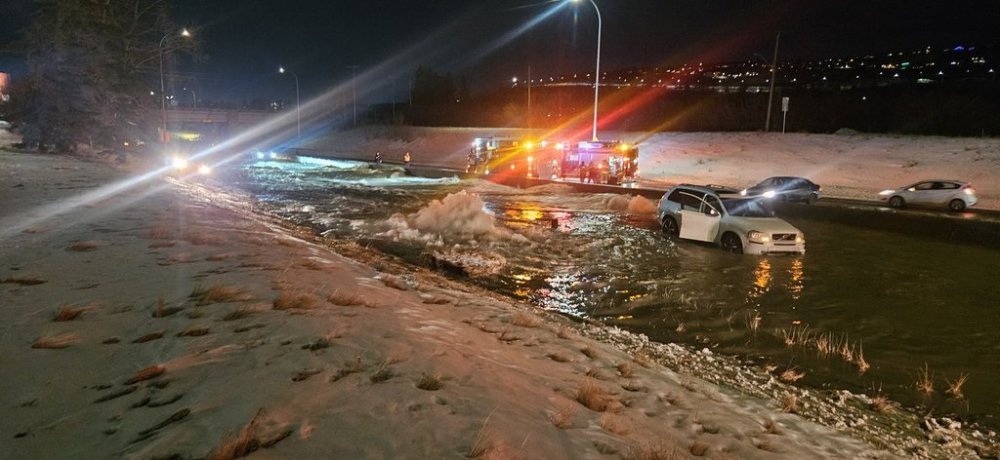
The main ruptured Tuesday night for a second time in a year and a half, flooding roads near the site of Canada Olympic Park. It supplies 60 per cent of the treated water for the city of 1.6 million people.
Calgary’s manager for drinking water has said people need to use less than 485 million litres of water every day for the next several weeks. Residents are asked to take shorter showers, reduce toilet flushes and run fewer loads of laundry and dirty dishes.
Boil-water advisories are also in effect for some neighbourhoods.
Nenshi, who was mayor from 2010 to 2021 and is now the Leader of the Opposition, responded that “of course the inspections were always done” and that there were no major water main breaks in the city in the 20 years prior to the 2024 failure.
He called Smith’s accusation “total garbage.”
“This is very emblematic of this government. Rather than actually trying to help solve the problem or act as adults in an emergency, they lash out. They look for someone to blame and they look for political gain,” Nenshi said during a video news conference.
After city officials said Thursday that too much water was being used, the city said Friday that water usage had dropped to approximately 473 million litres per day as of noon.
“We thank Calgarians for doing their part to conserve water. But we know with Monday coming and people heading back into the office and to school there may be increased demand,” Calgary Emergency Management Agency Chief Susan Henry said in the release.
City officials have said that acoustical equipment was being used after the 2024 failure to listen for snapping of wires that reinforce the main’s concrete. But they’ve said no snaps were heard in the two months prior to Tuesday’s failure.
Mayor Jeromy Farkas said he’s ordered that a technical report into that failure, which wasn’t scheduled to be released until later this year, be made available to councillors now. He said it should be ready in days.
Smith said she would look into whether more oversight is needed for municipal water systems.
“When we put dollars now into municipal infrastructure, we have oversight,” she said, noting the province already oversees other utilities like electricity or gas.
Nenshi noted that the type of pre-stressed concrete used in the main was common in the early 1970s, and while it was supposed to last 100 years, he said it’s commonly failing at 50 or 60 years.
“If the premier has some sort of way of predicting these wires snapping, I think she should share it with everyone because no one in the world has figured out how to do this kind of inspection,” he said.
— By Rob Drinkwater in Edmonton
This report by The Canadian Press was first published Jan. 2, 2026.