
Engineering students brace the cold to race concrete sleds in London, Ont.
Advertisement
Read this article for free:
or
Already have an account? Log in here »
We need your support!
Local journalism needs your support!
As we navigate through unprecedented times, our journalists are working harder than ever to bring you the latest local updates to keep you safe and informed.
Now, more than ever, we need your support.
Starting at $15.99 plus taxes every four weeks you can access your Brandon Sun online and full access to all content as it appears on our website.
Subscribe Nowor call circulation directly at (204) 727-0527.
Your pledge helps to ensure we provide the news that matters most to your community!
To continue reading, please subscribe:
Add Brandon Sun access to your Free Press subscription for only an additional
$1 for the first 4 weeks*
- Enjoy unlimited reading on brandonsun.com
- Read the Brandon Sun E-Edition, our digital replica newspaper
*Your next Free Press subscription payment will increase by $1.00 and you will be charged $20.95 plus GST for four weeks. After four weeks, your payment will increase to $24.95 plus GST every four weeks.
Read unlimited articles for free today:
or
Already have an account? Log in here »
Hundreds of engineering students braced the bone-chilling cold over the weekend to race concrete sleds down a hill in London, Ont.
As part of the annual Great Northern Concrete Toboggan Race, teams from about 20 universities across the country design and construct their own toboggans to send down a hill.
This year, the students gathered Saturday for the race at Boler Mountain. The last time a race was held at the mountain, located roughly two hours southwest of Toronto, was over a decade ago.
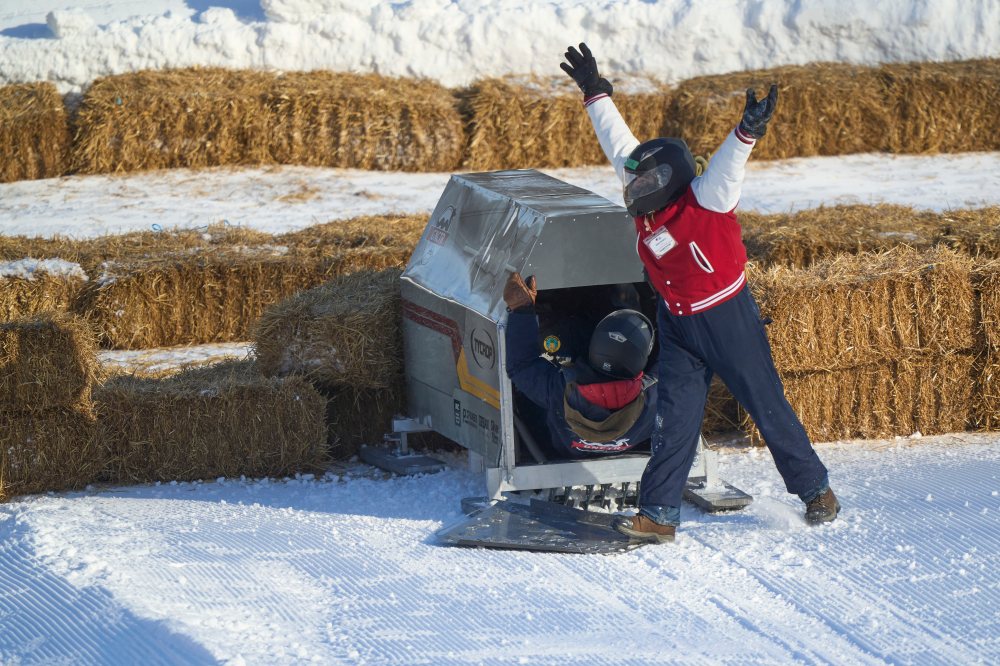
Owen Kirk, captain of the UBC Okanagan team, said it was a thrill to be part of the race. His 22-person team won the King of the Hill race-day tournament, while a team from the University of Alberta won the overall competition.
“I love the competition, I love this spirit,” Kirk said. “It’s a lot of anticipation building up to it because, you know, you’ve spent the last 10 or 11 months designing and building this thing that you’re really hoping will make it down the hill.”
Kirk, who has taken part in the competition in previous years, said it’s always satisfying to see the toboggan take off after its first push, picking up momentum and finally making it down the hill.
Each toboggan has concrete sliding surfaces, a safety roll cage and a mechanical steering and braking system and must weigh less than about 160 kilograms.
The game is divided into three parts — a drag race to judge for speed, a slalom race to judge the steering of the toboggan and a final race of winners from those brackets to determine the King of the Hill.
Abigail Young, captain of Western University’s team, which made it to the quarterfinals of the King of the Hill race, said her favourite part about it all was the camaraderie among the different teams.
Young said at one point, teams were even sharing their tools to help each other. One of her team’s welders stepped in to help another team so their toboggan could make it down the hill.
“When they won, it felt like you won, so overall everyone seemed like a winner, which was really fun,” Young said.
The prize for each of the awards will be announced by the corporate sponsor later, the GNCT rule book says.
“Winning King of the Hill for the first time at UBCO was such a joy and a great way to cap off my engineering degree,” Kirk said with a smile on his face.
This report by The Canadian Press was first published Feb. 9, 2026.