
Carney says Canada, Australia hold ‘rare convening power’ in Parliament speech
Advertisement
Read this article for free:
or
Already have an account? Log in here »
We need your support!
Local journalism needs your support!
As we navigate through unprecedented times, our journalists are working harder than ever to bring you the latest local updates to keep you safe and informed.
Now, more than ever, we need your support.
Starting at $15.99 plus taxes every four weeks you can access your Brandon Sun online and full access to all content as it appears on our website.
Subscribe Nowor call circulation directly at (204) 727-0527.
Your pledge helps to ensure we provide the news that matters most to your community!
To continue reading, please subscribe:
Add Brandon Sun access to your Free Press subscription for only an additional
$1 for the first 4 weeks*
*Your next subscription payment will increase by $1.00 and you will be charged $20.00 plus GST for four weeks. After four weeks, your payment will increase to $24.00 plus GST every four weeks.
Read unlimited articles for free today:
or
Already have an account? Log in here »
CANBERRA – Canada and Australia have a “rare” ability to help convene a coalition of middle powers because their allies know they can be trusted, Prime Minister Mark Carney said in a speech to Australia’s Parliament on Thursday.
Carney’s words built on the headline-grabbing speech he delivered in January at the World Economic Forum, in which he said the old world order had been ruptured and calling on middle powers to unite to prevent hegemons from dictating how the world is going to work.
“In a post-rupture world, the nations that are trusted and can work together will be quicker to the punch, more effective in their responses and more proactive in shaping outcomes, and ultimately those countries will be more secure and prosperous,” he said in Australia Thursday.
“Middle powers like Australia and Canada hold this rare convening power. Because others know we mean what we say and we will match our values with our actions. Canada and Australia have earned this trust throughout our history. The question now is what we do with it.”
Carney made no mention of the escalating conflict in the Middle East in his address to Australian Parliament.
During his speech, Carney said Canada and Australia had signed a series of new agreements on critical minerals, including Australia joining the G7 critical minerals alliance.
The prime minister also spoke about the countries’ plan to modernize their bilateral tax and investment treaty.
“The world will always be driven by great powers,” said Carney. “But it can also be shaped by middle powers that trust each other enough and act with speed and purpose.”
During a joint press conference after the speech, Australian Prime Minister Anthony Albanese said both Canada and Australia are looking to diversify their trading relationships.
“With the international system under increasing pressure, we want to work together, and with our partners, to uphold and defend peace, security and prosperity,” he said.
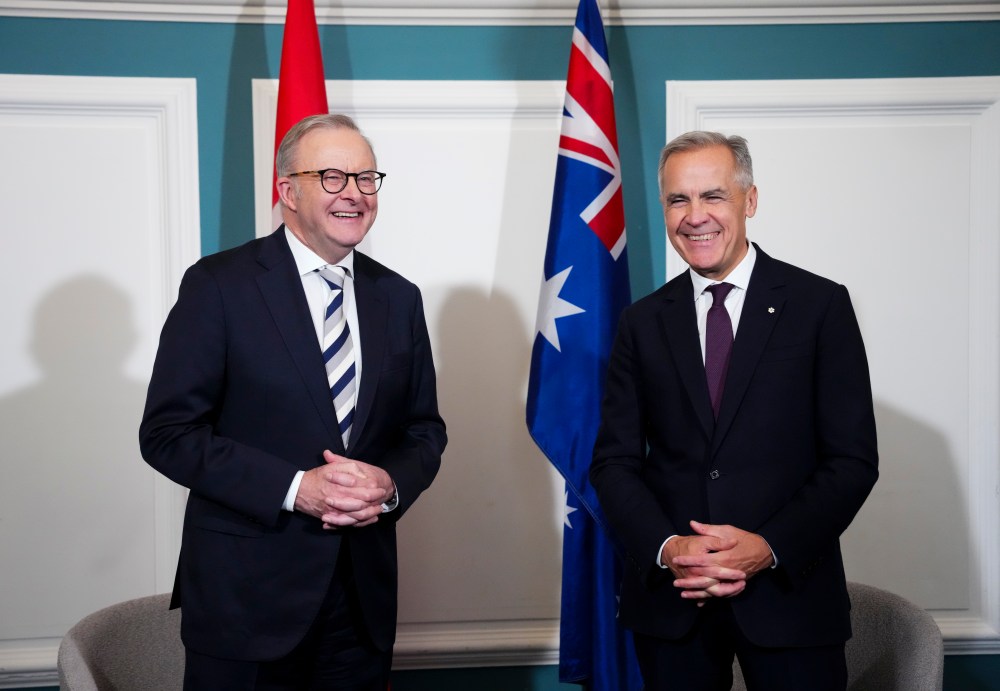
Earlier in the day, Carney met with Albanese and participated in a welcome ceremony at Parliament House.
During a meeting with cabinet members, Albanese said the two nations share common values and interests. As middle powers, he said there have been discussions about how to co-operate on defence, the economy and the environment.
“We’re both impacted by climate change, and one of the practical ways that we assist each other is your firefighters helping us and then our firefighters helping you,” said Albanese.
“We have much to learn from each other, much to gain from co-operation with each other,” he said.
Carney took time before his speech to recognize Australian firefighters in the Australian chamber, who had helped fight wildfires in Alberta last summer.
In his remarks at the meeting with Albanese, Carney said some of the discussions the leaders have had and some of the agreements the governments planned to sign reflected progress they started at the G7 summit last year.
“We’re looking forward to learning from you, co-operating in those areas, co-operating in other strategic areas such as critical minerals, and financial services,” Carney said.
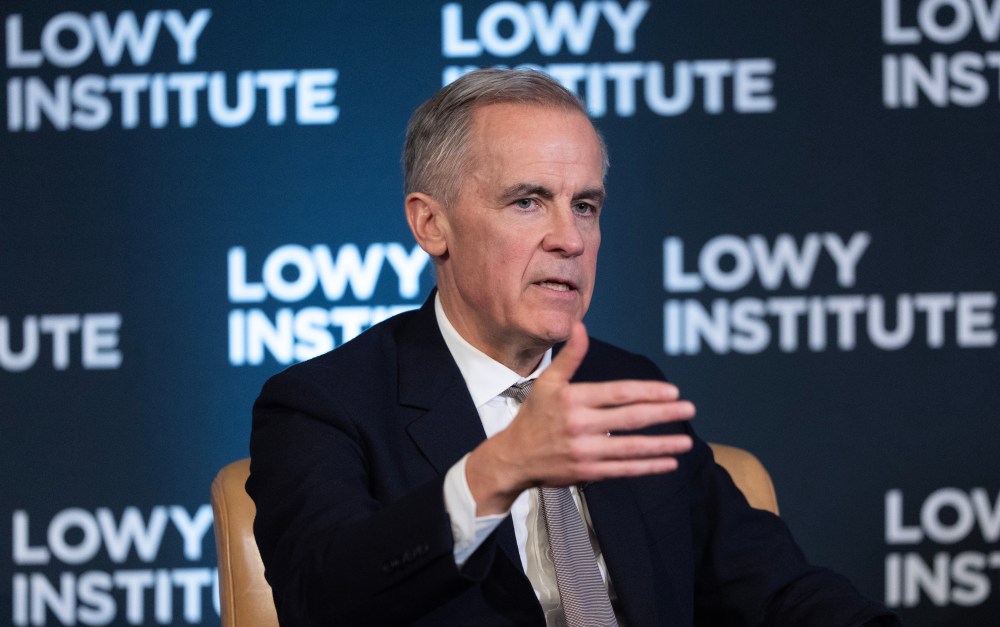
Carney’s Australian trip began Wednesday in Sydney, where he delivered a speech and took some questions at the Lowy Institute think tank, including one about what his “game plan” is for managing his relationship with U.S. President Donald Trump.
Carney laughed before discussing what he called the importance of “respect but not obsequiousness.”
“He’s president for a reason. He’s had success in other areas,” Carney said, calling Trump a “very successful politician” who has been elected twice.
Carney later added that, in private, Trump is more direct than he is in public and is more interested in hearing different viewpoints. The prime minister said that “creates an ability to work through things.”
“But it’s not easy, to be clear,” he added.
“What I find is that he appreciates, particularly in private, being direct and discussing issues and being clear where your position is. That is crucial.”
Carney said Canada and Australia are both rich in critical minerals and are working together to build “the largest mineral reserve held by trusted democratic nations.”
Canada and Australia could partner on more defence projects, such as those involving AI and aerospace, he said.
“Right now, when we spend capital on defence, 70 cents of those dollars goes to the United States,” he said.
Ottawa and Canberra signed an agreement last year for Canada to buy an Australian over-the-horizon radar system for use in the Arctic.
The two countries are also working to build links between the Comprehensive and Progressive Agreement for Trans-Pacific Partnership, or CPTPP, and the European Union, which Carney said would create a new trading bloc of 1.5 billion people.
The CPTPP is a massive Pacific Rim trade bloc that includes Australia. Canada is a member of the CPTPP and has a trade agreement with the EU.
Ahead of Wednesday’s speech, Carney held meetings with business leaders, including Simon Trott of the global mining company Rio Tinto and Jack Cowin, CEO of the fast food company Competitive Foods.
He also met with the heads of investment funds, including Raphael Arndt, CEO of the Future Fund, Shemara Wikramanayake, CEO of Macquarie Group, and Kate Galvin, CEO of Victorian Funds Management Corporation.
Carney visited India before arriving in Australia and will head to Japan for the third and final stop of his 10-day trip.
This report by The Canadian Press was first published March 4, 2026.