
Toxicologist sees no drug link to Myles Gray’s behaviour before police-involved death
Advertisement
Read this article for free:
or
Already have an account? Log in here »
We need your support!
Local journalism needs your support!
As we navigate through unprecedented times, our journalists are working harder than ever to bring you the latest local updates to keep you safe and informed.
Now, more than ever, we need your support.
Starting at $15.99 plus taxes every four weeks you can access your Brandon Sun online and full access to all content as it appears on our website.
Subscribe Nowor call circulation directly at (204) 727-0527.
Your pledge helps to ensure we provide the news that matters most to your community!
To continue reading, please subscribe:
Add Brandon Sun access to your Free Press subscription for only an additional
$1 for the first 4 weeks*
*Your next subscription payment will increase by $1.00 and you will be charged $20.00 plus GST for four weeks. After four weeks, your payment will increase to $24.00 plus GST every four weeks.
Read unlimited articles for free today:
or
Already have an account? Log in here »
VANCOUVER – A forensic expert has told a hearing into the 2015 police-involved death of Myles Gray that not much could be concluded from a toxicology report regarding his behaviour, that Vancouver officers have previously described as “animalistic” and “superhuman.”
Toxicologist Dr. Aaron Shapiro with B.C.’s Provincial Toxicology Centre told the hearing Friday the results showed neither alcohol nor the psychedelics LSD or psilocybin were detected in Gray’s samples.
He said there was a “good indication that cannabis was consumed” by Gray, but noted the timing of that consumption is unknown as that substance can remain in the body for weeks.
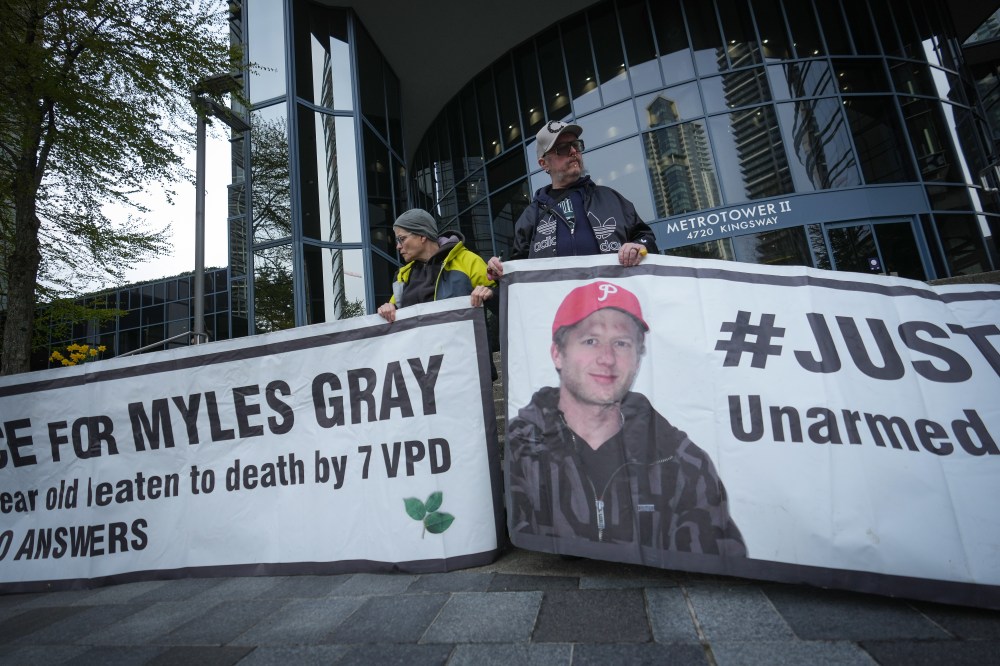
“We know that THC is psychoactive. It can lead to paranoia and hallucinations,” he said of the active ingredient in cannabis.
But Shapiro noted those symptoms would be on the “extreme side” as cannabis generally acts as a “calming drug.”
He said the drug mitragynine was also initially flagged, with the substance being able to act “as a stimulant at low doses,” then having opioid effects such as suppressing pain — similar to morphine — at high doses.
But Shapiro said confirmation testing was later performed, which found the quantity of the detection was below the “reporting limit.”
“So it either means that the drug was present at a very low concentration or that it wasn’t present at all in the sample,” he explained.
Shapiro told the hearing he was brought onto the case in 2023 and by that time all specimens had been destroyed “as a matter of process,” so he was relying on past reports and data produced during testing in 2015.
The hearing by the Office of the Police Complaint Commissioner is looking into the actions of seven Vancouver police officers in Gray’s beating death.
All were cleared of misconduct in 2024 by a police discipline authority.
Gray’s family doctor, Dr. Christoffel Mentz-Serfontein, had earlier testified that his patient, who had bipolar disorder, had been injecting unprescribed testosterone.
Shapiro said Friday that there was a flag for a steroid in the initial screening, indicating it might have been present. The initial flag was for the steroid trenbolone, which Shapiro said is similar to testosterone and is typically purchased as an anabolic steroid to build muscle.
“I just wanted to stress though that the flag of it doesn’t necessarily mean that was the drug in particular that was present,” he said.
“It could have been any other steroid that has a very similar structure including testosterone or it could have been random noise, but that is what the computer at least flagged as a possible hit.”
He said a followup analysis was done and it was not detected, but Shapiro noted that neither test could “reliably say that the drug was present or absent.”
“When I reviewed the analytical data, it didn’t look like a very strong detection,” he said Friday. “Steroids are very difficult to analyze, and I don’t think that the instruments that we had at the time were capable of saying whether or not it was present.”
A coroner’s inquest in 2023 heard that Gray was left with injuries, including a fractured eye socket, a crushed voice box and ruptured testicles.
The coroner’s jury ruled the death was a homicide. Coroner’s inquests do not find criminal fault, and a finding of homicide means death due to injury intentionally inflicted by another person.
Police had originally been called to a complaint of a man who sprayed a woman with water from a garden hose.
The hearing is expected to continue next week with testimony from a forensic pathologist and a use of force expert.
This report by The Canadian Press was first published March 6, 2026.