
Canadians plan to sail to Gaza despite detention risks
Advertisement
Read this article for free:
or
Already have an account? Log in here »
We need your support!
Local journalism needs your support!
As we navigate through unprecedented times, our journalists are working harder than ever to bring you the latest local updates to keep you safe and informed.
Now, more than ever, we need your support.
Starting at $15.99 plus taxes every four weeks you can access your Brandon Sun online and full access to all content as it appears on our website.
Subscribe Nowor call circulation directly at (204) 727-0527.
Your pledge helps to ensure we provide the news that matters most to your community!
To continue reading, please subscribe:
Add Brandon Sun access to your Free Press subscription for only an additional
$1 for the first 4 weeks*
*Your next subscription payment will increase by $1.00 and you will be charged $20.00 plus GST for four weeks. After four weeks, your payment will increase to $24.00 plus GST every four weeks.
Read unlimited articles for free today:
or
Already have an account? Log in here »
Canadians are planning to sail to Gaza again as part of a flotilla that aims to deliver aid and break a nearly 20-year naval blockade months after six Canadians were detained by Israel for attempting a similar mission.
Safa Chebbi, spokesperson for the Canadian arm of the Global Sumud Flotilla, said more than 100 boats and 3,000 participants from around the globe are set to depart from Spanish and Italian ports on April 12, bound for Gaza.
Chebbi said health-care workers, journalists and builders hoping to provide aid and help in Gazan reconstruction efforts will sail on the fleet of ships, along with medicine and other life-saving supplies.
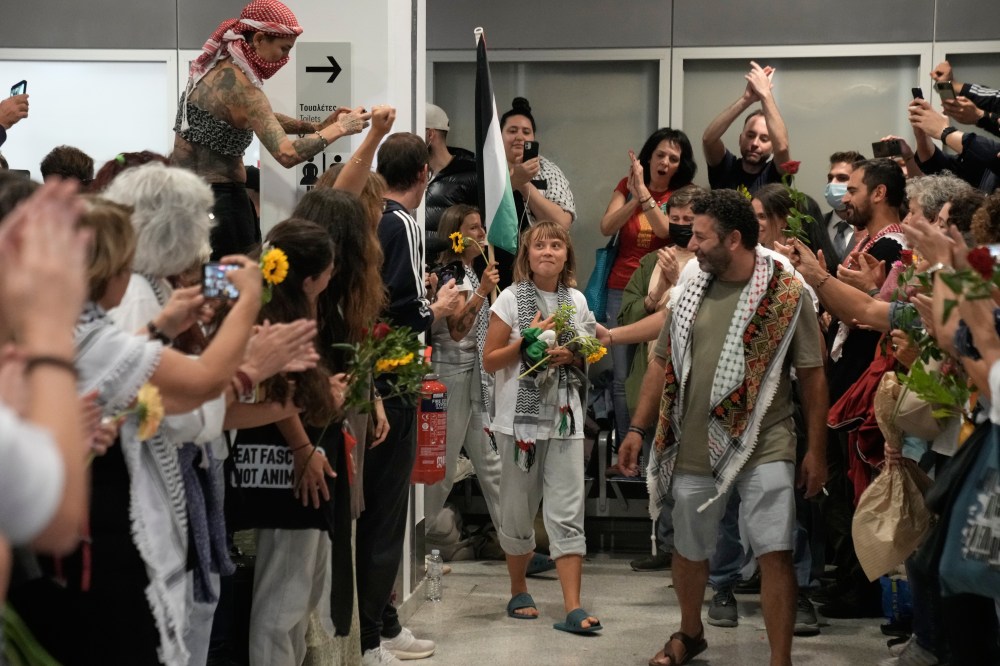
Hanging over the planned sailing is the possibility the boats will be intercepted by Israeli forces and passengers detained, as has been the case for dozens of ships in the past two decades, with none reaching Gaza since 2008.
Last fall, Israel took more than 400 activists, including Greta Thunberg and Nelson Mandela’s grandson, into custody during the first sailing of the Global Sumud Flotilla. Shortly after, six Canadians sailing in the Freedom Flotilla, which has been attempting to land ships in Gaza since 2010, were also detained before being deported back to Canada.
This year, the Freedom Flotilla has joined with the Global Sumud Flotilla for a joint sailing, says Ehad Lotayef, one of the founders of the Freedom Flotilla’s Canadian branch.
Lotayef spoke of detentions as a near foregone conclusion for the spring sailing. The Montreal poet said he experienced it himself in 2011, when he and other activists were held in Israel for a week after attempting to sail to Gaza.
“We are not trying to be martyrs, but we are also not ignorant to the realities,” he said, noting that participants receive training to prepare them for possible violence if they are taken into custody.
Dr. Suzanne Shoush, a Black and Indigenous family physician in Toronto who is hoping to sail with the flotilla again after participating last year, said she and many others are ready to put their own safety on the line for the chance to deliver aid.
“People are willing to take the risk,” she said. “There is so much hope that the flotilla will break the siege.”
“Yes, people expect that detention will be an outcome but it should not be,” she continued. “Gaza has the right to invite people … to its shores. Palestinians have the right to receive aid.”
Fida Alburini, a Palestinian-Canadian organizer, also hopes to sail to Gaza despite the safety concerns.
“We’re human, so we feel scared for sure,” she said. “But … the risk really shouldn’t be there because we’re sailing under international law in international waters. We have humanitarian aid. We have baby formula. We have medicine. We have doctors.”
“The risk exists because (Israel) decides to attack us illegally,” she added.
There’s debate over the legality of Israel enforcing its naval blockade in international waters, but some experts say international law protects the delivery of aid, regardless.
Israel says its naval blockade is needed to prevent Hamas from importing arms, while critics consider it collective punishment.
Aid is trickling into Gaza, though not at the level promised under the October 2025 ceasefire agreement, aid groups say. While the U.S.-brokered ceasefire halted major military operations, Israel has also continued to strike what it says are militants, often killing civilians.
A daily average of 225 trucks brought supplies into the Gaza Strip in January, the UN World Food Program said in its latest food security analysis, far below the promised 600 trucks per day.
Hunger is still acute in the region where the price of food has reportedly skyrocketed since the start of the Iran war.
Lotayef said the goal of the flotilla is not to solve the humanitarian crisis in Gaza, but to establish a maritime corridor to the region so more aid can flow, bypassing choked land crossings.
“The supplies we carry are more symbolic,” he said, adding that the ships in the flotilla are too small and too few to bring sufficient aid needed to make a meaningful impact.
“But the goal is to open a path to Gaza and to open the eyes of the world to what’s happening over there.”
Shoush, a member of the Leqʼá꞉mel First Nation, said Indigenous people see themselves in the plight of Palestinians, as people who have faced occupation and settler colonialism.
She says she has a duty to act, even if it means putting herself in harm’s way.
“At some point you pass this line where sitting there watching, knowing, and actually doing nothing is worse for you than anything else can be.”
This report by The Canadian Press was first published March 21, 2026.
— with files from The Associated Press