
China denies forced labour allegations amid fallout from Michael Ma’s comments
Advertisement
Read this article for free:
or
Already have an account? Log in here »
We need your support!
Local journalism needs your support!
As we navigate through unprecedented times, our journalists are working harder than ever to bring you the latest local updates to keep you safe and informed.
Now, more than ever, we need your support.
Starting at $15.99 plus taxes every four weeks you can access your Brandon Sun online and full access to all content as it appears on our website.
Subscribe Nowor call circulation directly at (204) 727-0527.
Your pledge helps to ensure we provide the news that matters most to your community!
To continue reading, please subscribe:
Add Brandon Sun access to your Free Press subscription for only an additional
$1 for the first 4 weeks*
- Enjoy unlimited reading on brandonsun.com
- Read the Brandon Sun E-Edition, our digital replica newspaper
*Your next Free Press subscription payment will increase by $1.00 and you will be charged $20.95 plus GST for four weeks. After four weeks, your payment will increase to $24.95 plus GST every four weeks.
Read unlimited articles for free today:
or
Already have an account? Log in here »
China is again denying claims of forced labour in the country as calls grow for Prime Minister Mark Carney to clarify Canada’s stance on the issue amid fallout from comments made by Liberal MP Michael Ma that appeared to cast doubt on reported human rights abuses.
The Chinese Embassy in Canada pushed back on the allegation that forced labour is used in the production of Chinese electric vehicle components in a social media post Friday night, calling it a “blatant lie” that some are using to undermine the Canada-China EV deal.
The comments from the embassy came a day after Ma apologized for a tense exchange during a committee hearing where he asked an expert if she’d seen forced labour in China with her own eyes or if she had relied on “hearsay.”
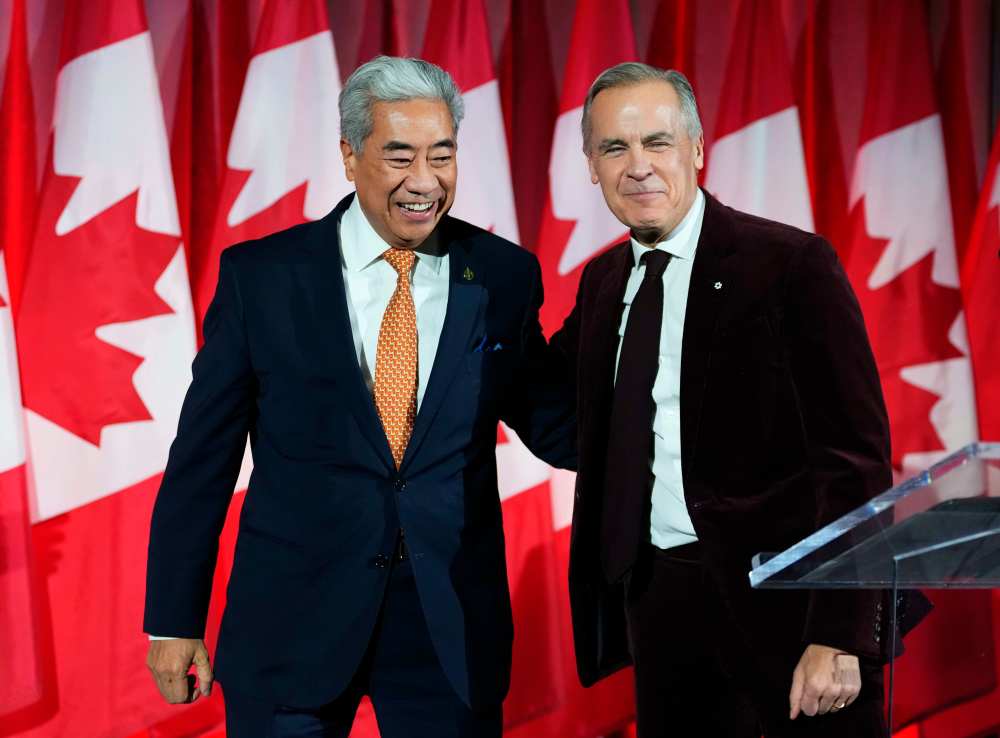
Margaret McCuaig-Johnston, a senior fellow at the University of Ottawa, had told committee members that Chinese vehicles are made with products of slave labour performed by members of the Uyghur minority, referring to research by Human Rights Watch.
Ma later clarified he had been asking McCuaig-Johnston about forced labour in Shenzen, an EV manufacturing hub, not Xinjiang, where the Chinese government has been accused of widespread abuses against Uyghurs.
Still, calls are growing among Conservatives for Carney to address Ma’s comments and clarify where the federal government stands on the issue of forced labour as Canada builds a stronger trade relationship with China.
Conservative Leader Pierre Poilievre called on Carney to do just that in a social media post Saturday morning, echoing a previous call from Conservative foreign affairs critic Michael Chong for Carney to “urgently” clarify his position.
“Mark Carney must tell us where he stands,” Poilievre wrote, asking the prime minister to provide a yes or no response on whether he believes there is forced labour in China.
Energy Minister Tim Hodgson said Friday the federal government is opposed to forced labour. In a statement Saturday, a spokesperson for International Trade Minister Maninder Sidhu said the same.
“Canada unequivocally condemns forced labour, in all of its forms, everywhere,” said spokesperson Huzaif Qaisar. “Mr. Ma’s comments as reported are not reflective of the Government of Canada’s position on the incredibly serious issue of forced labour.”
“Canada has robust legal and regulatory measures in place to ensure that no item imported to Canada is produced through forced labour,” Qaisar added in a statement that lacked explicit reference to China.
Lynette Ong, director of the China Governance Lab at the Munk School of Global Affairs and Public Policy, said the government should take this opportunity to acknowledge concerns of forced labour in China in the face of “overwhelming evidence” of the practice or else risk reputational harm.
“Refusing to admit that evidence exists, that would make us appear weak,” Ong said.
The United Nations reported in 2022 that China had committed serious human rights violations in Xinjiang against Uyghurs and other Muslim minorities that “may constitute international crimes, in particular crimes against humanity.”
A report issued that same year by Global Affairs Canada found China “is using otherwise legitimate programs for retraining and relocation of unemployed workers as instruments of a broader campaign of oppression, exploitation and indoctrination of the Uyghur Muslim population into Han (majority) Chinese culture.”
Ong says acknowledging human rights abuses in China won’t necessarily harm trade relations with the Asian superpower as Canada looks beyond the U.S. for trade partners in the midst of tariff-related uncertainty.
Ong says China is also in a position where it needs to strengthen trade.
“China’s domestic economy is actually not doing so well. It’s relying on export growth to drive its economy, particularly exports of EVs and other high-tech products,” she said.
“Canada is part of (The Canada-United States-Mexico Agreement), so for its EVs to be able to come into Canada has got implications for the North American market.”
The EV deal saw Canada lower its previous 100 per cent tariff on Chinese EVs to 6.1 per cent and allow for 49,000 Chinese EVs to be imported, with a ramp-up to 70,000 within five years. China, meanwhile, agreed to reduce tariffs on Canadian goods, including canola.
Ong took a pragmatic approach to Canada’s relationship with China, saying Beijing may be an incompatible political ally, but Canada has a lot to gain economically by maintaining good trade relations.
“In this age of global uncertainty and competition and geopolitical tension, we cannot afford to lump political and economic interests together,” she said. “We have a lot of incompatible values with China. But economic-wise, there are a lot of things that we can work on that will serve the interests of both countries.”
On Friday, Hodgson said Canada was in the process of recalibrating its relationship with China. While he acknowledged the two countries have had differences, he said those disagreements — and the bilateral conversations about them — don’t need to be made public.
“We will not allow for products done with forced labour into this country. They understand that. They understand what our lines are. and so we’re focused on where we do agree,” Hodgson said.
“Those lines are clear. We don’t need to have public discussions about where we disagree. We make that clear, to our friends in China.”
— with files from Dylan Robertson and Nick Murray
This report by The Canadian Press was first published March 28, 2026.