
Political neutrality mandate in Alberta classrooms offensive to teachers, union says
Advertisement
Read this article for free:
or
Already have an account? Log in here »
We need your support!
Local journalism needs your support!
As we navigate through unprecedented times, our journalists are working harder than ever to bring you the latest local updates to keep you safe and informed.
Now, more than ever, we need your support.
Starting at $15.99 plus taxes every four weeks you can access your Brandon Sun online and full access to all content as it appears on our website.
Subscribe Nowor call circulation directly at (204) 727-0527.
Your pledge helps to ensure we provide the news that matters most to your community!
To continue reading, please subscribe:
Add Brandon Sun access to your Free Press subscription for only an additional
$1 for the first 4 weeks*
- Enjoy unlimited reading on brandonsun.com
- Read the Brandon Sun E-Edition, our digital replica newspaper
*Your next Free Press subscription payment will increase by $1.00 and you will be charged $20.95 plus GST for four weeks. After four weeks, your payment will increase to $24.95 plus GST every four weeks.
Read unlimited articles for free today:
or
Already have an account? Log in here »
EDMONTON – Alberta’s teachers union says the government’s suggestion that educators don’t act with integrity or present issues in a balanced way is offensive.
Education Minister Demetrios Nicolaides tabled a bill this week that he said is aimed at getting politics and ideology out of classrooms.
The bill, with further rules expected to come later this year, includes a mandate that teachers present all issues in a neutral way.
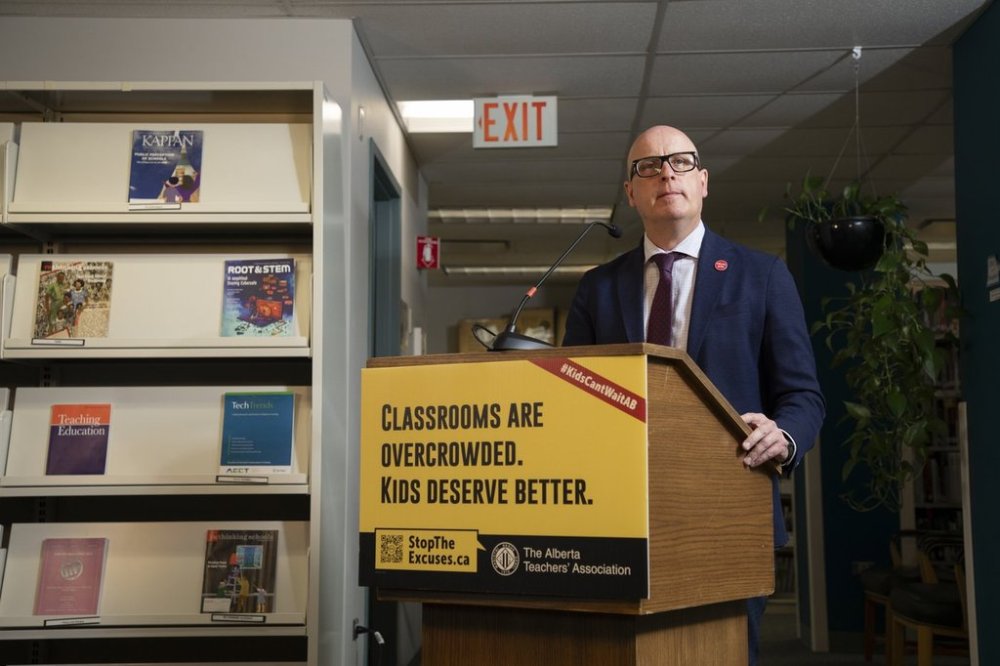
Jason Schilling, the president of the Alberta Teachers’ Association, told reporters Wednesday that it’s something already expected of teachers, and the government is legislating a solution to a non-existent problem.
“Teachers are professionals. They already teach the prescribed curriculum in a balanced, thoughtful and age-appropriate way,” he said.
“Any suggestion otherwise is unfair and quite frankly offensive to the profession.”
Nicolaides said Tuesday that some recent incidents pointed to a need for the new rule, including in January when a social studies teacher north of Edmonton was recorded denigrating conservative viewpoints and proponents of the oil and gas industry.
Premier Danielle Smith had shared the recording on social media and said at the time that she was “deeply disappointed” by what she heard.
Schilling, whose union is already at odds with the province after Smith’s government legislated teachers back to work last fall after a three week strike, said Nicolaides’ bill was another blow to teacher morale.
“Teachers are going to look at this and school leaders are going to look at this and see it as a way for them to be punished further,” he said, adding that he already knows the bill isn’t going “over well” with educators across the province.
He said that with issues that led to the strike — including overcrowded and complex classrooms — still needing to be addressed, it was disappointing to see the government shift its focus to “virtue signalling and dog whistling.”
“Sometimes I’m just baffled by the decisions that this government makes around the Education Act.”
Schilling also questioned how the government expects certain subjects be taught in a neutral and non-biased way, such as genocide.
Nicolaides said Wednesday he didn’t expect teachers to make any major deviations from their usual lesson plans and noted the provincial curriculum expects students to walk away knowing of the horrors of genocide.
“The primary responsibility, of course, is to teach those facts and, again, make sure that students are being provided with the information to develop their own opinions and to develop their own conclusions,” he told reporters at the legislature.
Nicolaides said the government isn’t trying to limit or prevent discussions in the classroom, but to make sure students develop and express their own opinions
“We’re safeguarding the students’ right … to express diverse viewpoints and we’re encouraging teachers to have these kinds of conversations,” he said. “All we’re saying is if you’re going to have these conversations, just make sure you’re doing it objectively and impartially and allowing different opinions to come out.”
The teachers’ association wasn’t the only group to criticize the bill Wednesday.
The Canadian Civil Liberties Association said in a statement that what the government calls neutrality, it considers censorship.
“Last year Alberta tried to ban books in schools. Now they are trying to limit what can be taught in schools,” said Howard Sapers, the association’s executive director.
“When governments label certain topics, books, or symbols as ‘ideological,’ the result is not neutrality — it is censorship.”
The association also took issue with other changes the government is proposing, such as a potential restriction on which flags can be displayed in schools and dropping a reference to diversity in the legal description of what kind of learning environment school boards are expected to provide.
Other changes being proposed include a new requirement that public school boards get ministerial approval for naming or renaming schools and a rule that school boards refrain from issuing statements on political, social or ideological issues that are unrelated to education.
The government also aims to require the national anthem be played once a week in schools and it seeks the ability to set strategic goals for school boards.
School boards in Alberta’s two biggest cities, as well as the provincial school board association, all said Wednesday that legislation was still being reviewed.
“This bill proposes multiple changes with school board governance and operational implications that require thoughtful consideration,” reads a statement from Shali Baziuk, the president of the Alberta School Boards Association, or ASBA.
The government said many of the changes its proposing will be set out in more detail in regulations that are expected to be finalized before the next school year begins in the fall.
This report by The Canadian Press was first published April 1, 2026.