
Environment Canada to use AI in new weather forecasting model
Advertisement
Read this article for free:
or
Already have an account? Log in here »
We need your support!
Local journalism needs your support!
As we navigate through unprecedented times, our journalists are working harder than ever to bring you the latest local updates to keep you safe and informed.
Now, more than ever, we need your support.
Starting at $15.99 plus taxes every four weeks you can access your Brandon Sun online and full access to all content as it appears on our website.
Subscribe Nowor call circulation directly at (204) 727-0527.
Your pledge helps to ensure we provide the news that matters most to your community!
To continue reading, please subscribe:
Add Brandon Sun access to your Free Press subscription for only an additional
$1 for the first 4 weeks*
- Enjoy unlimited reading on brandonsun.com
- Read the Brandon Sun E-Edition, our digital replica newspaper
*Your next Free Press subscription payment will increase by $1.00 and you will be charged $20.95 plus GST for four weeks. After four weeks, your payment will increase to $24.95 plus GST every four weeks.
Read unlimited articles for free today:
or
Already have an account? Log in here »
OTTAWA – Environment and Climate Change Canada will use artificial intelligence to make its weather forecasts more accurate, the federal department said Thursday.
It plans to launch a hybrid model this spring that uses both AI and traditional forecasting and says the combination of the two will lead to more accurate predictions.
“The new hybrid model relies on AI to better predict future weather conditions, as well as relying on the traditional physics‑based model to bring in our knowledge of unique local factors like wind, temperature, and precipitation,” it said in a news release.
AI can analyze decades of historical data covering a whole continent in minutes, the department said, adding AI models “identify relationships between temperature, wind, and pressure and use those learned patterns to estimate the future atmosphere, especially for major weather events like heat waves, or for tracking hurricanes.”
The hybrid model is better at predicting extreme weather, such as strong winds or heat waves, because the traditional model “keeps the small-scale details that AI models tend to miss,” the release said.
With the new model, Environment Canada said its six-day forecast will be as accurate as its five-day forecast. It said that’s “particularly significant because previous improvements to forecasting were only possible after several years of research and development.”
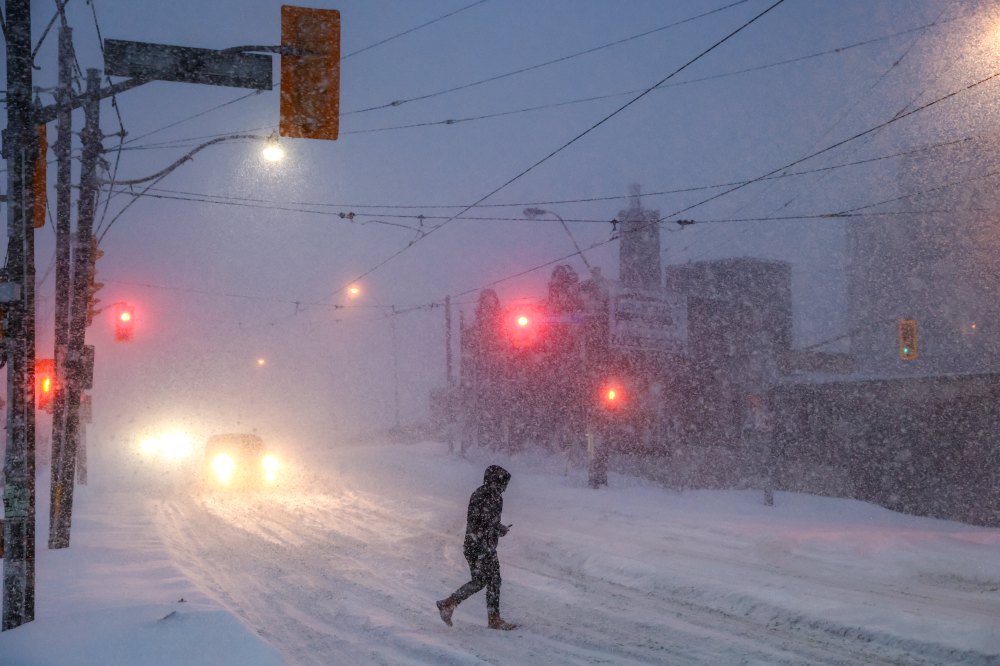
It said the hybrid system will also be faster at predicting major systems such as winter storms, heat waves and atmospheric rivers.
Environment Canada said that over the past year, its “scientists and meteorologists have been carrying out extensive testing on the hybrid model, running it in parallel with our traditional model to evaluate its performance for predicting weather conditions in Canada.”
The department added it will continue to rely on its meteorologists, whose is judgment is “critical” to interpreting results and communicating them to the public.
“The fact that that much climate data can be analyzed so quickly and incorporated into a product that we can use is exciting,” said Halifax-based Cindy Day, who has been a meteorologist for more than 40 years.
Day added that being able to identify systems earlier will benefit public safety by giving people more warning of big storms.
But she questioned how helpful historical data can be, given the effects of climate change.
“The rate at which our temperatures are changing and our climate is changing is significant. And so I’m not sure that the analysis of so much data going back so much time so very quickly is going to make a big difference into producing a forecast for the next five, six, seven days,” Day said.
This report by The Canadian Press was first published April 9, 2026.