
B.C. tables another First Nation treaty ratification, but overlap concerns persist
Advertisement
Read this article for free:
or
Already have an account? Log in here »
We need your support!
Local journalism needs your support!
As we navigate through unprecedented times, our journalists are working harder than ever to bring you the latest local updates to keep you safe and informed.
Now, more than ever, we need your support.
Starting at $15.99 plus taxes every four weeks you can access your Brandon Sun online and full access to all content as it appears on our website.
Subscribe Nowor call circulation directly at (204) 727-0527.
Your pledge helps to ensure we provide the news that matters most to your community!
To continue reading, please subscribe:
Add Brandon Sun access to your Free Press subscription for only an additional
$1 for the first 4 weeks*
- Enjoy unlimited reading on brandonsun.com
- Read the Brandon Sun E-Edition, our digital replica newspaper
*Your next Free Press subscription payment will increase by $1.00 and you will be charged $20.95 plus GST for four weeks. After four weeks, your payment will increase to $24.95 plus GST every four weeks.
Read unlimited articles for free today:
or
Already have an account? Log in here »
VICTORIA – The Kitselas First Nation in northwestern B.C. has reached a major milestone in its treaty process as the province tabled legislation to ratify the agreement, in the second such achievement for a First Nation in as many days.
But like the province’s treaty process with the K’omoks First Nation, the Kitselas process is also facing opposition from its neighbours.
The legislation tabled Wednesday by Indigenous Relations Minister Spencer Chandra Herbert grants the Kitselas First Nation ownership over 38,250 hectares of land in its territory near Terrace, B.C., along with self-governance in several areas, including the administration of justice.
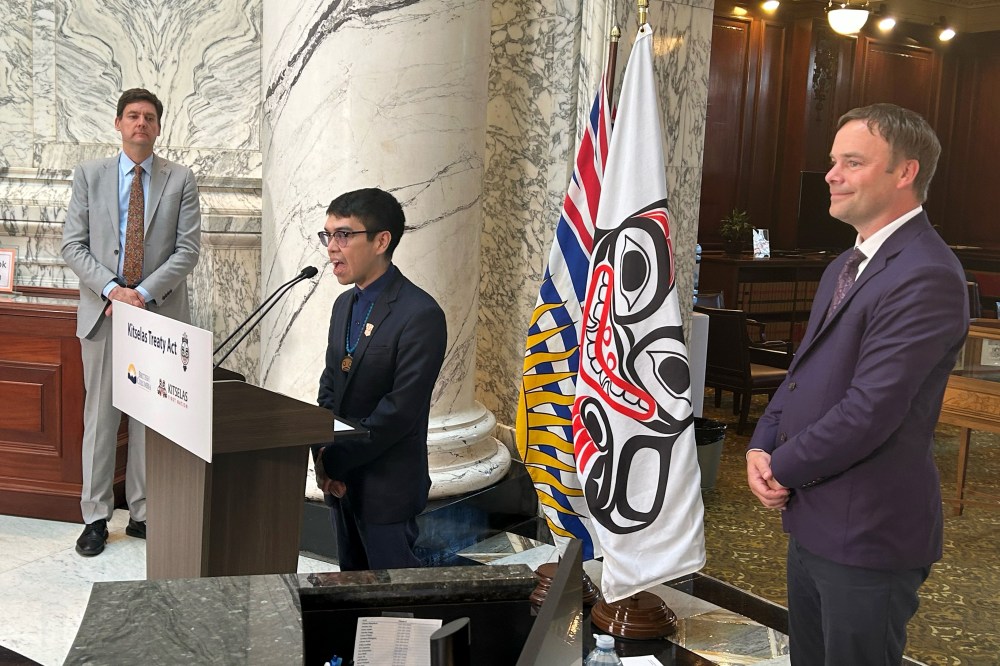
Deputy Chief Coun. Cyril Bennett-Nabess said during a ceremony before the legislation was tabled that his First Nation had overcome a “struggle,” which began over 113 years ago with the implementation of the Indian Act. It will no longer apply to the band, once Ottawa has ratified the treaty.
He built on those comments in the legislature.
“What this treaty will do for our people, it will provide a means forward, a path forward, a path that will be followed by our community, and when I say community, I mean Kitselas, British Columbia and Canada.”
The proposed treaty has critics among a group of First Nations neighbouring the Kitselas who have called on the provincial government to immediately pause ratification.
The Nine Allied Tribes and Lax Kw’alaams say in a statement that the proposed treaty would affect over 90 per cent of their title and ancestral rights, without full consultation, accommodation or consent.
Garry Reece, elected mayor of Lax Kw’alaams, wants the process paused.
“Above all, our Nine Allied Tribes and elected leaders will take every legal, peaceful and public step necessary to defend our territory, inherent rights and title, and ancestral birthrights of present and future generations of our Nine Allied Tribes and Lax Kw’alaams people,” he said.
Bennett-Nabess said the Kitselas First Nation is prepared to meet its neighbours and come to a protocol agreement that would speak to mutual concerns.
Tuesday’s advancement in the treaty process with the K’omoks First Nation faced opposition from the Wei Wai Kum First Nation, which has overlapping territory.
Negotiations between the provincial government and the Kitselas First Nation started in 1993 and an agreement in principle was reached in 2015, although the First Nation only initialled the deal in 2024.
Premier David Eby said during the ceremony before the legislation was tabled on Wednesday that the proposed treaty is a “historic” and “long-overdue” correction of past injustices, given B.C.’s lack of historical treaties.
He said the treaty will create certainty and opportunity, not only for the Kitselas, but all parties in the region.
The premier said in the legislature that it was his honour to speak in support of the legislation.
“This agreement is a major step forward in repairing damaged trust, and building a foundation we can grow together.”
Eby also referred to the K’omoks Treaty Act in his remarks. He said the back-to-back introduction marks a significant milestone for the modern treaty process.
“I said yesterday and I will say it again today,” Eby said. “This is what reconciliation means. It is the way forward to certainty, to shared prosperity, to the best future for all people in British Columbia.”
Under the agreement, the First Nation will receive about $109.8 million from the federal government and $20 million from the provincial government.
The Kitselas will be the ninth First Nation in B.C. to have a modern treaty.
This report by The Canadian Press was first published April 15, 2026.