
Alberta’s governing UCP to revisit proposed riding changes before next election
Advertisement
Read this article for free:
or
Already have an account? Log in here »
We need your support!
Local journalism needs your support!
As we navigate through unprecedented times, our journalists are working harder than ever to bring you the latest local updates to keep you safe and informed.
Now, more than ever, we need your support.
Starting at $15.99 plus taxes every four weeks you can access your Brandon Sun online and full access to all content as it appears on our website.
Subscribe Nowor call circulation directly at (204) 727-0527.
Your pledge helps to ensure we provide the news that matters most to your community!
To continue reading, please subscribe:
Add Brandon Sun access to your Free Press subscription for only an additional
$1 for the first 4 weeks*
- Enjoy unlimited reading on brandonsun.com
- Read the Brandon Sun E-Edition, our digital replica newspaper
*Your next Free Press subscription payment will increase by $1.00 and you will be charged $20.95 plus GST for four weeks. After four weeks, your payment will increase to $24.95 plus GST every four weeks.
Read unlimited articles for free today:
or
Already have an account? Log in here »
EDMONTON – Alberta’s governing United Conservatives are looking to take another run at redrawing provincial riding boundaries — a move the Opposition NDP calls a cynical backdoor scheme to rig the October 2027 general election.
“Why is the premier doing this? Why is she so afraid?” Opposition NDP Leader Naheed Nenshi said to Premier Danielle Smith in chamber debate Thursday.
Nenshi accused Smith of being so desperate to cling to power, that she’d stoop to gerrymandering — a process of designing boundaries around voting patterns to benefit one party over another.
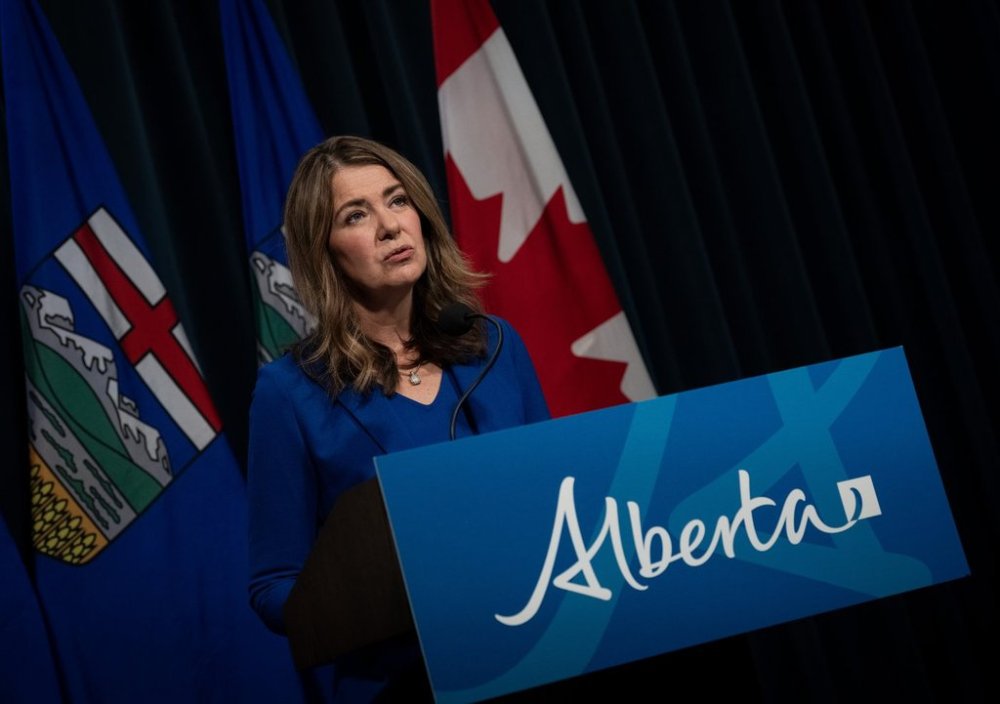
“This government has been clear from the start that they only care about power. They don’t care about ethical government,” Nenshi said.
Those accusations were brushed aside by Smith, who compared Nenshi’s claims of vote rigging to those made by U.S. President Donald Trump, while also accusing her opponent of hating rural Albertans.
Smith’s caucus signalled in legislature documents Thursday it will soon introduce a motion in the house to revisit a recent bipartisan commission’s recommendation on the new boundaries.
The motion, if passed, would see a new committee of legislature members — a majority of them from Smith’s caucus — oversee revisions crafted by a second bipartisan panel.
The first panel report was delivered to the legislature last month. The panel was comprised of five civilian members: chair Dallas Miller, two members appointed by the UCP, and two by the NDP. They were tasked with redrawing the maps while not adding more than two seats on top of the existing 87.
The document, however, was riven with conflict. The two UCP-appointed commission members disagreed sharply with the recommendations of the remaining three.
The UCP appointees recommended creating more than a dozen merged urban and rural ridings. They defended it as “necessary to respond to demographic change, reduce polarization and reflect Alberta’s increasingly interconnected urban-rural landscape.”
The other three members called that an indefensible – and at times illogical — suggestion that favoured the rural-dominant UCP at the ballot box.
They questioned, for example, the UCP appointees’ rationale for having some Calgary ridings stay within city limits while others were merged into rural ones, resulting in wide disparities in population from one riding to the next.
Miller and the NDP appointees presented new boundaries that added seats in Edmonton and Calgary while eliminating two rural ones. They also recommended some rural and urban hybrid ridings, though far fewer than what the UCP appointees suggested.
As a compromise between the two warring sides, Miller, a judge, has suggested the legislature could revisit the process with an eye to boosting the number of ridings to 91, which he said would allow for rural ridings to be maintained. He also said a boost to 91 would better reflect Alberta’s population growth.
Nenshi has labelled the UCP-appointee recommendations “nuts” and called for the legislature to simply adopt the recommendations of the remaining three.
But Smith told the house Thursday that going to 91 ridings, as Miller suggested, is the way to go, and that is why they are revisiting the process.
She said during question period it’s a way to make sure rural voters have an equal voice in the legislature. Smith said she was surprised the NDP would turn their backs on those outside the cities “when they know that this (new) report would make it better for rural Alberta.”
Should the motion pass, the new committee of MLAs and the second bipartisan panel would have until the fall to report back. UCP backbencher Brandon Lunty will chair the MLA oversight committee and told reporters all input from the public gleaned to date will be available to draw on.
Nenshi told reporters they were still determining whether to participate in the new process should the motion pass. He suggested it’s all a smokescreen to get the previous UCP-friendly recommendations approved. “We’re not going to stand for it,” he said.
Political scientist Duane Bratt, with Mount Royal University in Calgary, said the redrawing process to date is “not normal” and said he would be surprised if the new process results in a different proposal than the one originally put forward by the UCP appointees.
“They’re going to do the same thing, but wrap it in some other form of legitimacy,” Bratt said in an interview, adding he expects court challenges to be launched once the new riding maps are adopted.
Lisa Young, a political scientist with the University of Calgary, said the revisit and the rushed mandate threatens public trust.
“There’s going to be a great deal of suspicion and partisan animus around this process,” she said.
This report by The Canadian Press was first published April 16, 2026.