
Boeing commits $36M for Winnipeg projects
Advertisement
Read this article for free:
or
Already have an account? Log in here »
We need your support!
Local journalism needs your support!
As we navigate through unprecedented times, our journalists are working harder than ever to bring you the latest local updates to keep you safe and informed.
Now, more than ever, we need your support.
Starting at $15.99 plus taxes every four weeks you can access your Brandon Sun online and full access to all content as it appears on our website.
Subscribe Nowor call circulation directly at (204) 727-0527.
Your pledge helps to ensure we provide the news that matters most to your community!
To continue reading, please subscribe:
Add Brandon Sun access to your Free Press subscription for only an additional
$1 for the first 4 weeks*
- Enjoy unlimited reading on brandonsun.com
- Read the Brandon Sun E-Edition, our digital replica newspaper
*Your next Free Press subscription payment will increase by $1.00 and you will be charged $20.95 plus GST for four weeks. After four weeks, your payment will increase to $24.95 plus GST every four weeks.
Read unlimited articles for free today:
or
Already have an account? Log in here »
WINNIPEG — Canada’s next Air Force planes will be built with the help of a burgeoning workforce: robots.
Boeing announced $36 million for research and development at its Winnipeg facility on Friday. The hub produces parts for planes.
Staff often build pieces meant for Boeing 737s, the aerospace company’s commercial fleet. But with a contract for Canada’s defence department on the table, some of those parts may be shipped for use in new maritime patrol planes.
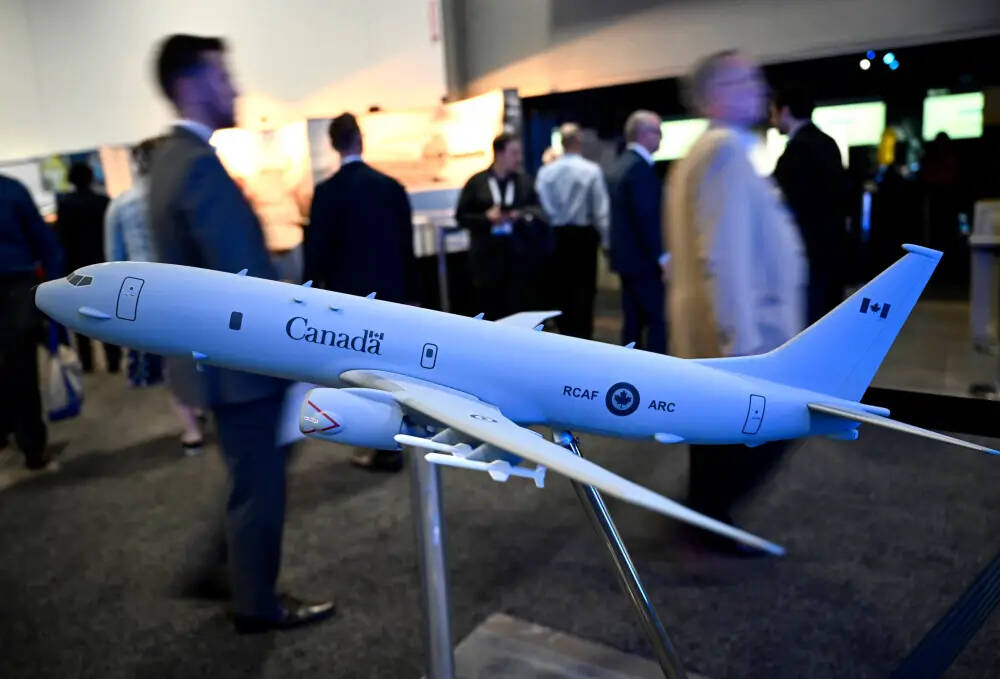
A scale model of the Boeing P-8 Poseidon is seen at the CANSEC trade show in Ottawa in 2023. (Justin Tang/Winnipeg Free Press files)
Boeing was awarded a contract to manufacture 14 P-8 Poseidons for the Royal Canadian Air Force a couple of years ago. Ottawa expects the first aircraft to be delivered next year.
The $36-million spend in Winnipeg stems from the deal, said Al Meinzinger, Boeing Canada president.
“There is a big future ahead of us — certainly in terms of aircraft opportunities — and that’ll be great for this facility,” Meinzinger said Friday.
The money will be spent over 10 years. Boeing will conduct some projects with the National Research Council Canada, Meinzinger added.
Matt Baxter heads the Winnipeg site’s engineering team, which encompasses roughly 130 staff. They started some of the research and development projects ahead of Friday’s announcement.
Boeing is working with the National Research Council on collaborative robotics — essentially robotic assistants helping technicians with production tasks, such as drilling, cleaning and sealing.
“We would target the operations that are harder on (the technician’s) body,” Baxter said. “The difficult postures.”
He doesn’t expect job losses to result from leaning into robotics, he said: such technology is already in Boeing’s production facility and acts as an “aid” to staff.
The $36-million boost could bring “some aspect of growth” in employment, Baxter said. Neither he nor Meinzinger shared a Winnipeg-specific number Friday.
The program for Ottawa’s P-8 Poseidon fleet will support around 3,000 jobs and add more than $350 million to the Canadian economy annually over the next decade, Meinzinger said.
“This is an example of how when the federal government chooses a platform … the private sector follows with investments in our country,” Manitoba Premier Wab Kinew said after Boeing’s announcement.
Kinew was in Ottawa earlier this week, meeting with Prime Minister Mark Carney and federal bureaucrats. He hinted Winnipeg’s aerospace sector could see new funding.
Manitoba is home to at least 20 aerospace and defence companies, including Magellan Aerospace and StandardAero. The sector contributed $850 million to Manitoba’s GDP in 2024, according to Winnipeg Economic Development & Tourism.
“When you have an aerospace sector like ours, with Boeing and with all the other companies who are really clustered around Winnipeg’s airport, you’re going to see a lot of other investments come alongside that,” Kinew said.
Ottawa unveiled a defence industrial strategy in February; it promises $180 billion in procurement and $290 billion in defence-related capital investment over the next decade. The strategy follows the United States, its closest trading partner, levying tariffs on Canada.
U.S. President Donald Trump has made comments about making Canada the 51st state. He has also eyed Greenland and Cuba and has co-launched a war in Iran.
Boeing’s announcement signals “significant momentum” in Manitoba, said Liberal MP Ben Carr (Winnipeg South Centre).
“We want to continue to advocate for the role that Manitoba’s aerospace industry can play,” Carr said.
“The elements of the industrial defence strategies policy will be implemented in the context of these broader investments.”
Mayor Scott Gillingham has begun referring to a “sky economy” in Winnipeg. Between aviation, aerospace and defence, Winnipeg has “years and years” of potential economic growth ahead of it, he said.
The $36 million for research and development will blanket more than robotics. It will cover automated processes and composite manufacturing more broadly, said Ibrahim Yimer, the National Research Council’s vice-president of transportation and manufacturing.
Ottawa signed for P-8 Poseidons to replace its CP-140 Aurora fleet. The Poseidons were the only models meeting Canada’s operational requirements for a long-range aircraft specializing in “anti-submarine and anti-surface warfare,” a government website says.
Upwards of 170 P-8 aircraft are already in operation globally. They each carry approximately $11 million worth of Canadian content and have contributed to more than $2 billion in contracts with Canadian companies, according to Boeing.
Eighty-one suppliers are connected to the P-8s’ construction, Meinzinger said. Assembly of the first plane for Ottawa’s transition began in Wichita, Kan., in February.
Boeing counts roughly 1,500 Manitoba workers.
» Winnipeg Free Press