
Alberta premier rejects Opposition claims UCP interfering on electoral boundaries
Advertisement
Read this article for free:
or
Already have an account? Log in here »
We need your support!
Local journalism needs your support!
As we navigate through unprecedented times, our journalists are working harder than ever to bring you the latest local updates to keep you safe and informed.
Now, more than ever, we need your support.
Starting at $15.99 plus taxes every four weeks you can access your Brandon Sun online and full access to all content as it appears on our website.
Subscribe Nowor call circulation directly at (204) 727-0527.
Your pledge helps to ensure we provide the news that matters most to your community!
To continue reading, please subscribe:
Add Brandon Sun access to your Free Press subscription for only an additional
$1 for the first 4 weeks*
- Enjoy unlimited reading on brandonsun.com
- Read the Brandon Sun E-Edition, our digital replica newspaper
*Your next Free Press subscription payment will increase by $1.00 and you will be charged $20.95 plus GST for four weeks. After four weeks, your payment will increase to $24.95 plus GST every four weeks.
Read unlimited articles for free today:
or
Already have an account? Log in here »
EDMONTON – Alberta Premier Danielle Smith is rejecting Opposition accusations that her United Conservatives are pulling the strings behind the scenes to rejig election ridings in their favour.
In question period Monday, Opposition NDP Leader Naheed Nenshi accused Smith’s government of being the architects of proposed maps that would’ve benefitted her party at the polls — but that are likely to be set aside as the government aims to take another stab at the redrawing process.
“They thought they could get away with passing the minority map, but it was so egregious, it was so wrong, that it was too shameless even for the UCP to do that,” Nenshi charged.
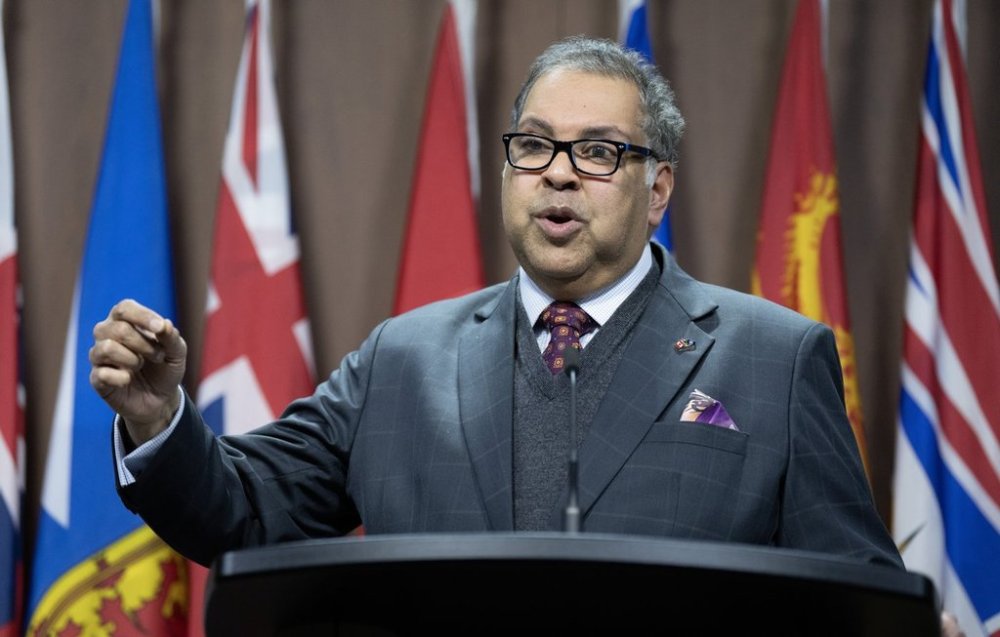
“Will the premier admit today that the minority report was actually authored by the government and is in fact the UCP report?”
Smith was quick to deny any involvement.
“Government did not have a role in drafting any maps,” she said.
“The member opposite keeps on implying that government had something to do with the outcome of this report. We did not.”
The back and forth comes as the house is expected to vote as soon as Tuesday on a motion to take back to the drawing board a recent bipartisan commission’s report on how Alberta’s electoral ridings should be redrawn ahead of the 2027 election.
Monday was the second straight sitting day where the NDP focused solely on the boundaries controversy and before question period had even begun Speaker Ric McIver admonished members for what he called disappointing conduct last week during the first war of words on the issue.
McIver had said members would be called out if he found them to be out of line — a promise he later kept when he stripped one NDP critic of a question and cautioned another. Both had accused or implied the UCP was trying to cheat their way into power in the next election.
Smith has repeatedly said they are revisiting the process after the chair of the commission, Dallas Miller, suggested creating an additional two seats to stave off the loss of rural ridings as had been proposed by himself and the two NDP-appointees who formed the commission’s majority.
Nenshi has said the UCP is using that as a smokescreen in order for the government to at least partially implement the recommendations of the UCP-appointed members of that panel, who submitted a minority report.
Their proposal called for more than a dozen new urban-rural hybrid ridings, which lead the other commission members to warn of attempts to skew Alberta’s ridings in favour of the rural-dominant UCP.
The government’s motion, if passed, would see a second panel with the same membership structure — a government-appointed chair and two nominees from each party — be formed to take another run at redrawing the maps using the majority’s proposal as a starting point.
The new panel would report to a new committee of MLAs, on which Smith’s UCP would have a majority. No public engagement is required.
Susan Samson, one of the NDP’s appointees on the first commission, said in an interview Monday that the government getting elected officials involved in redrawing the maps was the opposite of how the process should play out.
“It’s very, very important work that’s being manipulated right now,” said Samson, a former mayor of the town of Sylvan Lake.
She said it’s supposed to be, and has historically been, an independent process based on compromise.
“When we start rigging maps and gerrymandering, it can only end badly,” she said. “Unless the government chooses the majority report, this is not going to be a good outcome for Albertans.”
In their report last month the majority wrote that the split on the commission came out of nowhere. They said the commission had been unified up until January, about two months before the final reports came out and close to nine months after the work got underway.
Samson said she didn’t see the break coming, but that she had no doubts that “something or someone” had pressured the UCP-appointed members to come up with a minority report.
Samson said she’s been questioning how the minority group had produced their own report so quickly, noting it had taken the commission as a whole six months to produce the unanimous interim report, plus another month to make the final version.
“Within two to three weeks they can produce an entire set of maps for the province?” she said.
“You tell me where it came from.”
The government’s motion provides the panel and committee with a fall deadline to produce the new set of maps.
Nenshi told reporters earlier Monday that the NDP was still debating whether it will take part in the new process and that he’d have more to say if the motion passes.
Provincial law requires Alberta’s electoral divisions be reviewed every eight to 10 years to account for population changes.
This report by The Canadian Press was first published April 20, 2026.
Note to readers:This is a corrected story. A previous version misidentified the town where Susan Samson was mayor.