
Struggling Québec solidaire inspired by socialist policies of New York City mayor
Advertisement
Read this article for free:
or
Already have an account? Log in here »
We need your support!
Local journalism needs your support!
As we navigate through unprecedented times, our journalists are working harder than ever to bring you the latest local updates to keep you safe and informed.
Now, more than ever, we need your support.
Starting at $15.99 plus taxes every four weeks you can access your Brandon Sun online and full access to all content as it appears on our website.
Subscribe Nowor call circulation directly at (204) 727-0527.
Your pledge helps to ensure we provide the news that matters most to your community!
To continue reading, please subscribe:
Add Brandon Sun access to your Free Press subscription for only an additional
$1 for the first 4 weeks*
- Enjoy unlimited reading on brandonsun.com
- Read the Brandon Sun E-Edition, our digital replica newspaper
*Your next Free Press subscription payment will increase by $1.00 and you will be charged $20.95 plus GST for four weeks. After four weeks, your payment will increase to $24.95 plus GST every four weeks.
Read unlimited articles for free today:
or
Already have an account? Log in here »
MONTREAL – Québec solidaire, a leftist sovereigntist party struggling in the polls, says it’s taking inspiration from New York’s democratic socialist mayor, Zohran Mamdani, ahead of the October provincial election.
At its weekend convention in Montreal, the party, which holds 11 of the national assembly’s 125 seats, will be debating issues like rent caps and publicly run grocery stores — ideas similar those Mamdani campaigned on.
But while Ruba Ghazal — Québec solidaire’s co-spokesperson and legislature leader — says they are the only viable option for Quebec leftists, the party is sitting at the bottom of the polls in a province known for social democratic and interventionist policies.
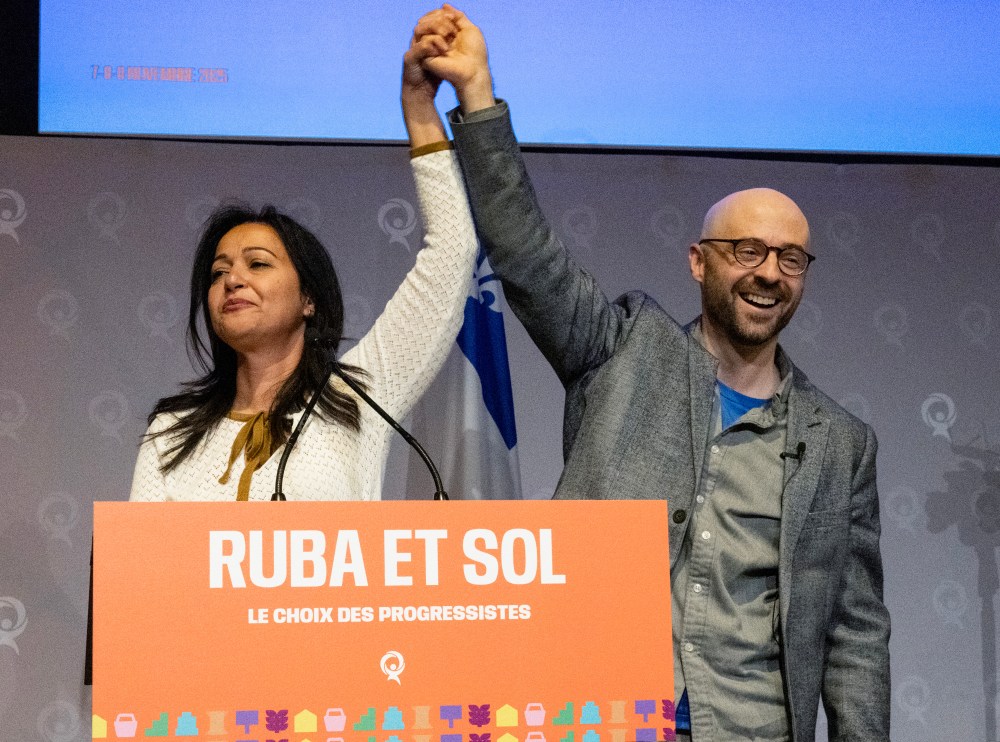
“Though the times may seem tough for the left, the left can still win,” she said in a recent interview, referring to Mamdani’s November 2025 victory in New York on an unabashedly leftist platform. “And that inspires me.”
Mamdani’s promises included faster — and free — buses, as well as city-run grocery stores. The initial store, he said, would open next year, with the remaining shops — eventually one in each of New York City’s five boroughs — opening by the end of his four-year term.
Ghazal says Quebecers already have “four flavours of conservatism to choose from” between the governing Coalition Avenir Québec, the Parti Québécois, the Liberals and the Conservatives.
“We’re alone on the left …. This gives us a great opportunity to focus on the issues that are priorities for Quebecers, but that others neglected,” she said.
The cost of living and wealth redistribution will be top issues over the weekend, Ghazal said. Members will also discuss the housing crisis, the environment, health and gender equality.
Daniel Béland, the director of McGill’s Institute for the Study of Canada, says the agenda Québec solidaire adopts at its convention — especially on fiscal issues and the question of a sovereignty referendum — will be pivotal for the party. Québec solidaire will also have to improve its messaging to broaden its appeal beyond urban centres and young people, he added.
“I think the left is in a difficult situation in many parts of the country, but not everywhere,” Béland said. “You go to Manitoba, the left, it’s going great. But … the NDP in Manitoba, it is quite different from Québec solidaire.”
Béland says Ghazal’s party could take inspiration from Manitoba Premier Wab Kinew who moved his NDP closer to the centre while keeping a populist flavour.
“They need to convince people that they have a serious, fully vetted spending plan that’s not something that will blow up the provincial budget,” he said.
He adds that Québec solidaire’s former co-spokesperson, Gabriel Nadeau-Dubois, tried to bring the party closer to the centre, but that approach created internal tensions.
Béland says that sliding toward the centre is not always a winning strategy, as shown by former federal NDP leaders Jagmeet Singh and Tom Mulcair. Mulcair, who was official Opposition leader in the 2015 election, campaigned to the right of the Liberals on economic issues, then saw his party fall to third place. The NDP under Singh failed to keep official party status in the 2025 election.
Under new leader Avi Lewis, the federal NDP is putting forward ideas like publicly run grocery stores and opposition to new fossil fuel developments — positions similar to Québec solidaire’s.
“Avi Lewis is trying something else, but he has not shown yet that it will work,” Béland said.
Jean-François Daoust, Université de Sherbrooke political science professor, says Québec solidaire is fighting for survival and could struggle to hang on to their 11 seats. Poll aggregator Qc125 says the party would win seven ridings if an election were held today.
Both Daoust and Béland agree that Québec solidaire’s position on a potential sovereignty referendum will need to be made clear before election day. Québec solidaire, they say, could make inroads with voters because of the PQ’s aggressive push to hold a referendum by 2030 and that party’s shift to the right on immigration and cultural issues.
The idea of a referendum is not appealing to two-thirds of Quebecers and many Québec solidaire members have voted in the past for the PQ. Should Québec solidaire convince voters they aren’t in a hurry like the PQ to hold a sovereignty referendum, the party could pick up support from voters — even federalists — with strong leftist politics, Béland said.
“Québec solidaire needs to appeal first of all to the left. And then to sovereigntists,” he said.
This report by The Canadian Press was first published May 8, 2026.
— With files from The Associated Press.