
Smith sees progress on pipeline deal with Ottawa after Carney meeting
Advertisement
Read this article for free:
or
Already have an account? Log in here »
We need your support!
Local journalism needs your support!
As we navigate through unprecedented times, our journalists are working harder than ever to bring you the latest local updates to keep you safe and informed.
Now, more than ever, we need your support.
Starting at $15.99 plus taxes every four weeks you can access your Brandon Sun online and full access to all content as it appears on our website.
Subscribe Nowor call circulation directly at (204) 727-0527.
Your pledge helps to ensure we provide the news that matters most to your community!
To continue reading, please subscribe:
Add Brandon Sun access to your Free Press subscription for only an additional
$1 for the first 4 weeks*
- Enjoy unlimited reading on brandonsun.com
- Read the Brandon Sun E-Edition, our digital replica newspaper
*Your next Free Press subscription payment will increase by $1.00 and you will be charged $20.95 plus GST for four weeks. After four weeks, your payment will increase to $24.95 plus GST every four weeks.
Read unlimited articles for free today:
or
Already have an account? Log in here »
OTTAWA – Alberta Premier Danielle Smith said Friday she was feeling far more confident about the prospects for a new pipeline following a meeting in Ottawa with Prime Minister Mark Carney earlier in the day.
“This morning I said ‘if’ a deal gets signed, and afterwards I said ‘when’ a deal gets signed. So that is an indication of my improved level of confidence after talking through some of the areas that we found that were of disagreement,” Smith told reporters in Ottawa a few hours after her discussion with the prime minister.
Smith said this progress comes at a crucial time — as activists in her province push for a referendum on separation — and it could demonstrate to Albertans that “Canada can work.”
Organizers behind a petition calling for a referendum said they turned over more than 300,000 signatures to Elections Alberta earlier this week. A court order is blocking the verification of those signatures while a judge considers a legal challenge mounted by a group of Alberta First Nations which argues the petition process violates treaty rights.
A decision in that case is expected soon.
In the meantime, Alberta and Ottawa are negotiating an energy and environment pact in a bid to overcome some long-standing disagreements between the two governments about oil and gas production and climate regulations.
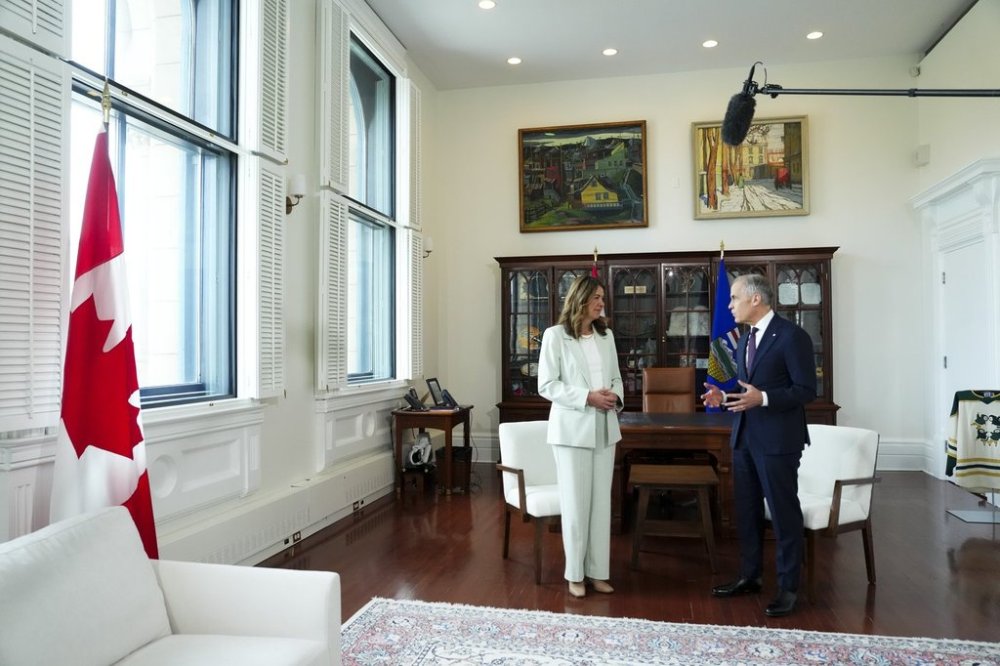
During a photo-op before their meeting, both Smith and Carney said Friday that progress had been made on the agreement, which outlines several conditions that need to be met before a new bitumen pipeline can be approved, including requirements for carbon capture and storage.
“I know industry is getting a bit impatient, Albertans are getting a little bit impatient. And if we’re going to move forward with that MOU, I hope it happens in the next number of days, because I think in Alberta there does need to be a demonstration that Canada can work,” Smith said before her private meeting with Carney.
Neither leader directly referred in their public remarks to the separatist push in Alberta or mentioned pipelines, though Smith has insisted a new pipeline must be built.
Carney told The Canadian Press last week that a new pipeline is now “more probable than possible,” in part because global energy markets have been upended by the war in Iran.
“We’re working to make Canada work better for Albertans and for all Canadians. And when Canada works well, it’s good for the world,” Carney said Friday.
Smith said once a deal is signed, she can be more open about the gaps that still exist between the two levels of government in the negotiations. She said one outstanding issue is the timeline for a $130 per tonne industrial carbon price.
“That’s always been really at the heart of the discussions, and so I think we had a meeting of the minds today on a few of the outstanding issues. And I hope to have something more firm to announce very soon,” Smith said.
The original deadline to complete the conditions laid out in the memorandum of understanding was April 1. That deadline has since been moved to July 1.
Any West Coast pipeline has to go through British Columbia, where Premier David Eby is looking for Ottawa’s support for liquefied natural gas projects he says already have private sector backing.
“I understand the pipeline project is of critical importance to Premier Smith, but there is still no route, there is still no proponent, there is no progress on this from when it was first announced about two years ago,” Eby said at a press conference in Langley, B.C.
“I am hopeful that the prime minister and I find a path to ensure that British Columbia’s projects get the same level of attention from Ottawa.”
Shortly after Smith and Carney met, the federal government published two discussion papers to consult on a proposal that would give authority to assess proposals for new interprovincial pipelines and transmission lines to the Canada Energy Regulator, rather than the Impact Assessment Agency.
The news was met with cautious optimism by some in the oil and gas sector, and with anger and alarm by environmental groups.
Smith said her government is looking at five potential pipeline routes for its submission to the Major Projects Office and major oil companies have been acting as advisers throughout the process.
“Our anticipation would be that yes, once it is submitted, once there’s a positive Indication that will be able to move ahead, that we will have significant private sector proponents behind it,” she said.
This report by The Canadian Press was first published May 8, 2026.
Note to readers:This is a corrected story. An earlier version said work is underway to verify the separation petition signatures.