
Alberta lawmakers wrap up a spring sitting overshadowed by separatist movement
Advertisement
Read this article for free:
or
Already have an account? Log in here »
We need your support!
Local journalism needs your support!
As we navigate through unprecedented times, our journalists are working harder than ever to bring you the latest local updates to keep you safe and informed.
Now, more than ever, we need your support.
Starting at $15.99 plus taxes every four weeks you can access your Brandon Sun online and full access to all content as it appears on our website.
Subscribe Nowor call circulation directly at (204) 727-0527.
Your pledge helps to ensure we provide the news that matters most to your community!
To continue reading, please subscribe:
Add Brandon Sun access to your Free Press subscription for only an additional
$1 for the first 4 weeks*
- Enjoy unlimited reading on brandonsun.com
- Read the Brandon Sun E-Edition, our digital replica newspaper
*Your next Free Press subscription payment will increase by $1.00 and you will be charged $20.95 plus GST for four weeks. After four weeks, your payment will increase to $24.95 plus GST every four weeks.
Read unlimited articles for free today:
or
Already have an account? Log in here »
EDMONTON – Alberta lawmakers are rising for the summer after a spring sitting overshadowed by the province’s vocal separatist movement and the political tensions that came with it.
The sitting saw legislation that will affect everything from books on public library shelves to who can access medical assistance in dying.
But all spring, the issue of secession is what often drove the war of words in question period.
The Opposition NDP accused Premier Danielle Smith’s United Conservative Party government of continuing to enable a divisive separatist movement.
Government house leader Joseph Schow told reporters Thursday the UCP was focused on the economy, affordability and jobs for Albertans, while New Democrats fixated on the separatism debate.
He characterized it as a distraction from NDP Leader Naheed Nenshi’s lack of a credible economic platform.
Schow pointed to the province’s perennial fight with Ottawa, saying federal policies have long stifled economic growth and frustrated Albertans.
“We are not leading the conversation on separatism.” He added that with legal changes last year, the UCP aimed to create a citizen-initiative process so Albertans can have their say.
“We have facilitated the process. We are not leading the charge.”
Speaking to reporters later Thursday, Nenshi responded: “What exceptional garbage.”
He said support for separatism hasn’t changed in decades, but the premier has been pandering to factions of her party for her own political survival.
“How about stop deflecting and blaming and insulting your perceived enemies as you get more and more and more isolated from what true Albertans and real Albertans are dealing with every single day,” Nenshi said.
He said Smith is trying to distract from affordability, health-care privatization and public education.
Before the legislature could convene to vote on the February budget, the separatist group Stay Free Alberta was busy collecting petition signatures to force a referendum on leaving Confederation.
That prompted an outcry and court challenges from multiple Alberta First Nations.
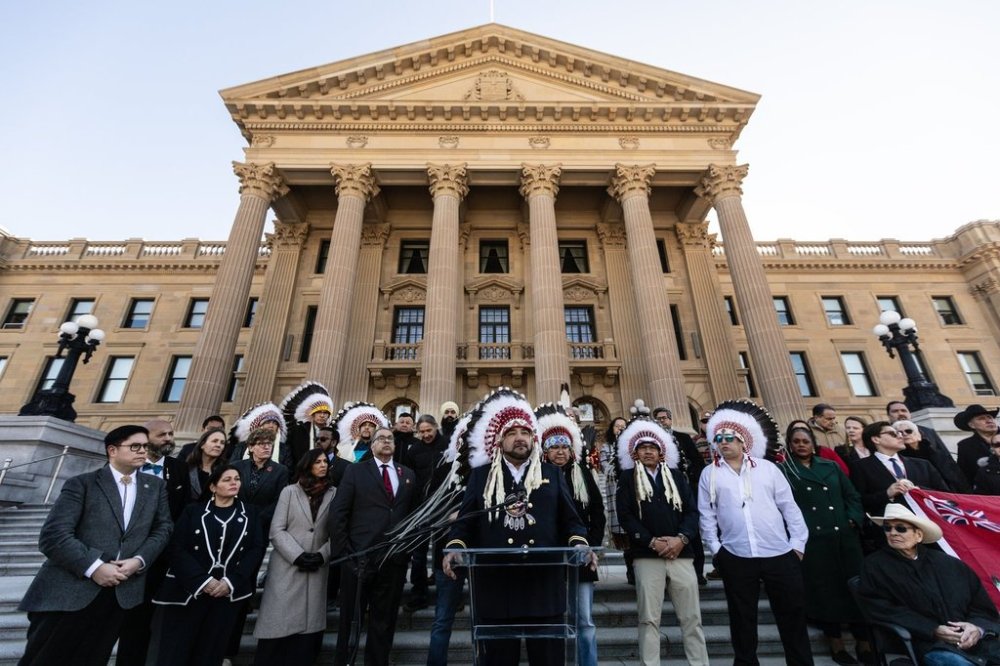
By early March, First Nations chiefs were trekking to the legislature demanding Smith stomp out talk about separatism.
They said it threatened their treaty rights. Some yelled at the government from the gallery, demanding the UCP denounce separatism.
This week, a judge sided with a group of First Nations in their legal challenge.
Justice Shaina Leonard threw out the separatist’s petition, ruling it never should have been issued and that Smith’s government neglected its duty to consult.
Smith has said the government will appeal the decision, calling it “anti-democratic,” but hasn’t ruled out putting the secession question to a vote this fall.
As separatists were busy organizing outside the legislature, debate in the house generated even more headlines about them.
Last month, a massive data breach involving the separatist group the Centurion Project and the personal information of almost three million Albertans sparked three investigations, including by the RCMP.
New Democrats said that weeks before it became public, they had reported the apparent breach to Mounties.
Smith’s United Conservatives, whose caucus staffers initially flagged nothing untoward about the since-shuttered voter database, in turn blamed the NDP for not reporting it to government.
Also this spring, the UCP sent the pro-federalist “Forever Canadian” petition, which gathered its requisite signatures in December, to a legislature committee.
There, UCP lawmakers have yet to decide whether the question, “Do you agree that Alberta should remain within Canada?” will be put on a ballot or to a vote in the legislature.
The former politician behind the petition, Thomas Lukaszuk, called it a cynical delay tactic.
All this, as the province marches toward a fall referendum on nine policy proposals. Those questions include limiting health care and education for newcomers to those with “Alberta-approved immigration status.”
That referendum is set for Oct. 19, before the legislature is set to convene again.
Since the end of February, Smith’s UCP passed 18 pieces of legislation, including a law to end biannual time changes.
The government also sent an electoral boundary commission report back to the drawing board with a new panel.
The government opened the door to allowing Albertans to pay out of pocket for private medical testing, including MRIs, CT scans and blood work without a doctor’s referral.
In an effort to keep children from accessing explicit sexual material, the UCP passed a law creating new ministerial authority over public libraries.
Education legislation also mandates teachers present all issues neutrally and allow the province to restrict which flags are displayed in schools.
Another law will dramatically restrict who’s eligible for medical assistance in dying to those likely to die of natural causes within a year.
Summarizing many of the notable measures the government has taken, NDP house leader Christina Gray called it a “tsunami of bad things.”
This report by The Canadian Press was first published May 14, 2026.