
Doctors alarmed over specialist’s pending resignation
Advertisement
Read this article for free:
or
Already have an account? Log in here »
We need your support!
Local journalism needs your support!
As we navigate through unprecedented times, our journalists are working harder than ever to bring you the latest local updates to keep you safe and informed.
Now, more than ever, we need your support.
Starting at $15.99 plus taxes every four weeks you can access your Brandon Sun online and full access to all content as it appears on our website.
Subscribe Nowor call circulation directly at (204) 727-0527.
Your pledge helps to ensure we provide the news that matters most to your community!
To continue reading, please subscribe:
Add Brandon Sun access to your Free Press subscription for only an additional
$1 for the first 4 weeks*
- Enjoy unlimited reading on brandonsun.com
- Read the Brandon Sun E-Edition, our digital replica newspaper
*Your next Free Press subscription payment will increase by $1.00 and you will be charged $20.95 plus GST for four weeks. After four weeks, your payment will increase to $24.95 plus GST every four weeks.
Read unlimited articles for free today:
or
Already have an account? Log in here »
WINNIPEG — A group of doctors and medical staff has warned the possible departure of a highly specialized Health Sciences Centre physician would be “devastating news” that could spark an exodus of skilled medical professionals from Manitoba.
The 14 doctors and medical staff at CancerCare Manitoba wrote a letter May 7 about the pending resignation of interventional radiologist Alessandra Cassano-Bailey.
The document, which was addressed to three members of the organization’s senior leadership, said Cassano-Bailey tendered her resignation after efforts to introduce a liver cancer procedure — which is available elsewhere in Canada — were ignored for years.
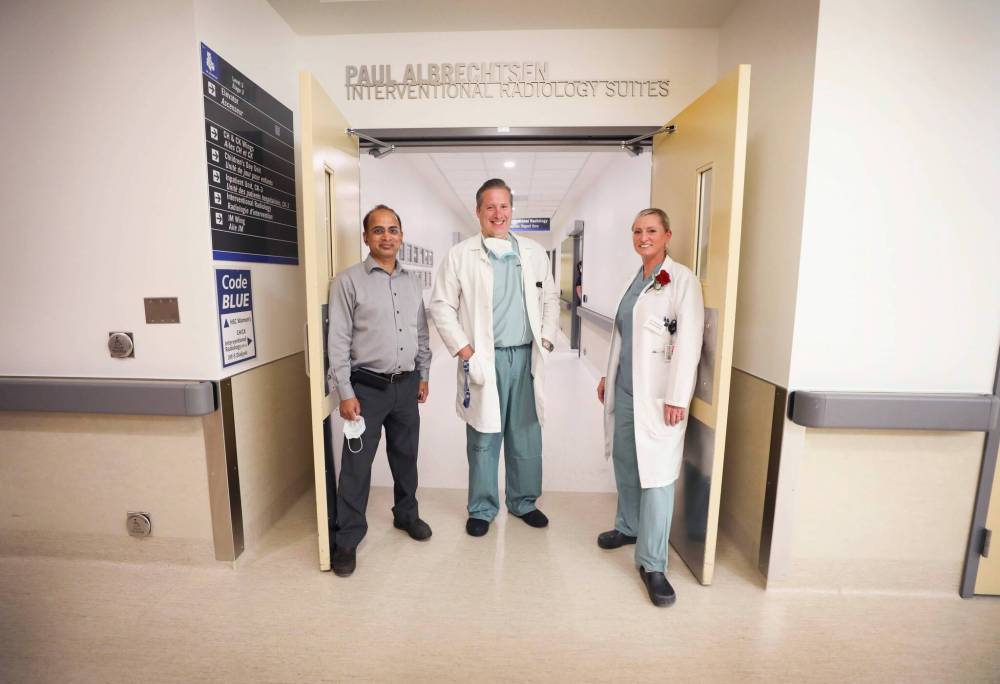
In this 2022 file photo, interventional radiologist Dr. Alessandra Cassano-Bailey (right) is shown with colleagues at the Health Sciences Centre in Winnipeg. Fellow physicians have expressed concern about Cassano-Bailey’s possible resignation. (Ruth Bonneville/Winnipeg Free Press files)
“It will be a huge loss to the province if such an excellent and compassionate doctor leaves,” reads the letter, obtained by the Winnipeg Free Press.
“Moreover, with continued disappointment and frustration among her colleagues, (Manitoba) will continue to bleed more competent staff.”
Maged Nashed, the chair of CancerCare Manitoba’s liver disease site group, wrote the letter on behalf of the multidisciplinary team, which develops treatment plans for patients with liver cancer.
Cassano-Bailey has “proven herself to be a competent, dedicated” and nationally recognized leader who had spearheaded efforts to introduce a liver cancer treatment linked to increased survival rates, Nashed wrote.
She had been fighting to introduce another procedure known as transarterial radioembolization (TARE), at the request of the disease site group, the letter says.
The procedure is applicable for specific forms of liver cancer. It is a minimally invasive treatment that uses targeted radiation to block the blood supply to a tumour, which helps to shrink or control its growth and reduce damage to healthy tissue.
“Sadly, after more than two years of meetings, requests, forms and communication, there is no evidence that TARE will ever be implemented. This is a disappointing outcome and Manitobans with hepatobiliary cancers will suffer from the lack of access,” Nashed wrote.
The provincial liver cancer disease site group sent letters to Health Minister Uzoma Asagwara and other CancerCare leaders in support of the initiative, to no avail, the letter says.
In an interview Friday, Asagwara acknowledged the province had received the letter in June 2025 and said a deputy minister, who is no longer in that role, had been assigned to review the request at that time.
Asagwara had not spoken with Cassano-Bailey, but intended to do so Friday night.
“Hearing that person has made the decision to move on from Manitoba is deeply concerning, and I want to understand first-hand what’s happened,” Asagwara said.
The group of physicians wants health officials and the department of diagnostic radiology at the University of Manitoba to “exert all efforts to keep Dr. Bailey for the sake of Manitobans with liver cancers as an asset to the province.”
Asagwara stressed the province is open to exploring all treatments to improve outcomes.
“I have concerns, I have questions that I expect answers to from Shared Health and from CancerCare — not only regarding the departure of this physician, but what is going to be done to ensure that we are retaining every expert … and supporting the people who bring forward innovative ideas,” the minister said.
In a statement, a spokesperson for Shared Health said it could not comment on the individual employment decisions or contracts.
The spokesperson acknowledged TARE is not available in Manitoba, but said the province’s chief medical officer and clinical leaders will continue to assess the needs of Manitobans.
Patients who might benefit from treatments not available in the province are assessed by clinical teams, and “appropriate arrangements are made to ensure access to medically necessary care,” the statement said.
Interventional radiologists such as Cassano-Bailey use medical imaging, including X-rays and MRIs, to perform minimally invasive procedures.
Doctors Manitoba said such highly skilled professionals offer procedures that are often the only treatment option available to a critically ill patient.
“What you are seeing in the letter from the cancer specialists is concern about losing a highly specialized colleague who has been instrumental in helping to treat liver cancer,” a spokesperson said in an email.
If Cassano-Bailey follows through with her resignation, Manitoba will have only five interventional radiologists. A province the size of Manitoba, which also treats patients in northwestern Ontario and Nunavut, likely needs nine or more, the spokesperson said.
Manitoba’s interventional radiologists often report a lack of equipment, staff and resources required to meet patient-care needs. That limits their ability to respond quickly to urgent cases or to offer advanced, modern treatments, the spokesperson said.
“These are all key retention issues for the specialists we have, but become recruitment challenges as specialists consider opportunities here or in other better-resourced provinces.”
Work continues on strengthening the capacity of interventional radiology in the health system, Shared Health said.
While Manitoba has made progress recruiting physicians overall, Doctors Manitoba remains concerned about shortages in specialty areas and small communities.
Physician retention is a critical issue because Manitoba typically loses more doctors to other provinces than it gains every year. Overall, Manitoba is ranked second worst in interprovincial physician migration within Canada, the spokesperson said.
Doctors Manitoba’s 2025 physician survey found 22 per cent of practising physicians were considering relocating or retiring within three years. They cited reasons such as systemic frustrations, excessive administrative burdens and burnout.
The Winnipeg Free Press requested comment from Cassano-Bailey and Nashed.
» Winnipeg Free Press