
NDP support holds steady at 55%: poll
Advertisement
Read this article for free:
or
Already have an account? Log in here »
We need your support!
Local journalism needs your support!
As we navigate through unprecedented times, our journalists are working harder than ever to bring you the latest local updates to keep you safe and informed.
Now, more than ever, we need your support.
Starting at $15.99 plus taxes every four weeks you can access your Brandon Sun online and full access to all content as it appears on our website.
Subscribe Nowor call circulation directly at (204) 727-0527.
Your pledge helps to ensure we provide the news that matters most to your community!
To continue reading, please subscribe:
Add Brandon Sun access to your Free Press subscription for only an additional
$1 for the first 4 weeks*
- Enjoy unlimited reading on brandonsun.com
- Read the Brandon Sun E-Edition, our digital replica newspaper
*Your next Free Press subscription payment will increase by $1.00 and you will be charged $20.95 plus GST for four weeks. After four weeks, your payment will increase to $24.95 plus GST every four weeks.
Read unlimited articles for free today:
or
Already have an account? Log in here »
WINNIPEG — Support for Premier Wab Kinew and the New Democratic Party remains steady, while Obby Khan and the Progressive Conservative official Opposition are heading into the summer on a bit of a backslide, new polling results show.
Probe Research’s latest omnibus poll for June shows overall support for the NDP remains steady at 55 per cent, while the Tories have slipped to 32 per cent support — starting the legislature’s summer break in a slightly weaker position than when the last session began in March.
The results reflect the ongoing honeymoon for the New Democrats, who took power in October 2023 with 45 per cent support and have surged in popularity over more than two years. The Tories, meanwhile, entered the election cycle with 42 per cent support and have lost ground every step of the way since.
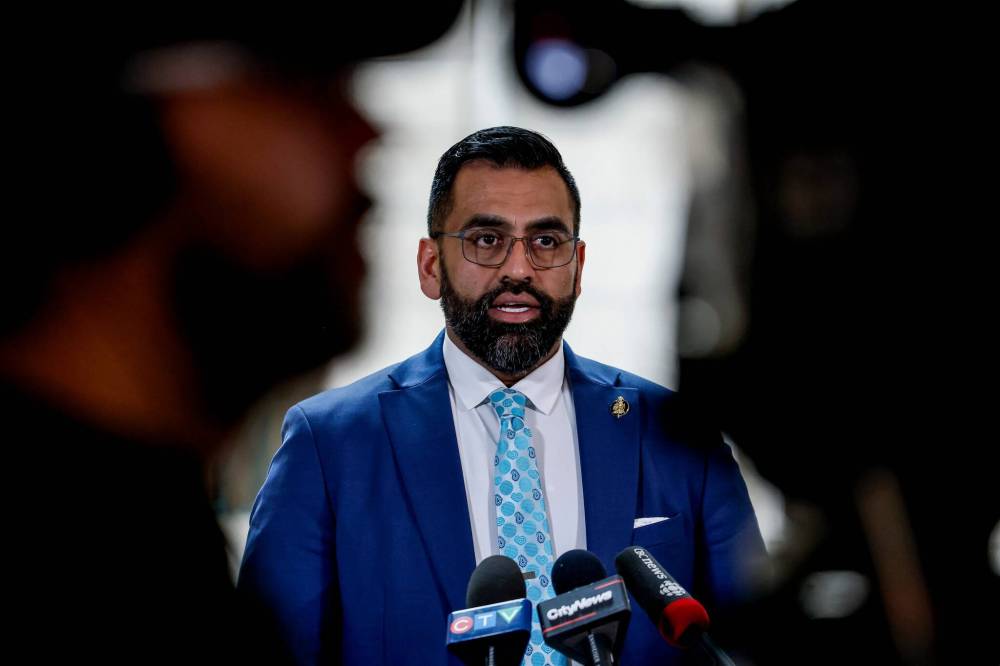
Progressive Conservative Leader Obby Khan, when asked about the poll results, pointed to his party’s push to raise the province’s basic personal tax exemption as an example of how he is listening to Manitobans. (John Woods/Winnipeg Free Press files)
“We keep watching these numbers, wondering when the (NDP) bubble might burst — because it has to burst at some point, that’s politics — but it just doesn’t seem to happen. They seem to be just riding this incredible wave of political capital,” Probe Research partner Mary Agnes Welch said Wednesday.
“The question is, when does the bloom come off the rose a little bit? And it just shows no signs of doing that. They are more popular now, by quite a lot, than when they were elected.”
The decline for the PCs is most pronounced in Winnipeg’s older suburban neighbourhoods, where support has fallen to 19 per cent — seven points lower than it was in March.
Only one-quarter of voters in Manitoba’s capital back the Tories, down from 29 per cent. Meanwhile, 63 per cent of respondents favour the NDP, up three per cent, and nine per cent prefer the Liberals, an increase of one per cent, during the same period.
Historically, Manitoba elections are won and lost in Winnipeg. If the PCs want to succeed, they must shore up support in the urban battleground, Welch said.
The Tories do not lead in a single polling bracket featured in the survey, including by region, race, age, income, education or gender.
Even outside of Winnipeg, where many voters traditionally lean right, the party has struggled to gain ground.
Support for the NDP dropped from 47 per cent to 42 per cent between March and June, but the PCs failed to capitalize on the loss. Instead, the party saw support shrink by one point, and is now tied with the NDP, at 42 per cent. The Liberals, meanwhile, enjoyed a three-point increase and now have seven per cent support outside of the capital, the poll results show.
“I think the Tories struggle to define themselves as a party and bridge that chasm between perhaps the more very right-leaning, populist members of their party, versus those more business-focused, socially liberal Tories in Winnipeg.”
Khan and Kinew spent much of the latest legislative session sparring over policy and procedure during the daily question period inside the legislature, where the premier has proven himself to be a master in the art of “political street fights,” Welch added.
“It’s (Kinew’s) ability to find every tiny moment, the merest hint of a misstep, that Obby or his caucus make and the ability to blow that up into a base-galvanizing incident,” she said.
“The NDP are really good at that. I don’t know whether that serves our political discourse very well in the long run, but it certainly serves the NDP fortunes for now.”
Looking at demographics, women and people aged 18 to 34 are more likely to favour the New Democrats, while support for the Tories is strongest among men and people aged 35 or older.
Based on the latest poll results, the Tories should not expect a victory in the next provincial election, which is not necessarily unusual in a province where it is common for incumbent governments to win consecutive terms, said Bryan Peeler, an assistant professor and associate head of the University of Manitoba’s department of political science.
While the NDP can take away the message that they should “keep doing what you’re doing,” the Tories should “be very worried,” Peeler said.
“I could see a fight over the (Progressive Conservative) leadership coming up again, and that is not going to be good for them,” he said. “In the second half of the cycle here, the government has consolidated its lead and the Tories have shown no trajectory at all.”
The next provincial general election must be held by Oct. 5, 2027.
Critical issues including health care, addictions and homelessness have not dramatically improved under NDP leadership, and yet the voting public seems largely undeterred in support for the party, Peeler said.
He urged the Tories to lean into their role as the Opposition party and do a better job of challenging the incumbents while presenting alternative solutions.
Asked about the poll results Tuesday, Khan said his job is to “ listen to Manitobans and what concerns them most about their province.”
“I turn those concerns into concrete solutions,” he said in an email statement, pointing to his party’s push to raise the province’s basic personal tax exemption as an example.
“That is a real affordability measure, and benefits everyone. I’m working hard to earn the trust of Manitobans, and I look forward to connecting with people across the province this summer.”
The NDP caucus did not respond to a request for comment.
The Probe Research poll surveyed a random group of Manitoba adults between May 25 and June 8. The results have a margin of error of plus or minus three per cent with 95 per cent certainty.
» Winnipeg Free Press