
Tighter spending, more revenue brings B.C. deficit down to $7.7B, minister says
Advertisement
Read this article for free:
or
Already have an account? Log in here »
We need your support!
Local journalism needs your support!
As we navigate through unprecedented times, our journalists are working harder than ever to bring you the latest local updates to keep you safe and informed.
Now, more than ever, we need your support.
Starting at $15.99 plus taxes every four weeks you can access your Brandon Sun online and full access to all content as it appears on our website.
Subscribe Nowor call circulation directly at (204) 727-0527.
Your pledge helps to ensure we provide the news that matters most to your community!
To continue reading, please subscribe:
Add Brandon Sun access to your Free Press subscription for only an additional
$1 for the first 4 weeks*
- Enjoy unlimited reading on brandonsun.com
- Read the Brandon Sun E-Edition, our digital replica newspaper
*Your next Free Press subscription payment will increase by $1.00 and you will be charged $20.95 plus GST for four weeks. After four weeks, your payment will increase to $24.95 plus GST every four weeks.
Read unlimited articles for free today:
or
Already have an account? Log in here »
VICTORIA – The British Columbia government says the final accounting for the budget year ending in March shows a deficit of $7.7 billion, more than three billion lower than forecast.
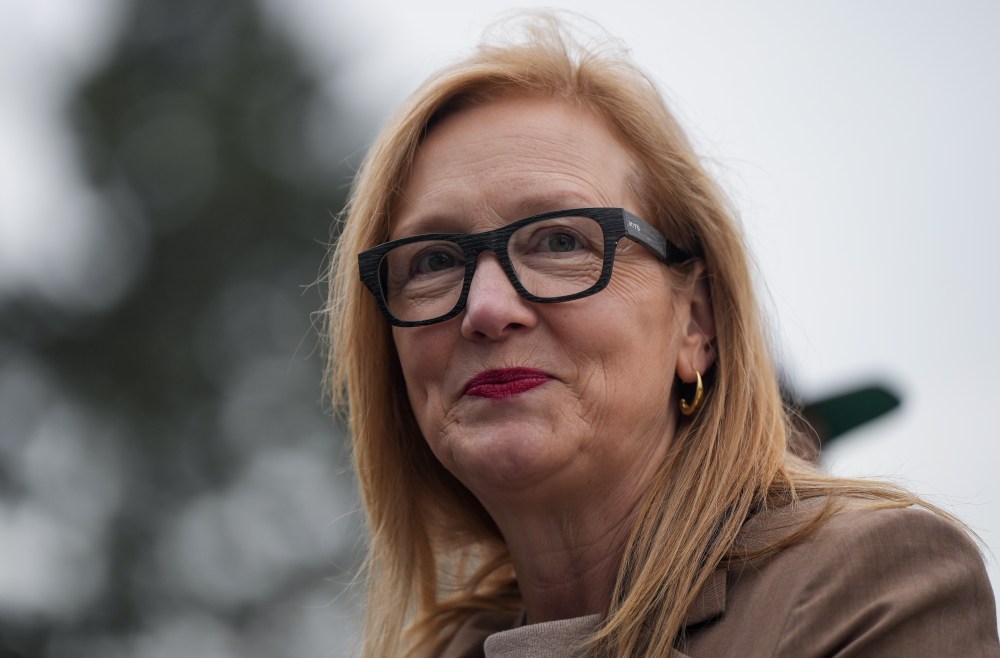
The latest fiscal update from Finance Minister Brenda Bailey on Monday says the deficit was $3.3 billion below the estimate for fiscal year 2025-2026 because of higher revenues and lower spending on capital projects.
The government forecasted a deficit $10.9 billion when it released the 2025-2026 budget, but it says spending on hospitals, schools and post-secondary facilities dropped by around $4 billion due to “project scheduling changes.”
The affected projects accounted for about 25 per cent of all taxpayer-supported projects in the last fiscal year.
Bailey described the changes as “slippage”, saying that it’s not about cancelling any projects.
“All of those projects are going ahead,” she says. “It was quite an aggressive capital allotment at $15 billion, and the slippage of $4 billion will in fact carry over into other years.”
A background statement from Bailey’s ministry says that spending on health care facilities was down more than $1.8 billion, while highways and public transit spending fell by $1.26 billion.
It also shows the government saved $466 million on education and post-secondary education, while it spent $463 million less than budgeted on social housing, core government and other Crown corporations.
Delays on the projects were from supply-chain challenges, she says.
The minister said earlier this year that government would be “re-pacing” several projects as part of a larger plan to trim back the deficit.
“These are not cancellations, this is recognition that the province needs to strategically resequence projects to address fiscal pressures,” she told reporters in March.
But slippage and re-pacing aren’t the same, Bailey says.
“Re-pacing is a deliberate pulling back of a project and looking at when we can deliver it and how to keep the costs down,” she says.
But Bailiey says slippage happens every year.
“The reality is that planning these major projects and measuring them exactly as how they will occur in one year is challenging,” she says. “All of that (is) far more challenging in the context of a global trade war and the supply chain challenges that we have seen.”
The update says revenues were $2.86 billion higher than previously budgeted, mainly due to the legal settlement with tobacco companies, which will pay $3.6 billion over 18 years.
Government received an initial payment of $936 million in August 2025 and is counting the entirety of the remaining amount $2.56 billion toward the 2025-2026 fiscal year.
She says B.C. ‘s economy grew by two per cent during the last fiscal year, and government continues to focus on developing new revenue streams.
“The focus on economic growth is imperative,” she says.
The provincial debt, however, is up about $700 million from the previous forecast to $154.7 billion.
Peter Milobar, the finance critical for the B.C. Conservatives, says the fiscal update attempts to distract the public about the true state of the provincial finances.
“You have seen the premier’s polls?” he says. “It’s very obvious that they are trying to present themselves as this sudden bastion of fiscal responsibility and awareness, despite presenting record deficits year after year, projecting further record deficits, not providing a proper plan on how to get out of the mess we are in, fiscally.”
This year’s budget is projecting a record-setting deficit of $13.3 billion for the current fiscal year, and the provincial government will present the figures for the first quarter next month.
“I’m fully expecting at the first quarter update in September that they can say that the re-pacing has now been slipping and more projects are on a delay, and that they can start combining both terminologies for cancellation.”
This report by The Canadian Press was first published Aug. 10, 2026.