
B.C.’s youngest wildfire evacuees begin processing the return home
Advertisement
Read this article for free:
or
Already have an account? Log in here »
We need your support!
Local journalism needs your support!
As we navigate through unprecedented times, our journalists are working harder than ever to bring you the latest local updates to keep you safe and informed.
Now, more than ever, we need your support.
Starting at $15.99 plus taxes every four weeks you can access your Brandon Sun online and full access to all content as it appears on our website.
Subscribe Nowor call circulation directly at (204) 727-0527.
Your pledge helps to ensure we provide the news that matters most to your community!
To continue reading, please subscribe:
Add Brandon Sun access to your Free Press subscription for only an additional
$1 for the first 4 weeks*
- Enjoy unlimited reading on brandonsun.com
- Read the Brandon Sun E-Edition, our digital replica newspaper
*Your next Free Press subscription payment will increase by $1.00 and you will be charged $20.95 plus GST for four weeks. After four weeks, your payment will increase to $24.95 plus GST every four weeks.
Read unlimited articles for free today:
or
Already have an account? Log in here »
The day she returned to her home in Summerland, B.C., more than a week after escaping from an out-of-control wildfire, Erin Trainer was cleaning when her four-year old daughter asked for orange paint.
Paint in hand, the next question from the girl was how to spell the word “no.”
Trainer said she spelled the word for her daughter and didn’t think much of it until she saw the art.
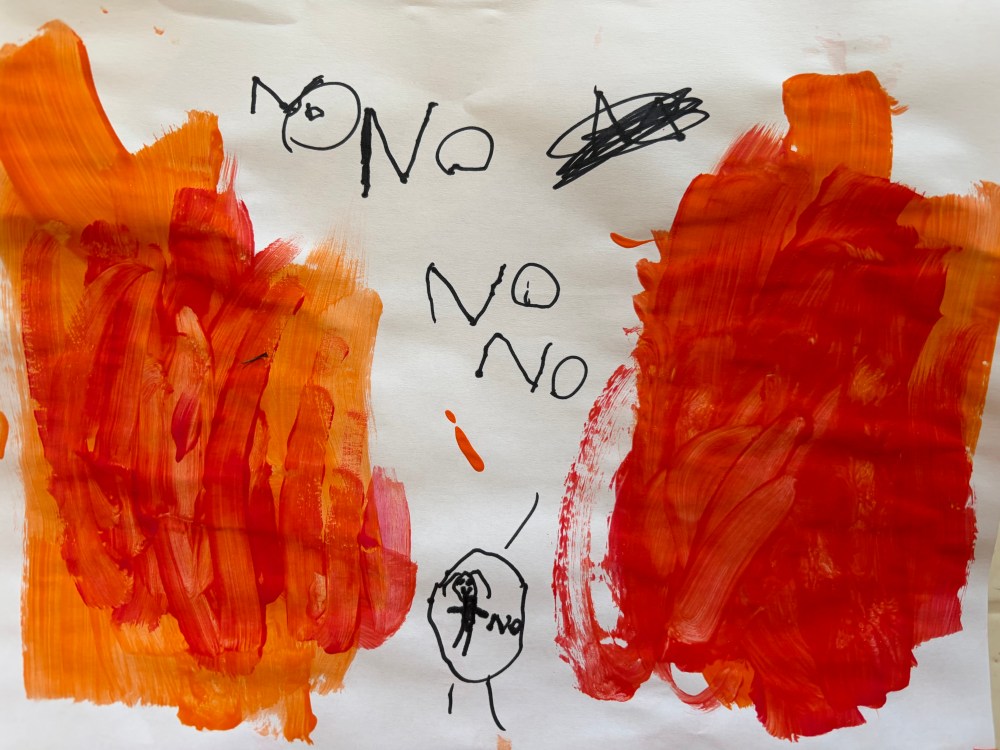
Willow had painted large swipes of orange surrounding a stick figure — which she said was either her or her dad — and the word “no” several times.
They put the painting on the fridge.
“I think it’s her way of saying she wants the fire to stop and that it was really scary for her,” she said of the way her daughter expressed her feelings.
“I was just really surprised. I’m doing this for the first time as a parent, right? So, I was just overwhelmed by it but also very proud of her.”
As the youngest of the more than 20,000 wildfire evacuees in the Summerland area return home, parents, schools and community members are coming up with ways to help them process what they have experienced, including a middle-of-the-night evacuation as the Bald Range fire exploded in size.
Negar Khodarahmi, an instructor in the early childhood education program at the University of British Columbia, said children learn and process things through play and drawing and so a reaction like Willow’s painting isn’t alarming.
She said children in the Summerland area are likely to feel the wildfire’s impact on their sense of safety even after they return home.
“Their home and their community, including their school and just their physical surroundings, are their safe place,” she said.
“They’re where they should be feeling the most secure and the most regulated and so losing that can be quite difficult for some children.”
She said parents could see changes in their children’s behaviour, such as an increase in anxiety or younger children regressing to bedwetting and tantrums, as they process what they experienced.
The Bald Range fire destroyed about 150 homes in the Regional District of Okanagan-Similkameen and in Summerland and triggered an evacuation that was lifted for most residents of Summerland this week.
Khodarahmi said it’s important parents are honest with their children about what they’ve experienced, while highlighting positives like hope, gratitude and preparedness for future emergencies.
“It may be every adult’s instinct to protect children as much as possible. But again, children do know quite well what’s going on and that uncertainty can only increase their anxiety and fear. So, it’s always good to address the questions openly and honestly,” she said.
Trainer, who is also the community’s deputy mayor, fled the fire around 2 a.m. with her three children and husband, who does communications for the regional district.
She said the family had been talking about the fire and that the kids knew there was a plan if they had to evacuate.
“We really explained the entire time exactly what was happening. I didn’t try to sugar-coat anything. I was just like, we need to leave because a fire could come to our house. And I said, I need you guys to be strong and I need you to listen and I need you to look after the pets. I gave them a job too, which I think really helped,” she said.
The family, dogs, cats and hamster made it out.
Trainer said a “comfort centre” set up for evacuees who fled to Penticton had games, arts and toys for children.
“We took our children there many times and it was very comforting for me. The volunteers were amazing so that really helped kids process things because every child handles this differently,” she said.
Khodarahmi said kids are helped by maintaining routine wherever possible.
Todd Manuel, superintendent of the region’s school district, said getting back to school can be part of that routine.
He said the secondary school and two elementary schools in Summerland, where about 1,300 students attend, survived the fire.
School officials are talking about ways to help students’ mental health when they return to class on Sept. 8 and they’ll be reaching out to families about their needs, Manuel said.
That could mean bringing in more counselling help or other types of supports.
“Are there opportunities for more gym time or after-hours supports that we can partner with community on to keep kids active, keep them connected?” he said.
Trainer said Summerland has cleared ash from playgrounds, parks and beaches so children will have something they recognize, and a recovery centre has been set up to offer support.
She took her three children around their community to see some of the damage as well as homes that were saved by fire crews.
“I wanted them to see the facts. Some things burned, but so many things were saved and we’re so lucky. And we need to be there to support the people who did lose their homes.”
Trainer said everyone will have experienced the emergency differently but she’s hopeful that children and youth will be able to eventually take what happened to them and turn it into a learning experience.
“That’s my message to the kids is: this is traumatic, but it will pass. And I say to my kids, when this happens in another community we’ll be able to go and help people because we lived through it.”
This report by The Canadian Press was first published Aug. 20, 2026.