
Carney says U.S. wants to wipe out Canadian industries or make them subsidiaries
Advertisement
Read this article for free:
or
Already have an account? Log in here »
We need your support!
Local journalism needs your support!
As we navigate through unprecedented times, our journalists are working harder than ever to bring you the latest local updates to keep you safe and informed.
Now, more than ever, we need your support.
Starting at $15.99 plus taxes every four weeks you can access your Brandon Sun online and full access to all content as it appears on our website.
Subscribe Nowor call circulation directly at (204) 727-0527.
Your pledge helps to ensure we provide the news that matters most to your community!
To continue reading, please subscribe:
Add Brandon Sun access to your Free Press subscription for only an additional
$1 for the first 4 weeks*
- Enjoy unlimited reading on brandonsun.com
- Read the Brandon Sun E-Edition, our digital replica newspaper
*Your next Free Press subscription payment will increase by $1.00 and you will be charged $20.95 plus GST for four weeks. After four weeks, your payment will increase to $24.95 plus GST every four weeks.
Read unlimited articles for free today:
or
Already have an account? Log in here »
OTTAWA – U.S. negotiators were pushing in trade talks last month for concessions from Canada that would have made key sectors like the automotive industry subsidiaries of their American counterparts or be “wiped out,” entirely, Prime Minister Mark Carney said Tuesday.
Canada and the U.S. were negotiating hard on a deal to address trade irritants on both sides of the border. Just ahead of a U.S.-imposed deadline of Aug. 22, Carney suspended those talks and summoned his team home
“The attitude of the United States in these discussions, and subsequently, has been one that core Canadian industries either would be subsidiaries effectively of the United States industries, or would put in place terms where those industries would be gradually wound down in Canada and wiped out,” Carney said in a scrum with reporters outside his office building.
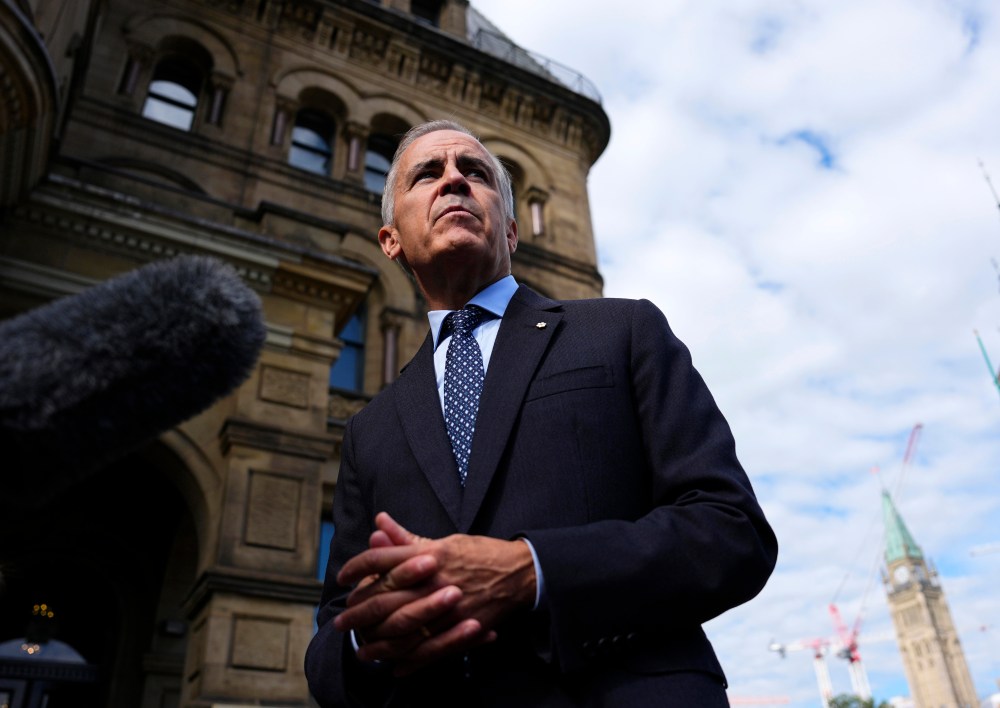
“Of course, we’re not going to accept those terms.”
Carney added there were “mutually beneficial” elements of a deal in place before the talks broke down last month.
The prime minister said there was an “accumulation of issues, each of them serious enough” that prevented Canada from signing a deal, including effects on French language and culture and restrictions on Canada’s ability to trade freely with other nations.
Carney said Canada is willing to get back to the table when the Americans are ready to have a serious discussion.
“When the Americans stop doing memes, stop throwing shade, stop trying to be tough and start being serious about having those discussions, we can have those discussions,” he said.
“It’s not constructive but that’s their democracy.”
Since the negotiations fell apart, U.S. President Donald Trump and members of his cabinet have taken to news shows and social media to repeatedly attack Canada. Trump signed an executive order to rename Lake Ontario as Lake America on U.S. maps, and the president and his cabinet secretaries posted AI images and memes disparaging Canada.
Carney is expected to discuss developments with labour groups in Ottawa on Tuesday. A source with knowledge of the meeting, who wasn’t authorized to speak publicly, told The Canadian Press it is scheduled for 2 p.m. eastern time.
The source said officials from unions representing affected industries, largely from the manufacturing sectors, were invited to the meeting.
Unifor, Canada’s largest private sector union, held a rally on Parliament Hill in late August to urge the government to protect Canadian jobs amid the ongoing trade war with the United States.
On Monday, Carney spoke about the friction with the U.S. with a group of business leaders from companies such as RBC, Bombardier, OpenText and Hydro-Québec.
Canada’s counter-tariffs on nearly $28 billion worth of U.S. products are scheduled to begin on Sept. 8. The Canadian tariffs will range from 15 to 50 per cent and target a wide range of goods, including dairy products, steel, copper and some beauty products.
The tariffs are in response to the 50 per cent duty Trump placed on $28 billion in Canadian goods, ranging from hockey sticks to honey.
The U.S. levies were in part a response to the decision by all Canadian provinces, apart from Alberta and Saskatchewan, to refuse to stock U.S. products on liquor store shelves due to American tariffs on steel, aluminum and autos.
Trump has threatened to increase Canadian automotive tariffs to 50 per cent from 25 per cent in the new year in response to Canada’s latest retaliatory tariffs.
This report by The Canadian Press was first published Sept. 1, 2026.
— With files from Catherine Morrison