
Parti Québécois heads a crowded election field into provincial election vote
Advertisement
Read this article for free:
or
Already have an account? Log in here »
We need your support!
Local journalism needs your support!
As we navigate through unprecedented times, our journalists are working harder than ever to bring you the latest local updates to keep you safe and informed.
Now, more than ever, we need your support.
Starting at $15.99 plus taxes every four weeks you can access your Brandon Sun online and full access to all content as it appears on our website.
Subscribe Nowor call circulation directly at (204) 727-0527.
Your pledge helps to ensure we provide the news that matters most to your community!
To continue reading, please subscribe:
Add Brandon Sun access to your Free Press subscription for only an additional
$1 for the first 4 weeks*
- Enjoy unlimited reading on brandonsun.com
- Read the Brandon Sun E-Edition, our digital replica newspaper
*Your next Free Press subscription payment will increase by $1.00 and you will be charged $20.95 plus GST for four weeks. After four weeks, your payment will increase to $24.95 plus GST every four weeks.
Read unlimited articles for free today:
or
Already have an account? Log in here »
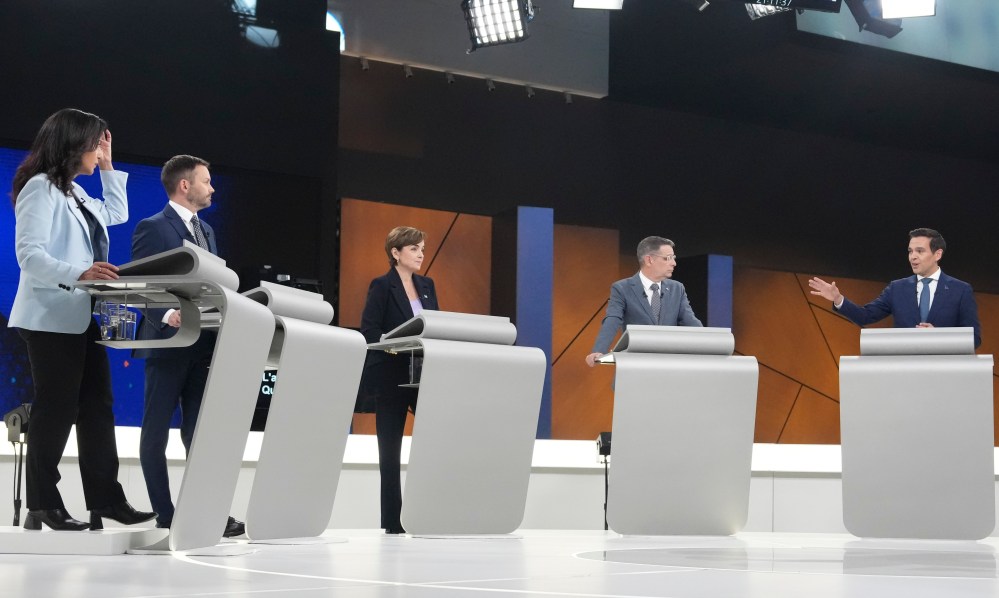
MONTREAL – Quebec’s campaign trail has been more crowded than ever in 2026, with five parties potentially in a position to have members elected to the legislature for the first time in 50 years.
But it’s Parti Québécois Leader Paul St-Pierre Plamondon who has appeared to pull away from the pack, at the tail end of a campaign that has been dominated by questions of economic uncertainty, cost of living and the looming prospect of a third sovereignty referendum.
While St-Pierre Plamondon has said he isn’t taking the result for granted, his talk has turned in recent days towards asking voters to help his party reach a majority, and looking beyond the Oct. 5 vote.
“In my mind, it is very clear that once the election is over, if people give you the mandate to be premier, you have a moral obligation to be the premier for absolutely everyone,” he said Friday in Quebec City.
A victory on Monday would represent a stunning comeback for a party that won only three seats in 2022, the lowest total ever since the party was founded in 1968.
André Lamoureux, a political science professor at the Université du Québec à Montreal, says the latest PQ momentum has come at the expense of the Coalition Avenir Québec, which has dropped in the polls in recent days.
He attributes the shift in part to a mistake by Leader Christine Fréchette, who suggested that Americans were trying to help sovereigntists take control of the province — a claim she was nearly immediately forced to walk back.
But while the Parti Québécois might be the biggest beneficiary of the CAQ drop, he stresses that there are still multiple players in the race.
“It still comes down to five parties, even though there have been significant changes over the last five or six days,” he said.
St-Pierre Plamondon has promised to hold a referendum in the next four years if his party forms government, despite polls showing most Quebecers don’t favour separation.
But Lamoureux says the PQ has become a “party of refuge” for nationalist and French-speaking Quebecers who want change from CAQ.
Lamoureux says another beneficiary of the waning support for the governing Coalition Avenir Québec could be Éric Duhaime’s Conservatives, who have focused their campaign around the Quebec City area.
Throughout the campaign, Duhaime has relentlessly hammered his rivals for being too bureaucratic and wasteful, while promising to address Quebecers’ cost of living through large tax cuts and slashing the cost of government.
The former right-wing radio host has been asking electors to give him the balance of power, which he has promised to use to block St-Pierre Plamondon’s planned sovereignty referendum.
On Friday, Duhaime and his candidate Maïté Blanchette-Vézina posed in front of a couple of buses branded with the “Yes” and “No” signs used in the 1995 referendum, symbolically slamming the garage door shut.
“We’re going to make sure that the ‘Yes’ bus and the ‘No’ bus remain nothing more than a fantasy of Charles Millard and Paul St-Pierre Plamondon, and that they certainly don’t become a nightmare for Quebecers over the next four years,” he said, attacking both the PQ and Liberal leaders.
Liberal Leader Milliard, meanwhile, has portrayed himself as the only federalist leader in the race, and the one who is best positioned to oversee an economic resurgence.
On Friday, Milliard suggested the Coalition Avenir Québec was “game over,” and suggested the vote was a race between his party and PQ. He suggested the CAQ had been an “empty chair” and that St-Pierre Plamondon “wants to take the chair away” from discussions with other provinces and Ottawa, as the PQ makes a bid for sovereignty.
However, Lamoureux says Milliard has struggled to increase his support among francophones, making it difficult to expand his base. Left-wing Québec solidaire, which has proposed ideas such as a wealth tax and public grocery stores, has also failed to make an impact outside their base in urban Montreal.
Fréchette entered the race as outgoing premier and what looked like an upswing in momentum. She has worked to present her team as the best-positioned to defend Quebec businesses amid an ongoing trade war, and has stated that U.S. President Donald Trump is her main adversary.
But Fréchette, who took over the party following François Legault’s resignation earlier this year, has also faced attacks from rivals who have accused her government of having wasted Quebecers’ money and failing to deliver on its promises during eight years in government.
Whoever wins will almost certainly preside over a very different legislature than the one that was elected four years ago, when the Coalition Avenir Québec captured 90 of 125 seats.
A minority scenario would force the winner to make partnerships and seek out cooperation, Lamoureux notes, meaning that any of the parties that are represented will still have their chance to make a mark.
This report by The Canadian Press was first published Oct. 4, 2026