
Kinew won’t budge on denialism stance
Advertisement
Read this article for free:
or
Already have an account? Log in here »
We need your support!
Local journalism needs your support!
As we navigate through unprecedented times, our journalists are working harder than ever to bring you the latest local updates to keep you safe and informed.
Now, more than ever, we need your support.
Starting at $15.99 plus taxes every four weeks you can access your Brandon Sun online and full access to all content as it appears on our website.
Subscribe Nowor call circulation directly at (204) 727-0527.
Your pledge helps to ensure we provide the news that matters most to your community!
To continue reading, please subscribe:
Add Brandon Sun access to your Free Press subscription for only an additional
$1 for the first 4 weeks*
- Enjoy unlimited reading on brandonsun.com
- Read the Brandon Sun E-Edition, our digital replica newspaper
*Your next Free Press subscription payment will increase by $1.00 and you will be charged $20.95 plus GST for four weeks. After four weeks, your payment will increase to $24.95 plus GST every four weeks.
Read unlimited articles for free today:
or
Already have an account? Log in here »
WINNIPEG — Premier Wab Kinew stood by his opposition to the proposed criminalization of residential school denialism Wednesday, after some First Nations leaders criticized his earlier comments and asked him to reconsider.
Kinew said he doesn’t think Canada should make residential school denialism a crime, nor does he think it’s feasible to do so, and he’d prefer to see it combated with education.
“When somebody has a question or wants to make a statement from a place of ignorance, the response isn’t to try to criminalize,” he told reporters.
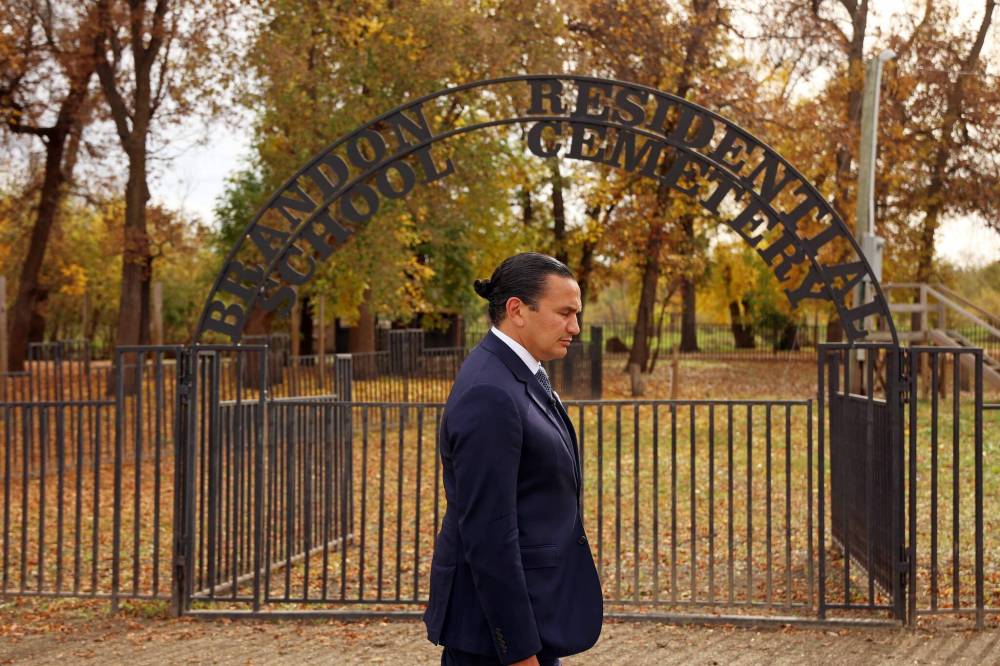
Manitoba Premier Wab Kinew walks near the entrance of the Brandon Residential School Cemetery at the former Turtle Crossing Campground along Grand Valley Road last month after the province announced that it had purchased the former campground in partnership with the City of Brandon.
(Tim Smith/The Brandon Sun files)
“The response should be to try to heal whatever is going on with them that would cause them to say something hurtful, to try and educate whatever they lack in terms of knowledge about the true history of our country, and ultimately to find a way for us to all live together.”
Some organizations objected to comments Kinew made to CBC Manitoba on Friday when he was asked about Winnipeg NDP MP Leah Gazan’s proposed bill to criminalize residential school denialism.
“I have a lot of respect for MP Gazan, but I don’t think we can criminalize this,” he said in the radio interview. “I think we have to just do the continued work of educating people and trying to combat misinformation.”
Gazan reintroduced a private member’s bill in October 2025 that seeks a Criminal Code offence of “wilfully promoting hatred against Indigenous Peoples by condoning, denying, downplaying or justifying the Indian residential school system in Canada through statements communicated other than in private conversation.”
Bill C-254, which is before the House of Commons, mirrors Criminal Code language that makes Holocaust denialism a crime.
Kinew’s radio comments were criticized by the Assembly of Manitoba Chiefs, Manitoba Keewatinowi Okimakanak, which represents northern First Nations, and the Southern Chiefs’ Organization this week.
Assembly Grand Chief Kyra Wilson said a serious national conversation is needed about how the law should respond to residential school denialism.
“Education matters, but it cannot be the only response to the deliberate denial of what happened to our children in residential schools,” she said in a news release.
MKO Grand Chief Garrison Settee said he was disappointed and expected more from Kinew, a separate news release said.
“As an Indigenous leader occupying the most powerful political office in Manitoba, he has an opportunity to lead this country, not simply follow the status quo,” he said in the release.
SCO Grand Chief Jerry Daniels said there is a need for both education and accountability to address harm caused by denialism.
“We believe governments have a responsibility to uphold the truth, protect the dignity of survivors and consider meaningful accountability measures that prevent the continued spread of harmful misinformation,” he said in a news release.
Kinew said anti-Indigenous and other forms of racism become a crime when someone goes beyond “what we might call the normal bounds of free speech” and incites hatred and violence toward specific people.
“If you go beyond that, my concern is you are going to undermine the potential for reconciliation, for expanding understanding, and you might be writing off people who could eventually become great allies,” he said.
His late father, Tobasonakwut Kinew, was a residential school survivor who was part of a delegation that had a private audience with Pope Benedict XVI at the Vatican in 2009, when the pontiff expressed sorrow for abuses.
Kinew said survivors of the “attempted cultural genocide” have presented a positive vision for the future, “and sketched out how we all might live together,” while their moral rectitude forced churches, governments and Canada to change.
The federal government estimated more than 150,000 First Nations, Inuit and Métis children were in residential schools between the 1830s and 1990s.
The Winnipeg-based Truth and Reconciliation Commission concluded in 2015 the schools were a systematic, government-sponsored attempt to destroy Indigenous cultures and languages, and to assimilate them so they “no longer existed as distinct peoples” as part of a policy of cultural genocide.
The commission has said it has documented more than 4,000 children who died, but the complete number of deaths will likely never be known because many documents were destroyed.
In July, chiefs from across Canada unanimously passed an emergency resolution at an Assembly of First Nations meeting to call on Ottawa to criminalize residential school denialism as hate speech.
The resolution was introduced by David Monias, chief of Pimicikamak Cree Nation in Manitoba, and seconded by Settee.
Some senators unsuccessfully tried to amend Canada’s new hate crime law in June to include residential school denialism.
» Winnipeg Free Press