
Air force pays tribute to retiring Hercules planes
Advertisement
Read this article for free:
or
Already have an account? Log in here »
We need your support!
Local journalism needs your support!
As we navigate through unprecedented times, our journalists are working harder than ever to bring you the latest local updates to keep you safe and informed.
Now, more than ever, we need your support.
Starting at $15.99 plus taxes every four weeks you can access your Brandon Sun online and full access to all content as it appears on our website.
Subscribe Nowor call circulation directly at (204) 727-0527.
Your pledge helps to ensure we provide the news that matters most to your community!
To continue reading, please subscribe:
Add Brandon Sun access to your Free Press subscription for only an additional
$1 for the first 4 weeks*
- Enjoy unlimited reading on brandonsun.com
- Read the Brandon Sun E-Edition, our digital replica newspaper
*Your next Free Press subscription payment will increase by $1.00 and you will be charged $20.95 plus GST for four weeks. After four weeks, your payment will increase to $24.95 plus GST every four weeks.
Read unlimited articles for free today:
or
Already have an account? Log in here »
WINNIPEG — Royal Canadian Air Force personnel in Winnipeg bid farewell Saturday to the military branch’s last remaining CC-130H Hercules planes — “workhorses” that crews flew in seemingly countless combat, rescue and transport operations.
The federal government is phasing out Canada’s fleet of CC-130H Hercules aircraft, which entered service in 1974, in favour of modern planes, including the CC-295 Kingfisher, which will be used for search-and-rescue operations out of 17 Wing Winnipeg as of November.
“It’s really part of our family and one of us. This was the backbone of a lot of things that we do here out of Winnipeg,” Col. Curtis Wright, commander of 17 Wing Winnipeg, said of the “mighty Herc” after a retirement ceremony and a flypast.
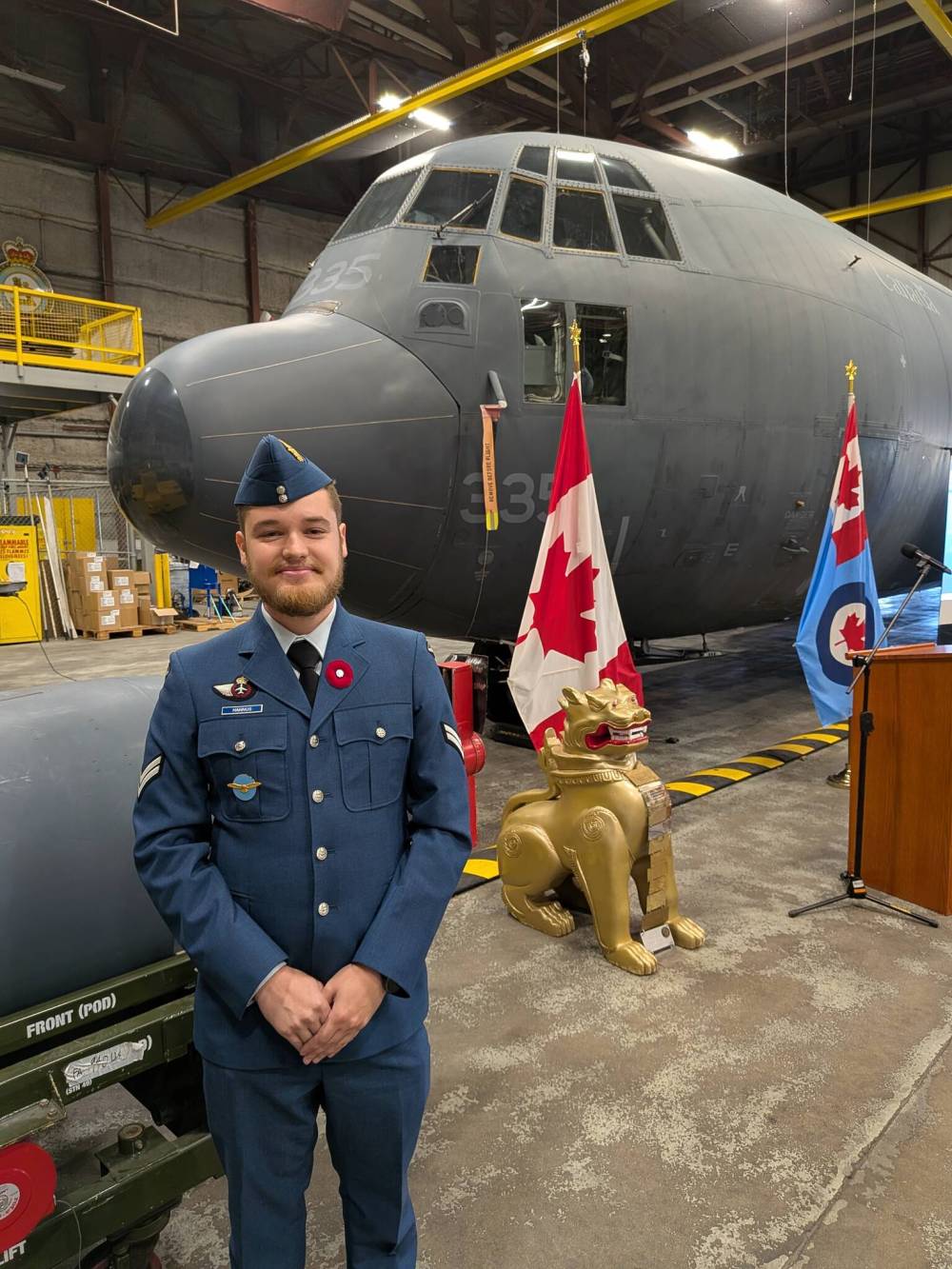
Cpl. Andrew Hannus, an aviation systems technician, helps to keep CC-130H Hercules and CC-295 Kingfisher planes running.
The 435 Transport Search and Rescue Squadron, based at 17 Wing Winnipeg, is the final RCAF unit to fly the CC-130H Hercules. Two Winnipeg-based planes are still being flown. They will be taken out of service Nov. 1 and Nov. 18, Wright said.
A fleet of 12 is being retired this year. Ten planes are being sold to Coulson Aviation Ltd., in B.C. to be converted and used to fight wildfires. Ottawa did not disclose the sale price.
Two aircraft will be put on public display at bases or museums. One could possibly be displayed in Winnipeg, Wright said.
Backdropped by a CC-130H Hercules, the ceremony’s speakers recounted memories of times on board the planes, while extolling the versatility and reliability of the fleet, and how it helped to shape the history of the RCAF during operations from the Arctic to Afghanistan.
They paid tribute to crews current and past, including several members who died in crashes and to Canadian Armed Forces personnel whose remains were returned to Canada on board the aircraft after dying in action.
In his address, Maj.-Gen. Chris McKenna, commander of 1 Canadian Air Division, acknowledged the 11 search and rescue technicians from Winnipeg who rapidly responded to a hospital in Wainwright, Alta. — parachuting from a CC-130H Hercules — after a fire at a nearby base killed four soldiers and injured dozens of others Oct. 17.
“On the Army’s worst day, you were at your best,” McKenna said to the technicians, who are elite primary-care paramedics, before they were applauded by the audience of about 200 people.
“The emails that I received this week from Army were singing your praises, so we’re really, really proud of you.”
In 2025, CC-130H Hercules planes were used to airlift thousands of evacuees out of northern Manitoba communities that were threatened by wildfires. The evacuations were part of Operation Lentus.
McKenna said one of the planes was unable to land on a runway that was surrounded by flames and shrouded by smoke at Norway House’s airport.
“The missed approach routing, unfortunately, took the crew through what is known as a pyrocumulus cloud, which is exactly what it sounds like: thick clouds made of fire and smoke and ash and extreme turbulence,” he said.
The crew fought turbulence to the “very limits” of the aircraft to get out safely, McKenna said. The plane was badly damaged and did not return to service afterward.
“I share this story as, once again, this tremendous aircraft did the job we needed it to under the most extreme conditions. It kept the crew and (its) occupants safe, and it brought them home to their families,” McKenna said.
“Without the incredible capabilities this aircraft brought to bear, I have serious doubts we would have been as successful as we were in Op Lentus, and I seriously doubt that crew would have come home.”
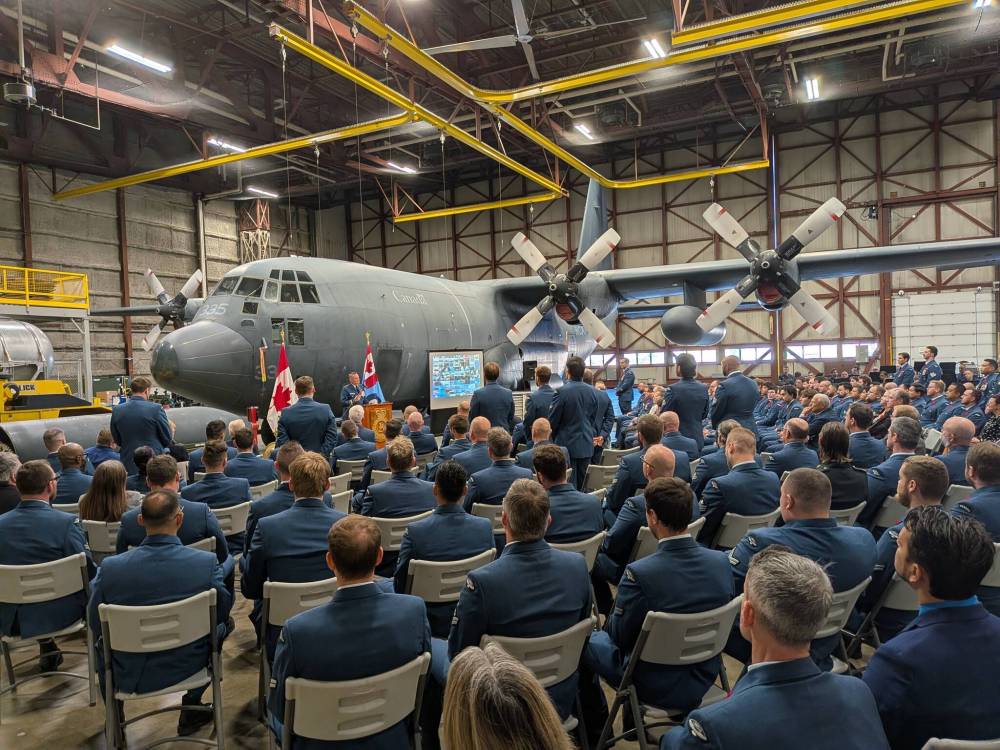
LEFT: Maj.-Gen. Chris McKenna, commander of 1 Canadian Air Division, acknowledges search and rescue technicians (standing) from Winnipeg who responded to Wainwright, Alta., after four soldiers were killed and dozens injured in a fire Oct. 17 at the Canadian Forces Base. RIGHT: Cpl. Andrew Hannus, an aviation systems technician, helps to keep CC-130H Hercules and CC-295 Kingfisher planes running. (Photos by Chris Kitching/Winnipeg Free Press)
The fleet supported Canadian military operations, including its role in the war in Afghanistan after the Sept. 11, 2001, terrorist attacks.
“This aircraft took me into Afghanistan. It took friends of mine out who didn’t make it,” McKenna said. “This aircraft took out our injured. It matters to a lot of us.”
In 2011, members of 435 Squadron were responsible for air-to-air refuelling of NATO-led coalition fighters in Libya.
The planes were used when Canada responded with personnel and supplies during humanitarian crises and natural disasters around the world, including a devastating earthquake in Haiti in 2010.
Domestically, the RCAF used the Winnipeg-based aircraft for many search-and-rescue missions — from lost hunters to missing civilian planes — across central Canada for decades.
“It’s truly a significant, emotional event,” Wright said of the retirement. “People have been flying on this aircraft for their entire careers.”
The ceremony paid tribute to the RCAF’s Winnipeg-based flight engineers and load masters, who Wright said will move to other bases and fleets in Canada because the newer CC-295 Kingfishers, which are smaller aircraft, will not be used for transport.
The retirement of the CC-130H Hercules is bittersweet for Cpl. Andrew Hannus, an aviation systems technician whose work includes maintaining and fixing engines.
“I love doing a lot of things on this plane. I love doing maintenance, I love doing servicing,” said Hannus, who will remain in Winnipeg to work on CC-295 Kingfisher aircraft. “Standing there in front of the (Hercules) as it takes off or as it’s landing, it’s always a little rush of adrenaline.”
» Winnipeg Free Press