
Chiefs question motive behind Indian Act talks after meeting with Carney, premiers
Advertisement
Read this article for free:
or
Already have an account? Log in here »
We need your support!
Local journalism needs your support!
As we navigate through unprecedented times, our journalists are working harder than ever to bring you the latest local updates to keep you safe and informed.
Now, more than ever, we need your support.
Starting at $15.99 plus taxes every four weeks you can access your Brandon Sun online and full access to all content as it appears on our website.
Subscribe Nowor call circulation directly at (204) 727-0527.
Your pledge helps to ensure we provide the news that matters most to your community!
To continue reading, please subscribe:
Add Brandon Sun access to your Free Press subscription for only an additional
$1 for the first 4 weeks*
- Enjoy unlimited reading on brandonsun.com
- Read the Brandon Sun E-Edition, our digital replica newspaper
*Your next Free Press subscription payment will increase by $1.00 and you will be charged $20.95 plus GST for four weeks. After four weeks, your payment will increase to $24.95 plus GST every four weeks.
Read unlimited articles for free today:
or
Already have an account? Log in here »
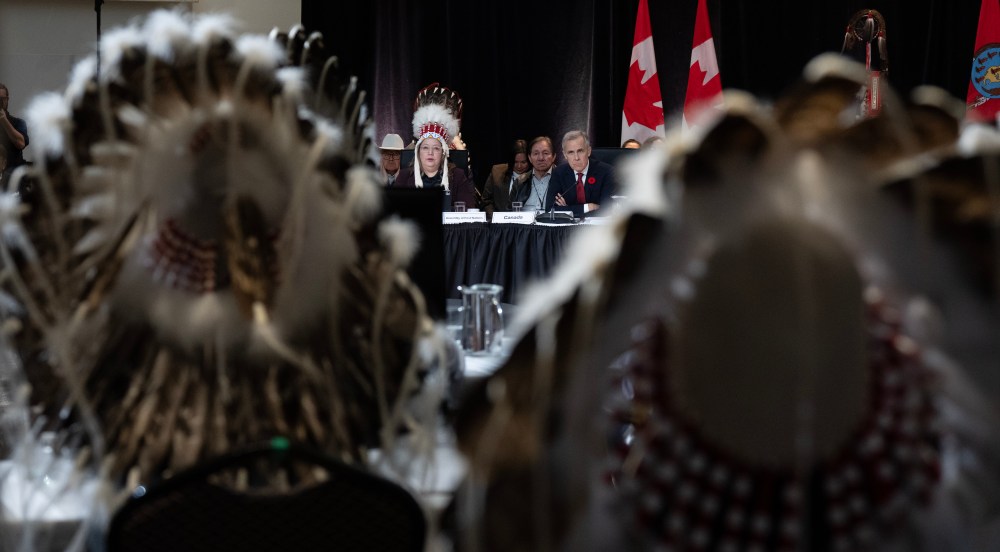
OTTAWA – First Nations chiefs who attended a closed-door meeting with Prime Minister Mark Carney and premiers last month say their concerns were overshadowed by Manitoba Premier Wab Kinew’s call for the abolition of the Indian Act.
One chief also criticized Carney’s tone as he responded to a comment about how the United States works with Indigenous people.
“We have to ask ourselves if this was a co-ordinated effort between Wab Kinew and the prime minister,” Treaty 8 First Nations Grand Chief Mercredi said of the talk about abolishing the Indian Act.
Chief Sheila North of Bunibonibee Cree Nation in northern Manitoba said it’s beginning to appear that way to her.
“I hope that wasn’t the case because that would mean they were disingenuous in what they wanted the outcomes [of the meeting] to be,” North said. “It was a complete waste of time if that’s the only outcome that they were hoping for.”
Chiefs gathered with Carney and most premiers in Ottawa in late October for their first meeting since the 2005 Kelowna Accord talks. First Nations leaders prepared for the meeting for months and even enlisted the help of former Indigenous Services deputy minister Gina Wilson to tailor their messages to government.
Chiefs said they wanted to use the gathering to discuss the federal government’s controversial major projects legislation, health services, policing and public safety and the Natural Resources Transfer Acts.
Those resource agreements were negotiated with the Prairie Provinces at a time when First Nations were barred by the Indian Act from hiring their own lawyers. Chiefs have said those agreements should be abolished or changed to ensure resource development projects meaningfully benefit their communities.
But the main topic to come out of the closed-door meeting was Kinew’s sudden call to abolish the Indian Act — something he acknowledged he didn’t consult on with chiefs beforehand.
The law, which dates from 1876, gives Ottawa sweeping power over First Nations communities and people, including the authority to decide who qualifies for status and what reserves can and can’t do. While there is a widespread consensus that the law is outdated and restrictive, there’s little agreement on what could or should replace it.
In an audio recording of the closed-door meeting obtained by The Canadian Press, Kinew referred to his own First Nations status card and said he would keep it until he dies or the Indian Act is abolished.
“The idea that we have a race-based identification in our country in 2026 is inconsistent, at the very least, with Canada being a leader for human rights and democracy around the world,” Kinew, who is Anishinaabe, told Carney, chiefs and premiers.
“Typically, prime ministers are around for about a decade. And if we don’t put it on the agenda for this prime minister, that means we’ll be back here in 2036 and I’ll still have my laminated plastic card …
“And to the chiefs who may be like, ‘He didn’t consult with us before he’s saying this,’ I just wanted to say I think this is consistent with what you’re bringing forward here.”
Kinew made similar remarks to media following the session.
In a closing press conference after the meeting with chiefs, Carney said he was “very open” to the idea of abolishing the Indian Act. He said it’s important that the call came from community members and not the federal government.
Assembly of First Nations National Chief Cindy Woodhouse Nepinak told The Canadian Press Kinew and Carney were the only ones at the meeting who brought up eradicating the Indian Act.
North said members of the Liberal Indigenous caucus told chiefs shortly after the meeting wrapped they didn’t believe Carney fully understood the comments he made about the Indian Act and that they would speak to the prime minister about clarifying his stance.
“I think they were a little bit caught off-guard, based on some of the reaction we got from them afterwards,” North said.
Carney did clarify his stance the next day, saying the Indian Act could be reformed instead of abolished.
In an emailed statement, a spokesperson for Indigenous Services Canada did not say if the relevant ministers were told in advance the prime minister would be commenting on the Indian Act. The spokesperson said those ministers were in the meeting with chiefs when the Indian Act was raised.
North said it was inappropriate for Kinew to divert attention from the issues the chiefs wanted to talk about.
“He may be Anishinaabe, he may have a status card, but that was not his place as a sitting premier to be calling for that,” she said.
North said that when the controversial Natural Resources Transfer Acts were brought up during the meeting, Kinew left his seat and didn’t return until the subject had changed. The day prior, North said, Kinew told chiefs he wasn’t open to the idea of moving past those agreements.
The acts, known as NRTAs, signed in 1930, transferred control of Crown lands and the resources they hold to Manitoba, Saskatchewan and Alberta. First Nations did not have a say in the negotiations that led to the agreements, nor were they allowed to hire legal representation to challenge them.
Chiefs, including former national chief Matthew Coon Come, have called for negotiations to change those agreements to something that better reflects their rights.
The Canadian Press asked Kinew’s office if he is open to revisiting the NRTAs and if he discussed the Indian Act with Carney before the meeting, and requested his response to the chiefs’ criticisms. His office said it would not be commenting further on the matter
In a statement sent to The Canadian Press, the federal Crown-Indigenous Relations Department said Carney has made it clear First Nations must have a direct stake in Canada’s economic future, and the NRTAs do not prevent the negotiation of new resource revenue sharing agreements.
Mercredi said that while conversations about moving away from the Indian Act aren’t new, it seemed “a little bit offside” to bring the topic up at a meeting when chiefs really wanted to discuss the NRTAs.
Mercredi also questioned the format of the meeting, saying Carney only responded to a handful of chiefs “when he wanted to respond.”
“There was no real discussion around the issues that we’re facing,” Mercredi said. “There was really no positive outcome when it came to this meeting.”
Another chief in the meeting took issue with the way Carney responded to their concerns.
Chief Rodger Redman of Standing Buffalo Dakota Nation in Saskatchewan said he told Carney in the meeting he thinks Indigenous people in the United States have a better relationship with their governments, and that they are generally left alone to govern their nations.
In a video of the interaction posted online, Carney asked if Redman was “seriously making that point.”
“Just look around this table. Imagine, imagine this in the United States, under a Democratic administration, a Republican administration. It doesn’t even enter their thinking to have this discussion,” Carney said, interrupting Redman’s remarks.
“It kind of got under his skin a bit and he went sideways on me,” Redman told The Canadian Press.
Redman said he thought it was a valid point to bring up, since the push to accelerate major project development in Canada — a push that some chiefs say threatens First Nations rights — is largely being driven by pressures in the Canada-U.S. trade relationship.
“How can you say that you’re being equal sitting at the table?” Redman told The Canadian Press. “What happened in that circus in Ottawa was just there for the photo ops. We weren’t there for the photo ops.”
In remarks to chiefs shortly after responding to Kinew’s comments, Carney said he “can’t sit here and hear that there will be no progress” on the issues chiefs brought forward.
“Part of a respectful dialogue is recognizing facts and where those facts fall short, and where there’s gaps. And, very importantly, where there are programs that don’t work and why they don’t work,” he said in the audio recording.
This report by The Canadian Press was first published Nov. 9, 2026.