
Changes to inspection rules at food plants putting safety at risk: union
Advertisement
Read this article for free:
or
Already have an account? Log in here »
We need your support!
Local journalism needs your support!
As we navigate through unprecedented times, our journalists are working harder than ever to bring you the latest local updates to keep you safe and informed.
Now, more than ever, we need your support.
Starting at $15.99 plus taxes every four weeks you can access your Brandon Sun online and full access to all content as it appears on our website.
Subscribe Nowor call circulation directly at (204) 727-0527.
Your pledge helps to ensure we provide the news that matters most to your community!
To continue reading, please subscribe:
Add Brandon Sun access to your Free Press subscription for only an additional
$1 for the first 4 weeks*
- Enjoy unlimited reading on brandonsun.com
- Read the Brandon Sun E-Edition, our digital replica newspaper
*Your next Free Press subscription payment will increase by $1.00 and you will be charged $20.95 plus GST for four weeks. After four weeks, your payment will increase to $24.95 plus GST every four weeks.
Read unlimited articles for free today:
or
Already have an account? Log in here »
OTTAWA – A federal union is warning about risks to food safety as the government cuts back on inspections at meat plants.
Canadian Food Inspection Agency documents, obtained by The Canadian Press, show that as of Oct. 1, daily inspections are no longer being conducted in domestic-only meat plants. They are also no longer being conducted in plants that export exclusively to non-U.S. markets.
The daily inspection program is continuing in plants where food is bound for the U.S. The agency said that’s because of U.S. equivalency and market access requirements.
“This reflects trade requirements and should not be interpreted as a difference in food safety standards,” said a Canadian Food Inspection Agency document. “Products destined for domestic and export markets remain subject to the same regulatory requirements and food safety expectations.”
The agency called the changes to inspection rules a “reallocation” of inspection activities and “not a reduction.”
The agency said it will continue to deliver inspection and oversight activities using a “risk-based approach” that considers food safety risks, compliance history, regulatory requirements and trade requirements.
It said establishments with higher-risk activities or unsatisfactory inspection outcomes will continue to see a heightened inspection presence, whether they serve domestic or international markets.
Milton Dyck, national president of the Agriculture Union, said inspectors on the plant floor are the “last line of defence” between Canadians and a deadly outbreak.
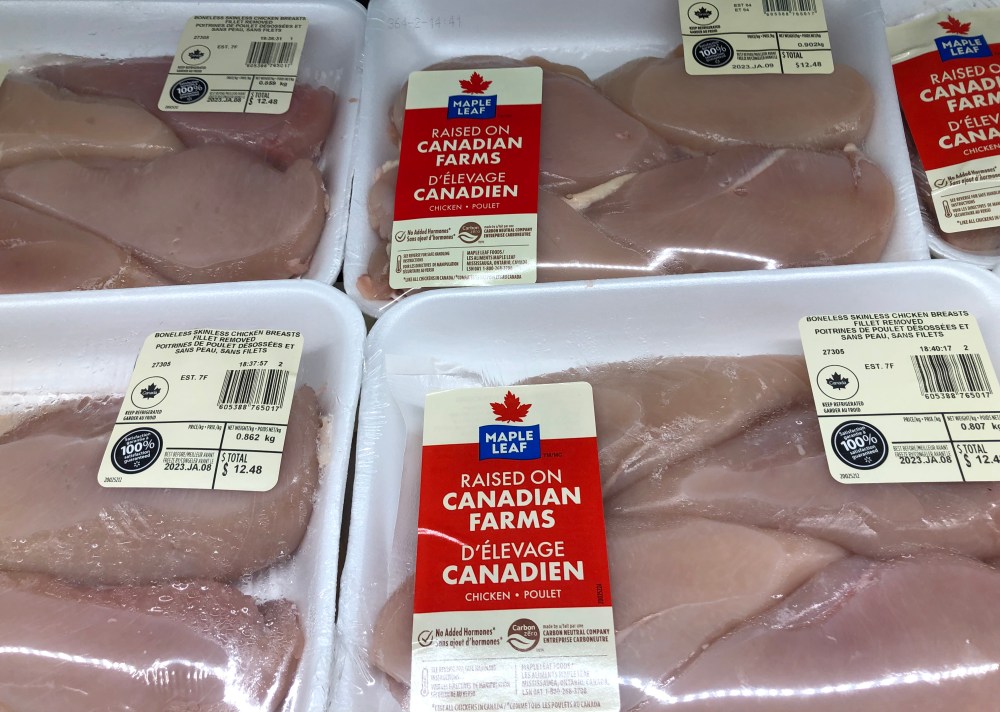
“A drop in inspection can be the difference between a routine day and another Maple Leaf 2008 tragedy,” he said.
In 2008, a listeria outbreak at a Maple Leaf Foods meat plant in Ontario led to dozens of illnesses and 22 deaths.
The union is raising concerns about the planned “risk-based” approach replacing daily inspection presence. It said it’s not clear what “risk” means and that there is no information on how often an inspector will now walk a domestic plant floor.
“They’ve replaced a written, transparent standard with a black box and called it modernization,” said Dyck. “The Carney government is rolling back protections to your health under the guise of cuts to red tape. We’re calling on the government to stop the cuts and to consult the people who do this work before it’s too late.”
Federal government data shows there were 6,207 employees working at the Canadian Food Inspection Agency as of the end of March. That’s down from 6,380 in 2025, and 6,833 the year before.
A Canadian Food Inspection Agency document said it’s reallocating approximately $30 million from existing resources to modernize how its inspection workforce is deployed and direct resources to “areas of greatest impact.” It said the funds will allow for around 250 new inspection and oversight positions.
It said the agency is creating a national food inspection team to support risk-based activities in the areas of food fraud, consumer protection and import oversight.
“The team will also provide surge capacity during large-scale food-related incidents and emergencies, helping to ensure a co-ordinated and effective operational response across the country,” said the document. “The CFIA’s mandate and regulatory responsibilities remain unchanged.”
This report by The Canadian Press was first published Nov. 24, 2026.