
New Brunswick bans non-essential travel into province, Nova Scotia tightens border
Advertisement
Read this article for free:
or
Already have an account? Log in here »
We need your support!
Local journalism needs your support!
As we navigate through unprecedented times, our journalists are working harder than ever to bring you the latest local updates to keep you safe and informed.
Now, more than ever, we need your support.
Starting at $15.99 plus taxes every four weeks you can access your Brandon Sun online and full access to all content as it appears on our website.
Subscribe Nowor call circulation directly at (204) 727-0527.
Your pledge helps to ensure we provide the news that matters most to your community!
To continue reading, please subscribe:
Add Brandon Sun access to your Free Press subscription for only an additional
$1 for the first 4 weeks*
*Your next subscription payment will increase by $1.00 and you will be charged $20.00 plus GST for four weeks. After four weeks, your payment will increase to $24.00 plus GST every four weeks.
Read unlimited articles for free today:
or
Already have an account? Log in here »
Hey there, time traveller!
This article was published 08/01/2021 (1912 days ago), so information in it may no longer be current.
HALIFAX – Nova Scotia and New Brunswick are increasing border controls to stop the spread of COVID-19 across the Atlantic region.
New Brunswick announced Friday it is prohibiting all non-essential travel into the province following a sustained rise in COVID-19 infections. “We return to the pre-June rule that unnecessary travel into the province is prohibited,” chief medical officer of health Dr. Jennifer Russell told a news conference.
Even Canadians who own property in New Brunswick or who have family there are no longer allowed to enter for reasons the government deems non-essential, Russell added.
“While the virus isn’t very mobile, people are,” Russell said. “It’s that constant movement of people between cities, provinces, countries that has enabled COVID-19 to spread to every corner of the globe.”
She said travel into the province will be permitted for work, medical appointments and for compassionate and child custody reasons. New Brunswick residents returning home from travel deemed non-essential, or people who are moving to the province, must isolate for 14 days, Russell said.
Health officials reported 18 new infections of COVID-19 Friday and said there were 143 active cases in the province. No one was in hospital with the disease.
Two new cases were identified at the Parkland Saint John long-term care facility. That facility now has 20 cases involving 13 residents and seven staff. A case was also reported at a nursing home in Baker Brook, N.B.
In Nova Scotia meanwhile, authorities said starting Saturday at 8 a.m., people entering Nova Scotia from New Brunswick will be required to isolate for two weeks.
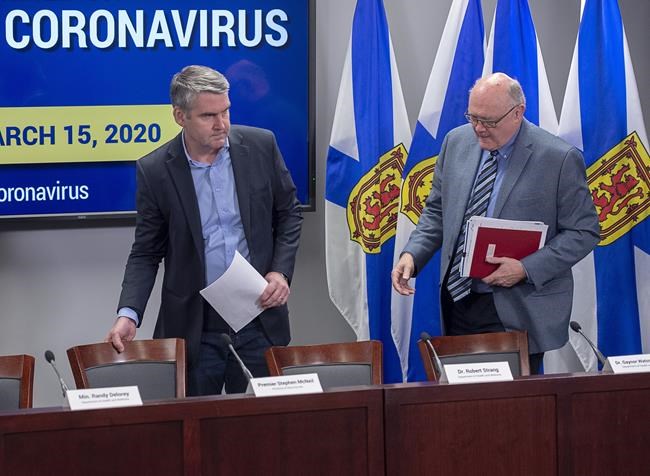
“What we’re saying here is, ‘Do not go to New Brunswick, and New Brunswickers, do not come here, unless it is for essential purposes,'” Nova Scotia Premier Stephen McNeil told reporters.
There are exceptions to the new rules, however. Chief medical officer of health Dr. Robert Strang said essential workers, people with medical appointments and those honouring legal child custody arrangements will be exempt from the order.
Otherwise, New Brunswick residents arriving in the province will have to complete a check-in form and immediately begin their 14-day isolation period.
The new order is not retroactive, but people who arrived from New Brunswick during the last two weeks are asked to get a COVID-19 test immediately and to isolate. Strang extended the request to Nova Scotians who have had visitors from New Brunswick during the last two weeks, though he said no isolation is necessary in those cases.
Permanent residents of Prince Edward Island and Newfoundland and Labrador are not subject to the order if they drive through New Brunswick with zero or minimal stops.
Strang said schools in Nova Scotia will reopen on Monday as planned after the province had extended the holiday break.
On the vaccination front, Nova Scotia received an additional 3,900 doses of the Pfizer-BioNTech vaccine this week, which will be delivered to hospitals in Cape Breton and the Annapolis Valley — the first areas to receive doses outside Halifax. Vaccine clinics for health-care workers will begin in both hospitals on Monday, Strang said.
In Halifax, long-term care residents will begin getting vaccinated as early as Monday — a week earlier than planned — in Northwood’s Halifax and Bedford campuses, Strang said, adding that by the end of next week, the province will have been supplied with 23,000 doses of vaccine.
Health authorities in Nova Scotia reported two new cases of COVID-19 Friday. Officials said one case was identified in the eastern zone and the other in the central zone, which includes Halifax. Both are related to travel outside the Atlantic region.
McNeil said the 29 active cases of COVID-19 in his province is a low number coming off the holiday season, and said he wants to keep it that way.
This report by The Canadian Press was first published Jan. 8, 2021.
— With files from Kevin Bissett in Fredericton.
—
This story was produced with the financial assistance of the Facebook and Canadian Press News Fellowship.