
1919 — Manitoba on strike
Advertisement
Read this article for free:
or
Already have an account? Log in here »
We need your support!
Local journalism needs your support!
As we navigate through unprecedented times, our journalists are working harder than ever to bring you the latest local updates to keep you safe and informed.
Now, more than ever, we need your support.
Starting at $15.99 plus taxes every four weeks you can access your Brandon Sun online and full access to all content as it appears on our website.
Subscribe Nowor call circulation directly at (204) 727-0527.
Your pledge helps to ensure we provide the news that matters most to your community!
To continue reading, please subscribe:
Add Brandon Sun access to your Free Press subscription for only an additional
$1 for the first 4 weeks*
*Your next subscription payment will increase by $1.00 and you will be charged $20.00 plus GST for four weeks. After four weeks, your payment will increase to $24.00 plus GST every four weeks.
Read unlimited articles for free today:
or
Already have an account? Log in here »
Hey there, time traveller!
This article was published 18/04/2019 (2571 days ago), so information in it may no longer be current.
This spring marks the centennial of the Winnipeg General Strike of May-June 1919.
For six long weeks, 30,000 strikers — more than half not even union members — and their families shut Winnipeg down. Because these events were rooted in a deeply felt rejection of the status quo, they have much to tell us about contemporary social, political, and economic dissent.
Too often we think of events such as the Winnipeg General Strike within narrow national narratives when, like the tides of protest in 2019, the strike is more usefully examined as a feature of an international phenomenon. Winnipeg’s crisis was a seismic event, part of a reverberation from below, that began in Russia in 1917, spread across Europe, Great Britain, and North America at the end of the Great War, and shook Winnipeg’s social order to its core. In Britain workers joked about the King — post-revolution — working in a mine, or driving a lorry; in Winnipeg, in the spring of 1919, the editors of the Western Labour News imagined the new parliament buildings turned into a labour temple.
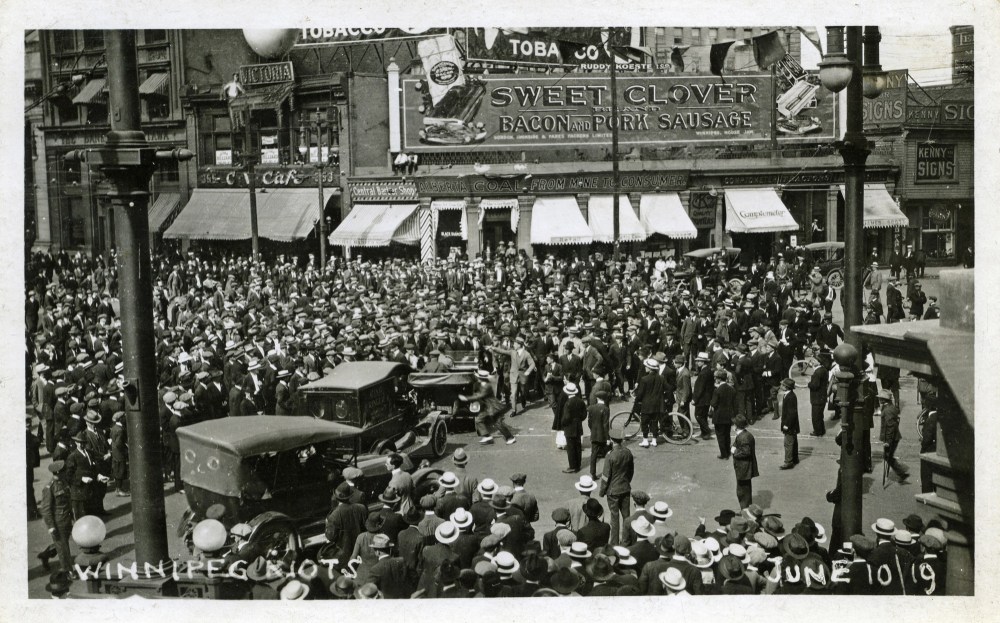
General strikes are directed against societies by those who feel that such protest is the only way to call attention to (or reform) a deeply flawed social order. After a visit to strike bound Winnipeg, W.A. Mackintosh, a professor at Brandon College, confided to his notebook that the such a general strike was possible “only where there is a patent and fundamental evil; an evil so patent and so fundamental that the community becomes a co-partner in maintaining it.” Suffering was the necessary product of a sympathetic strike: suffering that was “aimed directly at a public which has been ignorant of, or has shirked its responsibilities.” The opponents of the strike blamed foreign-born radicals for the crisis, when the origins of the strike were to be found on the streets of Winnipeg.
In his testimony before the royal commission appointed to investigate the causes of the strike, James Winning, president of the Winnipeg Trades and Labour Council, explained, “Never before in his life, had he found it so easy to take a strike vote. Every man seemed to have his own particular grievance.” The high cost of living, wartime profiteering, the refusal by employers to recognized collective bargaining, poor working conditions, and the threat of unemployment, were all sources of working-class anger and desperation. Such anger and desperation led workers to lose faith in governments, to embrace increasingly radicalized labour unions, and to support the call for a general strike to shut society down.
For ordinary working people in Winnipeg and Brandon, the rising cost of living made making ends meet a daily challenge. The wages of railway shop men, among the best-organized and paid section of labour, increased between 30 and 40 per cent during the war, while the federal government’s Labour Gazette reported that the cost of living had gone up 150 per cent since 1913. Even with increases, in 1919 a CPR locomotive fireman with several years’ seniority earned only $22 per week for working seven days a week and 12 hours a day and had to support a wife and children. And others were worse off. In 1919 the provincial Minimum Wage Board said that a single woman needed a minimum of $12 per week to acquire “the bare necessities of life.” Across Winnipeg and Brandon bread winners with families to support were being paid $12, $15, and $18 per week.
Low wages, the dramatic rise in the cost of living during the war, and the existence of war profiteering, created a combustible mix especially when governments refused to offer real solutions. Workers lost faith in government and looked to organized labour as the only and the last hope they had for a better life. From at least 1917, Winnipeg and Brandon workers were organizing and demanding collective bargaining. Organized labour in both cities could not keep up with the demands of workers for assistance and direction in forming and joining unions. Workers were getting organized and they were getting ready to strike. The rejection of unions and collective bargaining — the latter promised to all by the federal government in 1918 — only added to the anger and alienation of ordinary working people. Trouble was coming.
In an eight-part weekly series continuing next Saturday, we explore Canada’s 1919 labour revolt as it took shape in Brandon and Winnipeg. First we will set the stage with a broad historical account of the rise of labour and the world-wide impact of the 1917 Russian revolution, we will look closely at the role of the Great War in shaping post-war protest in Canada, and outline the circumstances that led to the calling of the Winnipeg General Strike. Then we will examine the rise of organized labour in Brandon from 1900 to 1919, the Brandon Civic Employees strike of April 1919, and the remarkable Brandon Sympathetic strike that persisted through May and June in support of the Winnipeg strikers. Our last instalment recounts the violent end of the Winnipeg strike on Bloody Saturday, June 21, 1919.
Next Week: Workers Around the World Mobilize for Action.
» This was the first in an eight-part series on the Winnipeg General Strike of May-June 1919. It was prepared by James Naylor and Tom Mitchell, using notes by the late Errol Black.