
New names can send a message
Advertisement
Read this article for free:
or
Already have an account? Log in here »
We need your support!
Local journalism needs your support!
As we navigate through unprecedented times, our journalists are working harder than ever to bring you the latest local updates to keep you safe and informed.
Now, more than ever, we need your support.
Starting at $15.99 plus taxes every four weeks you can access your Brandon Sun online and full access to all content as it appears on our website.
Subscribe Nowor call circulation directly at (204) 727-0527.
Your pledge helps to ensure we provide the news that matters most to your community!
To continue reading, please subscribe:
Add Brandon Sun access to your Free Press subscription for only an additional
$1 for the first 4 weeks*
- Enjoy unlimited reading on brandonsun.com
- Read the Brandon Sun E-Edition, our digital replica newspaper
*Your next Free Press subscription payment will increase by $1.00 and you will be charged $20.95 plus GST for four weeks. After four weeks, your payment will increase to $24.95 plus GST every four weeks.
Read unlimited articles for free today:
or
Already have an account? Log in here »
Hey there, time traveller!
This article was published 03/04/2022 (1496 days ago), so information in it may no longer be current.
Ahead of the municipal election this fall, the City of Brandon is exploring the idea of changing the boundaries and names of its wards, which are each represented by an elected councillor.
The fate of the 10 existing wards will be further revealed at this evening’s city council meeting, where councillors will decide whether the motion passes first reading.
There has been some contention with the current names of wards, such as Rosser, named after a Confederate general and an engineer with the Canadian Pacific Railway. Thomas Lafayette Rosser was born and died in Virginia — more than a hop, skip and a jump away from Brandon.
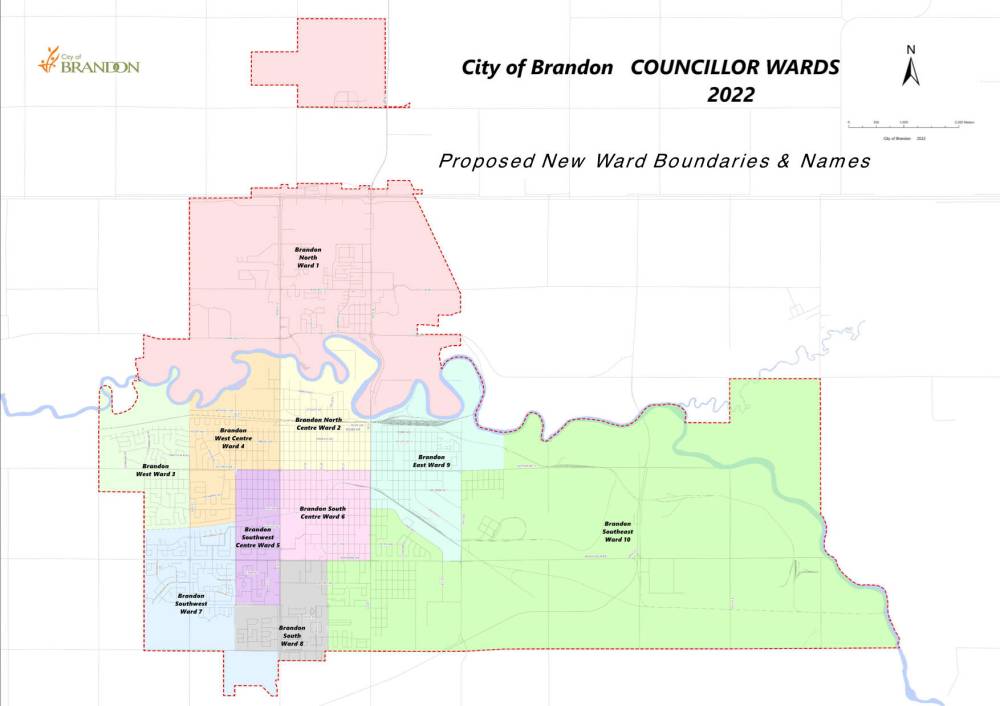
Proposed changes on the city’s website show the ward boundaries would not shift too much. However, all the wards would be renamed to reflect their geographic location, such as Brandon North Centre Ward 2 (currently Rosser), or Brandon Southwest Centre Ward 5 (Meadows-Waverly) — not to be confused with its neighbour Brandon South Centre Ward 6 (South Centre).
“It is proposed that they [wards] be changed to directional names which will allow resident to identify wards based on their locations within the city,” a city document says.
While naming wards after their geographic position within the city may seem like the wise choice — it avoids any kind of hassle and contention associated with naming the districts after historical figures and provides some flexibility as the city morphs over time — it would be a missed opportunity for the city to commemorate people who have made a positive impact upon Brandon.
There are, of course, numerous people who fit that bill, from the volunteers in our community who have helped make it function to those who have lent their time and energy to see the city grow and prosper. Teachers, coaches, veterans and other community leaders who have led Brandon through prosperous times and out of dark ones. They all should be considered.
But there are other options, too; names and cultures that could speak to the changing character of our city, or at least give vision to what kind of community we want to become.
In recent years, Manitobans and Canadians have been encouraged to confront their colonial history and the effects it continues to have during the present day and will have in the future. We have been surrounded by conversations about truth and reconciliation, what they look like and how they can succeed in our society which is largely built around settler systems. The names of streets, buildings and wards may seem trivial to some — what’s in a name, anyway? After all, isn’t it more about the destination than the person after whom it is named?
That is not entirely true. The names with which we decorate our communities matter. For example, in 2021, the RM of St. Clements and Brokenhead Ojibway Nation collaborated to rename a street in the community of Libau, northeast of Winnipeg. Colonization Road became Reconciliation Road last November.
“What it does, I think, is we become more aware of Canada’s colonial history, as a country, as a province, as communities, as people,” Brokenhead Chief Deborah Smith told the Winnipeg Free Press in 2020 about the efforts to rename Colonization Road.
“It is important we understand the impact these symbols have and recognize the negative impact of colonialism,” St. Clements Mayor Debbie Fiebelkorn told the Free Press.
Renaming streets, wards, buildings and other public entities will not undo Canada’s colonial legacy, nor will it make up for the harms to Indigenous people caused by settlers. But by removing the names of people who had a direct hand in those actions — and replacing them with people who have contributed positively to communities — we acknowledge that there is no room for that behaviour in our future.