
When change is the lesser of two evils
Advertisement
Read this article for free:
or
Already have an account? Log in here »
We need your support!
Local journalism needs your support!
As we navigate through unprecedented times, our journalists are working harder than ever to bring you the latest local updates to keep you safe and informed.
Now, more than ever, we need your support.
Starting at $15.99 plus taxes every four weeks you can access your Brandon Sun online and full access to all content as it appears on our website.
Subscribe Nowor call circulation directly at (204) 727-0527.
Your pledge helps to ensure we provide the news that matters most to your community!
To continue reading, please subscribe:
Add Brandon Sun access to your Free Press subscription for only an additional
$1 for the first 4 weeks*
- Enjoy unlimited reading on brandonsun.com
- Read the Brandon Sun E-Edition, our digital replica newspaper
*Your next Free Press subscription payment will increase by $1.00 and you will be charged $20.95 plus GST for four weeks. After four weeks, your payment will increase to $24.95 plus GST every four weeks.
Read unlimited articles for free today:
or
Already have an account? Log in here »
Hey there, time traveller!
This article was published 23/06/2023 (1212 days ago), so information in it may no longer be current.
Canadians want a different federal government, but many of them are scared of the alternative.
That’s the main finding arising from a large national poll conducted by Abacus Data earlier this month. It found that 81 per cent of Canadians believe it is time for a change in government, and just 20 per cent believe Justin Trudeau and his Liberal government deserves to be re-elected.
Among the group who want a change in government, however, 31 per cent say there isn’t a good alternative to the Liberals they are comfortable with. Within that group, one-third would still vote for a Liberal candidate if an election were held today, and just 19 per cent would vote for a Conservative Party candidate.
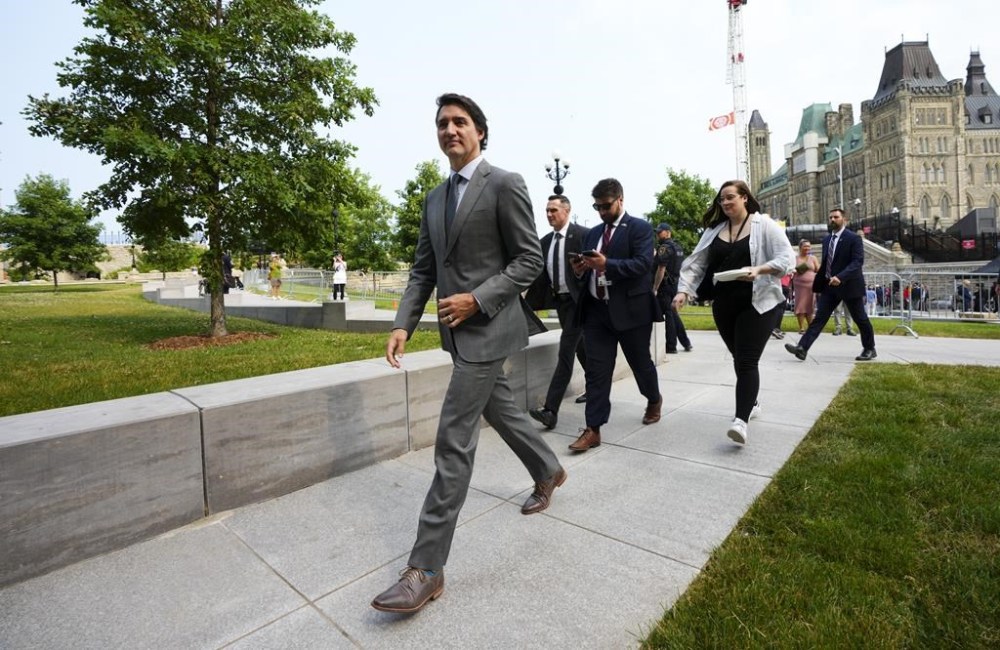
Reflecting on the poll results, Abacus CEO David Colletto says that “While it might seem like a grim outlook with 80 per cent of the populace desiring change, the Liberals can find some solace in the fact that a notable fraction of those yearning for change still doesn’t see a viable alternative. This can be seen as a testament to the government’s relative stability or the perception of the Liberals as the lesser of multiple evils.”
The Abacus data is consistent with the results of another public opinion poll released last month, which found that 70 per cent of Canadians describe themselves as centrist (25), centre-left (29) or centre-right (16). That poll found that a majority of respondents believe that Canadian politics has become more polarized and extreme, and 80 per cent of respondents are prepared to vote for a different party than they’ve voted for previously.
That same poll found that 36 per cent of respondents would be interested in supporting a new centrist political party.
If you combine the findings from those two polls, it is clear that a large majority of Canadians want change in the form of a moderate, centrist alternative, but that they believe that such an alternative is not currently available. That’s why so many of them want the Trudeau Liberals gone, yet view the Liberals as the only real option for their votes.
We see something similar at the provincial level here in Manitoba. Austerity measures implemented by our Progressive Conservative government, combined with its too-soft approach to anti-vaxxers and the convoy crowd during the pandemic, has caused many Manitobans to want a moderate, centrist alternative. The problem a growing number of Manitoba voters face, however, is that they do not regard the New Democrats as that moderate option.
That appears to be one of the messages flowing from the results of the latest Probe Research poll, which found that the Tories and NDP are tied in voter support, and that a large majority of Manitobans have unfavourable opinions of both Premier Heather Stefanson and NDP Leader Wab Kinew.
If so many voters want a pragmatic, centrist option to vote for, why is it so hard for them to find one? Why are our mainstream parties abandoning the centre of the political spectrum? Why are they increasingly focused on the thousands of voters who hold extreme views than the millions who have reasonable, moderate opinions?
There are several reasons. Voters with more strident opinions on issues tend to be more active in politics. They show up for meetings, they work on campaigns, they donate money, they get elected to riding association executive positions and they get nominated as candidates. In other words, they increasingly occupy all of the levers of power in a political party and eventually drive out those who don’t share their values and tactics.
Beyond that, both the Liberals and Tories (at the federal level) have seen the harm that vote-splitting can do to them. Jean Chrétien’s Liberals won three majorities thanks to vote-splitting on the right. When Jack Layton’s New Democrats shaved left-wing support away from the Liberals, it resulted in Stephen Harper becoming prime minister for a decade.
They would rather have the extremists in their “tent” than be forced to compete against them in another party.
That is the disheartening reality of our provincial and federal politics these days. Until either the Liberals or Conservatives decide to return to being the moderate parties they once were, growing numbers of voters will continue to feel they are being forced to choose between the government they don’t want anymore and the alternative they don’t want either.
The “lesser of multiple evils,” indeed.