
Report puts ball in council’s court
Advertisement
Read this article for free:
or
Already have an account? Log in here »
We need your support!
Local journalism needs your support!
As we navigate through unprecedented times, our journalists are working harder than ever to bring you the latest local updates to keep you safe and informed.
Now, more than ever, we need your support.
Starting at $15.99 plus taxes every four weeks you can access your Brandon Sun online and full access to all content as it appears on our website.
Subscribe Nowor call circulation directly at (204) 727-0527.
Your pledge helps to ensure we provide the news that matters most to your community!
To continue reading, please subscribe:
Add Brandon Sun access to your Free Press subscription for only an additional
$1 for the first 4 weeks*
- Enjoy unlimited reading on brandonsun.com
- Read the Brandon Sun E-Edition, our digital replica newspaper
*Your next Free Press subscription payment will increase by $1.00 and you will be charged $20.95 plus GST for four weeks. After four weeks, your payment will increase to $24.95 plus GST every four weeks.
Read unlimited articles for free today:
or
Already have an account? Log in here »
Hey there, time traveller!
This article was published 16/12/2023 (1005 days ago), so information in it may no longer be current.
“This is a long-term projection. So for the long term, it’s our first long-term outlook, or the community. So there’s good data in this report. And is this report is going to be a good starting point for us to having a longer-term conversation than we’ve had in the past? Absolutely.”
— Brandon city manager Ron Bowles
“You know, I think some councillors were under the assumption that you know, with growth paying for growth, that if you borrow this money, you borrow money to pay for the growth, (that) the development charges, and all the taxation that you’re going to receive from all those additional properties will easily offset any, you know, overwhelming tax increases. I just think we’re, you know, they’re realizing that’s not the case.”
— Coun. Kris Desjarlais (Ward 2)
“You know, I’ve been asking all along, I want to do a four-year budget. I don’t particularly like the four-year budget that was presented in this model. But you know what? We have to deal with, with what is out there, and we will … It will not be those rates. This wasn’t just gospel. Just like every year, we get these things, we will discuss it.”
— Brandon Mayor Jeff Fawcett
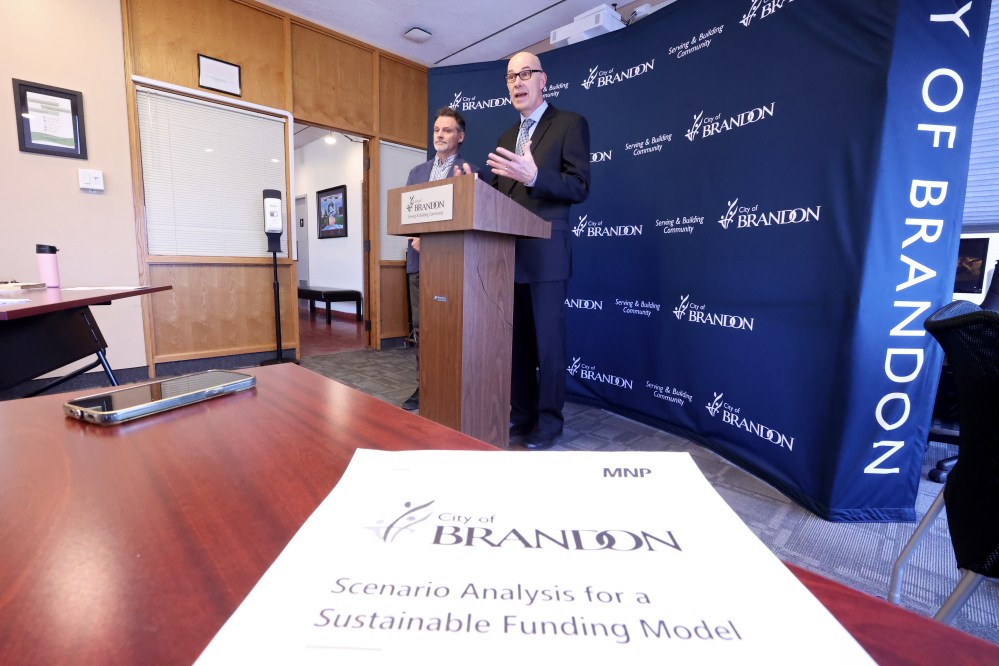
Friday morning’s press conference with city manager Ron Bowles and the non-speaking corporate services general manager Cory Schermann amounted to a study in contradictions that left media with unanswered questions, and the uneasy feeling of pending financial disaster.
As The Brandon Sun first reported, Brandon’s administration this week released the results of an MNP report — commissioned by the city — which determined city council will need to impose “extraordinarily” larger property tax increases over the next 10 years to remain sustainable.
Two scenarios put forward by the report included one situation in which property taxes rise about 13 per cent a year between 2024 and 2027 and another three per cent from 2028 to 2033 each year. The second would see increases worth nine per cent per year over the same time frame.
The press conference, at which only Bowles and Schermann stood up to take questions, was a means to introduce to media both the apparent strengths inherent in our city operations as well as the financial weaknesses outlined in the report.
And while assembled members of the media were focused on trying to get answers to the financial weaknesses — any clear answer at all, really — and to the clear admission by this administration that successive councils had not sufficiently raised taxes to reflect inflation increases, Mr. Bowles was trying to point out the silver lining in this bombshell report.
“We’re saying that we’re providing really good information to council,” he said. “They are getting the best information to the day.”
Mr. Bowles characterized at least part of this report as “good news” in that city council should now fully understand the cliff we’re collectively about to jump off. Perhaps there is some wisdom in that, if you liken the city’s financial decisions to the Looney Tunes character Wile E. Coyote, who notices too late that he’s about to become a puff of dust at the bottom of a desert ravine.
But he was also quite evasive on some very straight questions. How long has the city manager known or suspected that successive city councils were digging a financial hole for the city, even as reserves were being depleted and inflation was rising? They have the information now, says the city manager, and they’re starting to review it.
Why didn’t mayor and council — especially the mayor — feel it necessary to show up to Friday morning’s press conference? Well, council is behind this, “but they are just engaging now.”
Mayor Jeff Fawcett, shortly after, suggested that this was “management’s presser,” and seemed interested in putting some distance between himself and the report’s findings.
Mr. Bowles also suggested that the report proved Brandon was “living up to its core values” of low taxes and providing good and efficient city services — more “good news.” But the MNP report states that successive low tax increases have not met the financial needs of the city, so how is that particular core value something to hold up as a bright spot?
The city manager was clearly going out of his way not to criticize this council, or previous iterations of council, for doing too little to care for city finances by replenishing reserves and socking something away for future growth. And yet that criticism is baked into the report.
And those “efficient city services” Mr. Bowles spoke of — that was mentioned in the report under the heading of Council Interviews as a “perceived strength,” in that the city is “running as efficiently as possible and still provides a good balance of services.” But Mr. Bowles also acknowledged that the city has never conducted an efficiency study. If a city is depleting its reserves to the edge of a fiscal cliff, does it still deserve to be called “efficient?”
So, too, did that phrase came up again — the one about “growth paying for growth” — but it certainly feels like this report certifies that growth will come on the backs of city ratepayers, as well as the developers. This is an unprecedented and perilous moment in the city’s history.
The proposed budget documents for the 2024 fiscal year, when they come out, should be quite telling. Perhaps they, and the resulting debate around the council table, will provide more answers than we received yesterday.
The question now will be whether this report has painted city council into a corner — don’t raise taxes and see what happens next. Or, raise taxes, and see what happens next.
» Matt Goerzen, editor