
Keep provincial exams in place
Advertisement
Read this article for free:
or
Already have an account? Log in here »
We need your support!
Local journalism needs your support!
As we navigate through unprecedented times, our journalists are working harder than ever to bring you the latest local updates to keep you safe and informed.
Now, more than ever, we need your support.
Starting at $15.99 plus taxes every four weeks you can access your Brandon Sun online and full access to all content as it appears on our website.
Subscribe Nowor call circulation directly at (204) 727-0527.
Your pledge helps to ensure we provide the news that matters most to your community!
To continue reading, please subscribe:
Add Brandon Sun access to your Free Press subscription for only an additional
$1 for the first 4 weeks*
- Enjoy unlimited reading on brandonsun.com
- Read the Brandon Sun E-Edition, our digital replica newspaper
*Your next Free Press subscription payment will increase by $1.00 and you will be charged $20.95 plus GST for four weeks. After four weeks, your payment will increase to $24.95 plus GST every four weeks.
Read unlimited articles for free today:
or
Already have an account? Log in here »
Hey there, time traveller!
This article was published 13/03/2024 (949 days ago), so information in it may no longer be current.
“Incoming college freshmen spend their first year re-learning course work that was either badly learned or badly taught (or perhaps not even offered) in their final high school year. It is not uncommon for college professors to encounter substantial numbers of students who read with no more proficiency than a junior high school student. Few college students are able to express themselves well in either written or in spoken form. The consequence of all this is that the university rightly or wrongly takes unto itself the responsibility of providing an improved but warmed-over high school curriculum to unprepared students.”
— Dr. Evan Pepper, former associate professor of botany at Brandon University, in January 1970, The Brandon Sun
“We’re seeing a lot of (university students) coming in with consumer math. It’s a disaster. They’re coming in with grade-school math. We’re seeing students come into education with extremely poor math skills.”
— University of Winnipeg math professor Anna Stokke, September 2011, Winnipeg Free Press
“It really does hit students like a ton of bricks when they get to university … I would have students come to me after a midterm and say, ‘I don’t understand what’s happening. I got 90s in high school.’”
— University of Manitoba math professor Darja Barr, December 2019, CBC
What is it about education ministers in Manitoba who can’t seem to read the classroom?
In the wake of the COVID-19 pandemic, the government of Heather Stefanson announced in August 2022 the discontinuation of Grade 12 provincial exams in math and language arts as part of its plan to revamp the K-12 system’s province-wide assessment schedule. In lieu of distributing timed provincial exams to final-year pupils, the government said it wanted instead to pilot a series of new standardized tests created by local teachers for Grade 10 students in 2022-23.
Eight months later, then-education minister Wayne Ewasko scrapped the province’s plan to abandon Grade 12 provincial tests, and instead decided to complement the new provincial evaluation at Grade 10 by reinstating Grade 12 provincial tests for the 2023-24 school year.
As part of the explanation for the flip-flop, Ewasko told CBC that the province would be doing a disservice if it didn’t prepare students for the exams they’d encounter if they pursue post-secondary schooling.
Fast-forward a year later, and the New Democrats are having similar flip-flops.
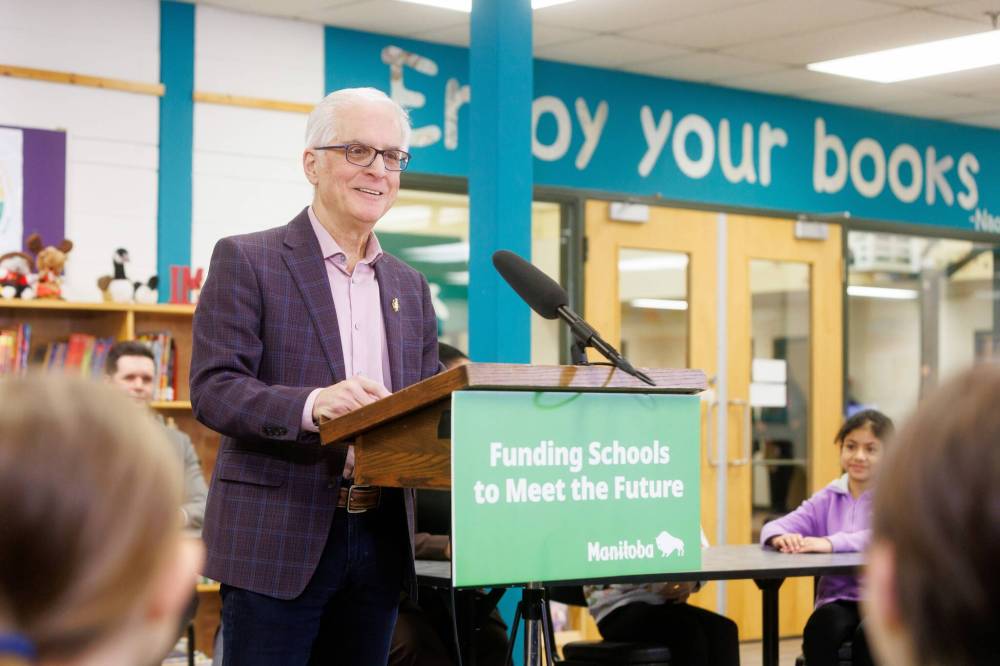
Late last month, superintendents and private school principals received a letter from the province informing them that Grade 10 and 12 provincial exams were being called off, as the NDP government began reviewing and redeveloping the annual assessment schedule.
Then this past Monday, little more than a week later, deputy education minister Brian O’Leary reversed that decision, saying that the initial memo had sparked concern among caregivers who feared halting the end-of-semester tradition, particularly in the final year of high school, because it would disadvantage graduates pursing a post-secondary education.
Education Minister Nello Altomare apparently told our sister paper, the Winnipeg Free Press, that he was regretful about not having spent more time working on the file before deciding to cancel systemwide exams for next year.
The debate over the quality of education received in Manitoba high schools is a long-standing one, with professors in universities and colleges across the province decrying the teaching methods in our schools, and the resulting lack of reading and math proficiency in far too many graduate students who try to make it through their first year of post-secondary education.
And while it’s true that the recent pandemic hindered the efforts of high school teachers to ready their students for the realities of a post-secondary workload, decades of poor decisions and unfulfilled promises from successive Manitoba governments have not helped either.
There is good reason to be concerned that the math and reading scores of Manitoba students has been steadily dropping over the last several years. And while the latest Program for International Student Assessment tests showed that Manitoba was no longer ranked last in the country when it came to mathematics, our province has routinely shown the worst outcomes in the country.
We welcome the NDP’s decision to try to modernize education assessment in Manitoba. Altomare is quite right when he asserts that assessments should better reflect what kids are learning in school. Hopefully the NDP’s attempt at education reform will have a better end result than the previous government’s.
But keep the provincial exams in place.
Provincial exams, though hotly debated by educators and parents alike, offer our provincial a bare-minimum guidepost for student outcomes, and should be kept in our regular curriculum. Not only do they provide statistical data to our education officials, they also offer a glimpse of the heavy workload that will be expected of students going into post-secondary education.
And it appears we’re not the only ones who think so.