
Police body cameras do little to ensure more transparency
Advertisement
Read this article for free:
or
Already have an account? Log in here »
We need your support!
Local journalism needs your support!
As we navigate through unprecedented times, our journalists are working harder than ever to bring you the latest local updates to keep you safe and informed.
Now, more than ever, we need your support.
Starting at $15.99 plus taxes every four weeks you can access your Brandon Sun online and full access to all content as it appears on our website.
Subscribe Nowor call circulation directly at (204) 727-0527.
Your pledge helps to ensure we provide the news that matters most to your community!
To continue reading, please subscribe:
Add Brandon Sun access to your Free Press subscription for only an additional
$1 for the first 4 weeks*
- Enjoy unlimited reading on brandonsun.com
- Read the Brandon Sun E-Edition, our digital replica newspaper
*Your next Free Press subscription payment will increase by $1.00 and you will be charged $20.95 plus GST for four weeks. After four weeks, your payment will increase to $24.95 plus GST every four weeks.
Read unlimited articles for free today:
or
Already have an account? Log in here »
Hey there, time traveller!
This article was published 12/09/2024 (614 days ago), so information in it may no longer be current.
Protesters recently gathered for a rally outside Edmonton Police Service headquarters to demand justice for the death of Mathios Arkangelo, who was shot and killed by an EPS officer in June. The shooting is currently under investigation by the Alberta Serious Incident Response Team (ASIRT), Alberta’s civilian police oversight agency.
The Arkangelo case shares similarities with the 2013 killing of Sammy Yatim by Toronto Police Service officer James Forcillo. Both Yatim and Arkangelo were in possession of a small knife when they were killed by police, and each incident was documented on publicly circulated video.
Nearly 150 recommendations were issued in response to Yatim’s death: 84 in 2014 in a report commissioned by the TPS from former Supreme Court justice Frank Iacobucci and another 63 in February 2024 from jurors in the coroner’s inquest. Among Iacobucci’s recommendations was to issue body cameras to officers, while the coroner’s jury stressed that body-camera footage must be reviewed in use of force cases. The inquest also notes the need to ensure transparency with respect to body-camera footage.
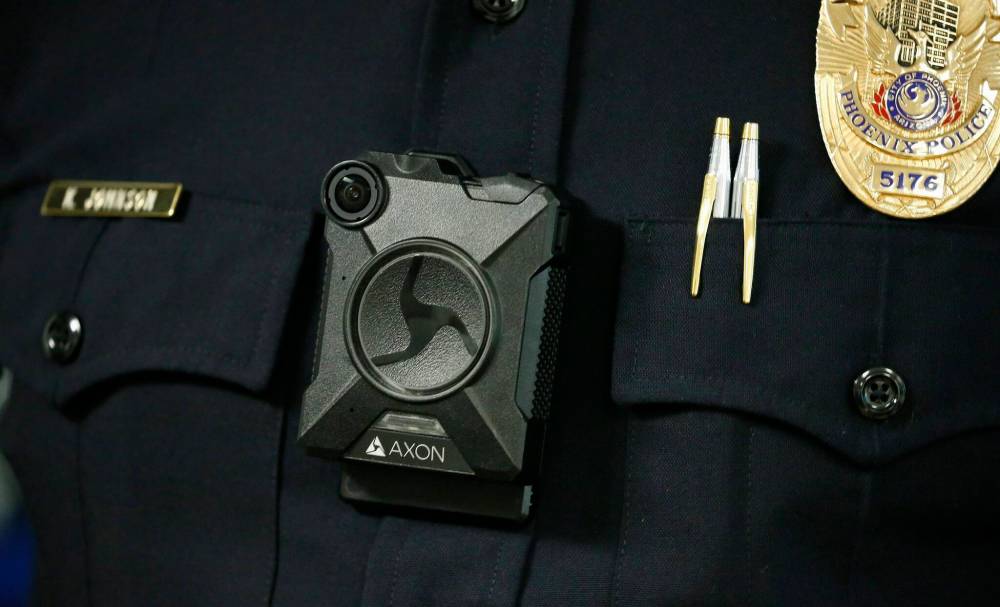
Police body-camera footage is almost never made public in Canada due to strict privacy regulations. As a result, there is much less transparency in a Canadian context than in other international jurisdictions, Christopher J. Schneider writes. (File)
Following the March 2023 mandate by the government of Alberta to equip all officers in the province with body cameras, the devices will be issued to all EPS officers in the coming months. However, despite EPS claims that the devices will “enhance transparency, public trust (and) confidence” in policing, the cameras will do little to ensure transparency in Edmonton or across Canada in situations like Arkangelo’s death.
James Forcillo, the now-former Toronto officer who shot Yatim, was quickly suspended and charged with second-degree murder just three weeks following the shooting. One of the reasons for the expediency of the charges in response to the shooting of Yatim was due initially to a 90-second bystander video uploaded to YouTube minutes after Yatim’s death. According to the director of the Special Investigation Unit, Ontario’s civilian police oversight agency, the bystander recording “ratcheted up public interest” in the case, driving the urgency of the SIU investigation.
About three weeks after Arkangelo’s death, his family shared a 25-minute video compilation on YouTube showing the shooting from multiple angles. The video offers much detail and is substantially longer than the initial Yatim footage.
EPS Chief Dale McFee suggested that the Arkangelo family “step back and realize they’re not helping the justice process,” by releasing video. However, the recording, like the Yatim video, has helped to increase public interest in the case while serving as essential evidence for ASIRT. The 25-minute video on YouTube has also provided the public with transparency, something body cameras are unlikely to do.
Body-camera footage is almost never made publicly visible in Canada due to strict privacy regulations that limit the publication of footage, thus bringing much less transparency in a Canadian context than in other international jurisdictions.
There is no reason to believe Manitoba will be any different when body cameras are eventual rolled out in cities like Winnipeg and Brandon.
The 2014 Iacobucci report after Yatim’s death recommended developing a protocol to protect the privacy of information documented on body cameras. However, the need for privacy must be balanced against the public’s right to transparency with its police service.
When critical incidents with the public are recorded on a police body camera, trust in police then follows based on public assessments of the footage in question, a process that is sustained by transparency. The idea that body cameras will somehow lead to improvements in police transparency cannot simply be assumed.
The public must instead call upon the federal government to consider amending privacy restrictions around the sharing of body-camera footage to align with public expectations concerning transparency; it is clear from their release of the video footage that the Arkangelo family are more concerned with transparency and justice than with privacy in the case of their son’s death.
In the meantime, there is one of the 2024 Yatim inquest recommendations that could be immediately implemented: the coroner’s jury called for provincial government assistance concerning the “immediate and ongoing financial and mental health support for family members of persons who were killed or seriously injured in an interaction with police.”
The Arkangelo family should immediately be provided with necessary funding support from the Alberta government. The family has launched a GoFundMe account to solicit donations to help with the “unforeseen costs associated” with Mathios Arkangelo’s death, but the Yatim jurors believed, and I agree, that they certainly shouldn’t have to.
» Christopher J. Schneider is professor of sociology at Brandon University. He has published eight books and more than 100 scholarly papers and essays and has written extensively on police body cameras. His most recent book is “Policing and Social Media: Social Control in an Era of Digital Media,” 2nd edition (Lexington Books, 2024).