
Enact electoral changes before the next election
Advertisement
Read this article for free:
or
Already have an account? Log in here »
We need your support!
Local journalism needs your support!
As we navigate through unprecedented times, our journalists are working harder than ever to bring you the latest local updates to keep you safe and informed.
Now, more than ever, we need your support.
Starting at $15.99 plus taxes every four weeks you can access your Brandon Sun online and full access to all content as it appears on our website.
Subscribe Nowor call circulation directly at (204) 727-0527.
Your pledge helps to ensure we provide the news that matters most to your community!
To continue reading, please subscribe:
Add Brandon Sun access to your Free Press subscription for only an additional
$1 for the first 4 weeks*
*Your next subscription payment will increase by $1.00 and you will be charged $20.00 plus GST for four weeks. After four weeks, your payment will increase to $24.00 plus GST every four weeks.
Read unlimited articles for free today:
or
Already have an account? Log in here »
Hey there, time traveller!
This article was published 30/01/2025 (310 days ago), so information in it may no longer be current.
After 18 months of hearings regarding allegations of foreign interference in Canada’s electoral process, Commissioner Marie-Josée Hogue says she found no evidence of “traitors” in Parliament conspiring with foreign nations to undermine our democracy.
She adds that she saw no evidence that foreign interference impacted the overall outcome of recent federal elections, and she identified only a handful of ridings in the country where such interference may have had some effect.
Those conclusions should be received as welcome news by the many Canadians who were concerned about the integrity and validity of our elections, but there are still many challenges identified in Hogue’s report that must be addressed.
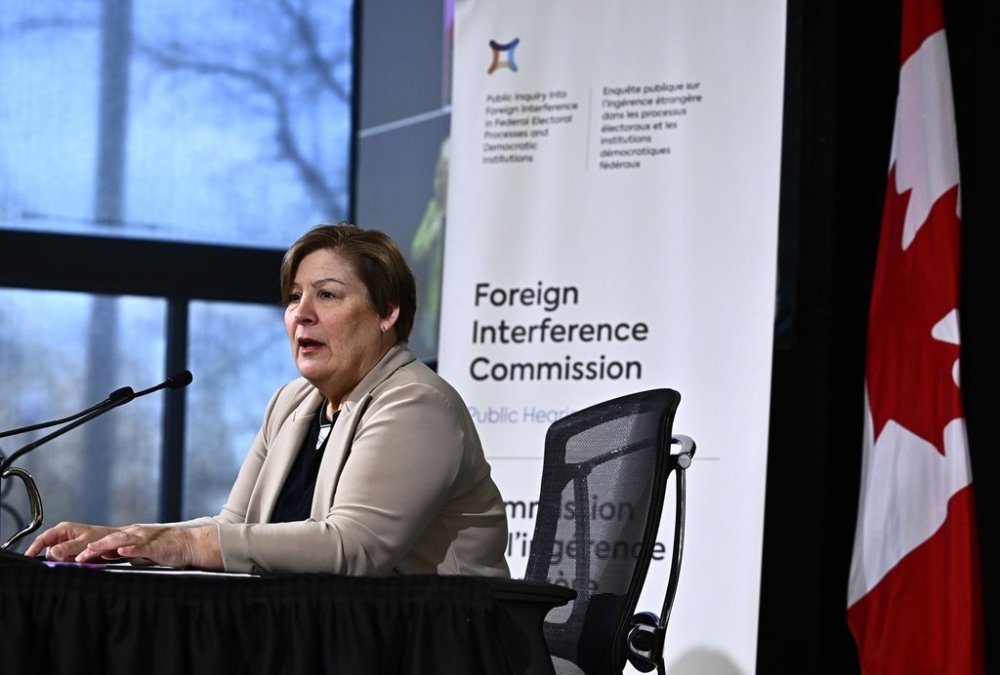
Among her many findings, Hogue concluded that the federal government has done a “far from perfect” job of sharing information on foreign interference within government, thereby making Canada more vulnerable. She uncovered instances when the government reacted too slowly to allegations of foreign interference, and says that information did not always flow properly to the appropriate decision-makers.
She also found evidence of efforts by foreign states to control diaspora communities within Canada, and that those efforts can take the form of “threats of physical and sexual violence, and even threats to life.”
Hogue’s report also contains dozens of recommendations to enhance federal preparedness, improve transparency, strengthen electoral integrity and respond to threats against diaspora communities within Canada.
Those recommendations include the suggestion that all political party leaders be “encouraged” to obtain “top-secret” security clearances, the creation of a hotline for citizens to report suspected foreign interference, and the adoption by the federal government of a “duty to warn” policy to alert individual Canadians of “credible threats of serious harm” from a foreign entity. Hogue’s greatest concern, however, relates to the growing danger posed by misinformation and disinformation.
She says that “information manipulation (whether foreign or not) poses the single biggest risk to our democracy. It is an existential threat.” In response to that danger, she says the government should consider creating a new agency that would monitor open-source information, including social media platforms, for misinformation or disinformation that could undermine the integrity of our elections.
Beyond that, she suggests that riding nomination and party leadership contests be brought under the Canada Elections Act, and only Canadian citizens and permanent residents should be allowed to vote in them. In response to the growing threat posed by artificial intelligence, she recommends that all electoral communications distributed during an election period which have been generated or manipulated by AI should be watermarked.
Hogue’s recommendations regarding extending the application of the federal Elections Act to include riding nomination and party leadership contests make sense — and largely echo recommendations already made by Canada’s chief electoral officer, Stéphane Perrault — but her suggestions arrive too late to apply to the Liberal leadership contest that is currently unfolding. That is unfortunate, but it is noteworthy that the Liberals have already decided that those wishing to vote in the contest must either be Canadian citizens or permanent residents of Canada.
While hundreds of riding nomination contests could occur in the coming weeks, in anticipation of a federal election that could occur as early as this April, it is extremely unlikely that Hogue’s recommendations will, or even can, be passed into law before those contests occur.
That is because Parliament is currently prorogued and will not re-commence operations until late March. When that happens, the odds are high that the government will be defeated by a non-confidence motion, plunging the nation into an election campaign.
The same is true vis-à-vis Perrault’s suggested changes to the Elections Act, including his recommendation that the Act be amended to include anti-deepfake provisions.
Hogue’s mandate was originally focused on the issue of foreign interference in our nation’s elections, but it is obvious that she realized during the course of her investigation that misinformation, disinformation and artificial intelligence technology pose equal, if not greater, threats to our democracy.
Given the seriousness of that threat — and the genuine possibility that it could adversely impact the integrity and/or result of the upcoming federal election — it is in the nation’s interest that the recommended amendments be passed into law prior to the next election, even if that necessitates delaying that election campaign for a few weeks.
Our nation’s democracy — and Canadians’ faith in it — is worth protecting. Let’s allow Parliament the time to do it right.