
MOU a good start, but barriers remain
Advertisement
Read this article for free:
or
Already have an account? Log in here »
We need your support!
Local journalism needs your support!
As we navigate through unprecedented times, our journalists are working harder than ever to bring you the latest local updates to keep you safe and informed.
Now, more than ever, we need your support.
Starting at $15.99 plus taxes every four weeks you can access your Brandon Sun online and full access to all content as it appears on our website.
Subscribe Nowor call circulation directly at (204) 727-0527.
Your pledge helps to ensure we provide the news that matters most to your community!
To continue reading, please subscribe:
Add Brandon Sun access to your Free Press subscription for only an additional
$1 for the first 4 weeks*
*Your next subscription payment will increase by $1.00 and you will be charged $20.00 plus GST for four weeks. After four weeks, your payment will increase to $24.00 plus GST every four weeks.
Read unlimited articles for free today:
or
Already have an account? Log in here »
Hey there, time traveller!
This article was published 15/05/2025 (315 days ago), so information in it may no longer be current.
“We’re facing a tariff war on two fronts, and now is the time to build up this country we love so much. As premiers, we are all working toward the common goal of powering our Canadian economy toward the future.”
— Manitoba Premier Wab Kinew
“Today’s MOU is just the latest step we are taking to unlock the enormous potential of true free trade within Canada …”
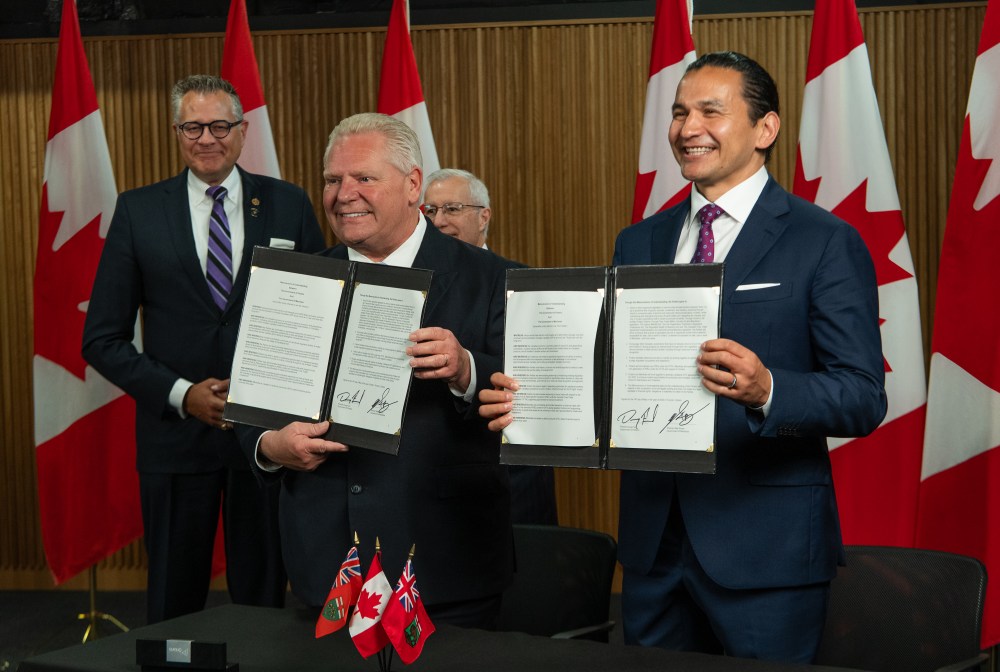
— Ontario Premier Doug Ford
In light of yesterday’s joint announcement between Manitoba Premier Wab Kinew and Ontario Premier Doug Ford, Manitobans should be pleased to see some movement on the subject of the interprovincial trade file. The two provinces became the latest governments in the country to promise co-operation on removing trade barriers in the country.
As reported by the Globe and Mail shortly after the announcement yesterday, Kinew and Ford signed a memorandum of understanding at Queen’s Park that seeks to remove barriers to trade between Manitoba and Ontario, including through legislation that increases the flow of both goods and workers.
According to the memorandum, Manitoba and Ontario will reach a bilateral agreement on direct-to-consumer alcohol sales by June 30, building on a previous pledge by provinces to improve the ease of sale of alcohol across provincial jurisdictions.
The agreement also includes improved interprovincial labour mobility. The stated intention of this agreement is to ensure goods, services and workers who are acceptable in one province be deemed acceptable in the other.
Interprovincial trade barriers have long been an irritant in the business community, as well as Manitoba premiers. Former premier Brian Pallister had made substantial efforts during his tenure at breaking down those trade barriers, and in 2018 argued that such barriers to trade cost Canadian households $1,500 every year.
A fall economic statement made by the Trudeau government in 2024 suggested that Canada could increase its GDP per capita by up to four per cent — or $2,900 per capita, according to Global News — if internal trade barriers were removed.
Interestingly, it took an outside threat from an unhinged American president to finally force the issue among premiers, and an added push from newly elected Prime Minister Mark Carney, who has promised to remove federal barriers to interprovincial trade by Canada Day.
If U.S. President Donald Trump’s ambition is to weaken Canada’s economy, one of the best moves we can make is to strengthen internal trade and make it more difficult for outside forces to wreak havoc with our fiscal stability.
Not surprisingly, the business community has welcomed the news.
Following the announcement, Brandon Chamber of Commerce vice-president Jennifer Ludwig said the decision would have significant implications for Brandon and western Manitoba.
“The MOU is good news for area businesses, and we are happy to see that the Manitoba government is following through with its promises to increase interprovincial trade, especially given the impact of recent cross-border and international tariffs,” Ludwig told the Sun.
Having better access to Ontario markets would be a boon for some manufacturers and even local breweries that might jump at the chance to expand their reach.
These are good moves by Canada’s leaders, but there are a few stumbling blocks that must be noted, particularly when it comes to the movement of labour between provinces, and those industries that require licensed professionals. One example that we can point to would be the field of nursing.
Both Manitoba and Ontario have had significant problems with nurse shortages, and both jurisdictions are working to attract new staff to local facilities. Manitoba, however, seems to be at a larger disadvantage in this regard as there are specific requirements demanded of nurses from other provinces looking to move to Manitoba, particularly regarding registration and currency of practice.
According to the College of Registered Nurses of Manitoba, the body that governs licensing in this province, the organization requires Canadian RN applicants “to obtain evidence of currency of practice documenting 450 RN practice hours in Canada,” over the last two years, or 1,125 practice hours in Canada for the last five years. Alternative options include completion of the full Nurse Re-Entry Program at Red River College or the successful completion of a Clinical Competence Assessment.
It also states that if an applicant completed a basic nursing education in Canada in the four years prior to their application, they would be considered as having met the requirement for currency of practice.
Licensed practical nurses from outside Manitoba looking to find work in this province require an endorsement application to be granted before they can work as an LPN in Manitoba.
While it is somewhat easier in Canada to work as a nurse between jurisdictions than in other countries, there are still some barriers to break down. Removing these kinds of barriers to labour flow is a worthy goal, one that we hope Manitoba will continue to pursue in the weeks and months to come.
All in all, however, yesterday’s announcement is welcome news.