
PM’s difficult balancing act
Advertisement
Read this article for free:
or
Already have an account? Log in here »
We need your support!
Local journalism needs your support!
As we navigate through unprecedented times, our journalists are working harder than ever to bring you the latest local updates to keep you safe and informed.
Now, more than ever, we need your support.
Starting at $15.99 plus taxes every four weeks you can access your Brandon Sun online and full access to all content as it appears on our website.
Subscribe Nowor call circulation directly at (204) 727-0527.
Your pledge helps to ensure we provide the news that matters most to your community!
To continue reading, please subscribe:
Add Brandon Sun access to your Free Press subscription for only an additional
$1 for the first 4 weeks*
*Your next subscription payment will increase by $1.00 and you will be charged $20.00 plus GST for four weeks. After four weeks, your payment will increase to $24.00 plus GST every four weeks.
Read unlimited articles for free today:
or
Already have an account? Log in here »
Hey there, time traveller!
This article was published 31/05/2025 (307 days ago), so information in it may no longer be current.
Canada’s newly elected government is reportedly in the final stages of drafting a “national interest bill” aimed at fast-tracking nation-building projects via a less-arduous regulatory approval process than is currently in place under Bill C-69, the Impact Assessment Act.
According to a Canadian Press report, the goal of the legislation is to “send a clear signal early that will build investor confidence” and ensure that important projects are completed far faster.
The new law will apparently identify specific criteria for deciding if a project is in the national interest. Among those hurdles will be “whether a project will make an exceptional contribution to Canada’s prosperity, advances economic security, defence security and national autonomy through improved movement of goods, services and people” and whether the project would strengthen “access of Canadian resource, goods and services to a diverse group of reliable trade partners.”
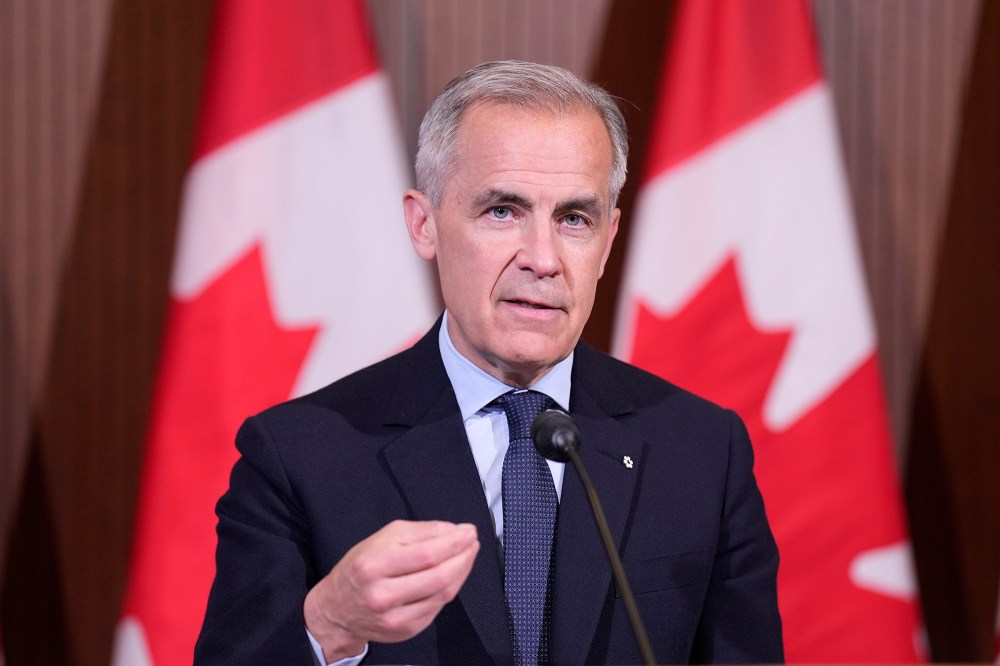
Prime Minister Mark Carney speaks with media during a news conference in Ottawa on May 21. The PM faces a challenge to balance the need to build infrastructure important to the national interest with Indigenous, environmental and other interests. (The Canadian Press)
Projects would also be assessed against Indigenous and provincial and territorial interests and on their “clean growth potential.”
If all those thresholds are met — if a project is ultimately determined to be in the national interest — the focus would then shift to how best to advance that project. A single federal minister would be assigned to oversee a review process that would specify how the project can proceed to completion. That process would reportedly “streamline multiple decision points for federal approval and minimize the risk of not securing project approval following extensive project work.”
The proposed legislation is consistent with Prime Minister Mark Carney’s campaign promise to streamline the approval process for major projects, and is a critical component of his government’s efforts to make Canada’s economy less reliant on the United States. The draft law is expected to be a key focus of discussions between Carney and Canada’s premiers when they gather next week in Saskatoon.
Carney is under intense pressure to deliver on the ambitious commitments he has made. Alberta Premier Danielle Smith is demanding a “clear commitment” from the PM to partner with Alberta to build an oil pipeline to the northwest B.C. coast, and to repeal Bill C-69, the greenhouse gas emissions cap, the West Coast tanker ban and the net-zero electricity regulations.
Raising the pressure even higher, Saskatchewan Premier Scott Moe told the Globe and Mail this week that Carney has an unprecedented opportunity to fix Canada’s approvals process for major infrastructure projects.
“I don’t know that Canada has ever been presented such a tremendous opportunity,” he said, “and it will be on this prime minister and the federal government to see whether they take it.”
The expectations surrounding next week’s leaders’ meeting are sky-high, but they should be tempered with a dose of reality. The goal of the new legislation is to accelerate the approval of major projects, but we cannot ignore the reality that the existing process — widely criticized as too slow and burdensome — is intended to ensure that jurisdictional issues, Indigenous rights and important environmental issues are not ignored.
The draft legislation appears to at least partially acknowledge the importance of those goals by making clear that projects would also be assessed within the context of Indigenous, provincial and territorial interests, as well as through an environmental lens.
Beyond that, the new law would apparently not apply to decisions made by arm’s length authorities or regulators, federal-provincial entities nor treaty-based processes in the North. It also commits to upholding Canada’s obligations under the United Nations Declaration on the Rights of Indigenous Peoples.
Viewed from that perspective, the difficulty of the balancing act that Carney is attempting to execute becomes far clearer. How does he speed up an approval process that is widely criticized as being too slow because it is too protective of provincial, Indigenous and environmental interests? How does he do that without downgrading the importance those interests as part of that process?
How does he ignore the unspoken message of his campaign commitments and his government’s draft legislation — that strengthening the national economy is a higher priority than other interests that some allege get in the way of that goal?
Politicians are often criticized for trying to be all things to all people, for trying to please everyone. Carney has created expectations among voters, premiers, Indigenous leaders and environmental groups that will be very difficult to reconcile, let alone protect.
Next week’s meeting could reveal exactly how challenging that task will be.