
National wildfire strategy needed
Advertisement
Read this article for free:
or
Already have an account? Log in here »
We need your support!
Local journalism needs your support!
As we navigate through unprecedented times, our journalists are working harder than ever to bring you the latest local updates to keep you safe and informed.
Now, more than ever, we need your support.
Starting at $15.99 plus taxes every four weeks you can access your Brandon Sun online and full access to all content as it appears on our website.
Subscribe Nowor call circulation directly at (204) 727-0527.
Your pledge helps to ensure we provide the news that matters most to your community!
To continue reading, please subscribe:
Add Brandon Sun access to your Free Press subscription for only an additional
$1 for the first 4 weeks*
*Your next subscription payment will increase by $1.00 and you will be charged $20.00 plus GST for four weeks. After four weeks, your payment will increase to $24.00 plus GST every four weeks.
Read unlimited articles for free today:
or
Already have an account? Log in here »
Hey there, time traveller!
This article was published 01/08/2025 (238 days ago), so information in it may no longer be current.
Canada’s season of fire has already been one for the record books, and we’re barely past the halfway point.
This year’s fire season has been cited as the second-most severe wildfire season in Canadian history — certainly the worst in three decades — with 15 million acres having burned so far.
Currently in Manitoba, the FireView 2025 map shows 25 uncontrolled fires burning in Manitoba as of Aug. 1, with dozens more being monitored and 16 under control. And while Manitoba’s fire situation is bad enough, the fire risk in central Saskatchewan, central Alberta and a large swath of the Northwest Territories — as well as some parts of British Columbia — is in the extreme. In Canada generally there are 59 uncontrolled fires, 30 fires being held, 108 controlled fires.
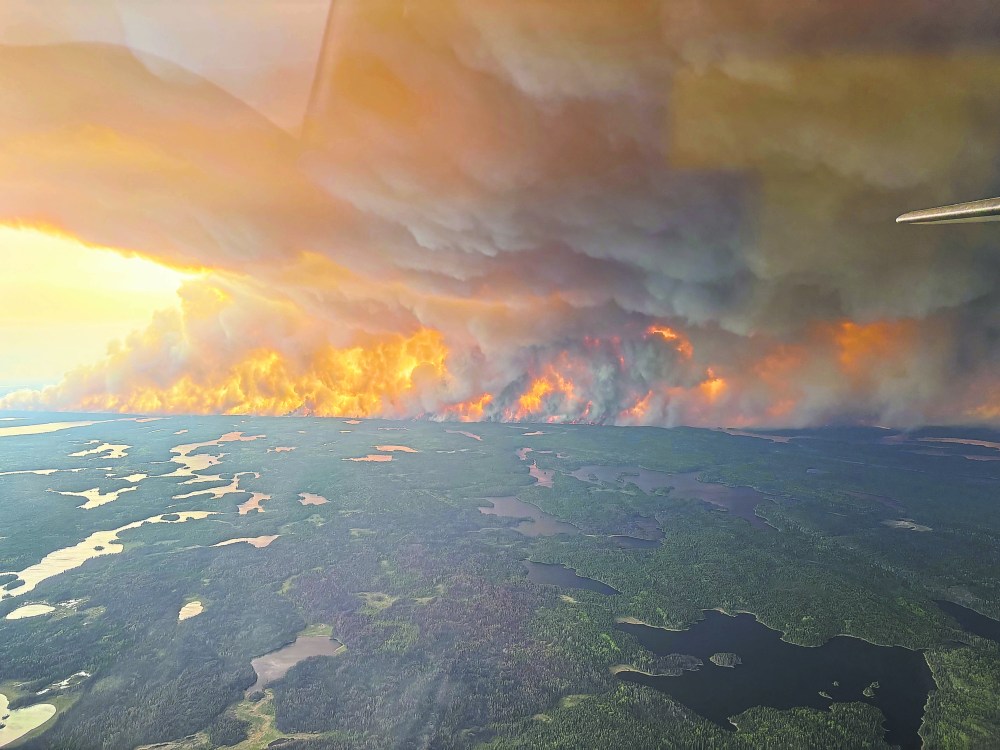
First and foremost, we have to be concerned with the health and safety of evacuees in this province. The stress of evacuation alone is hard on families, but losing homes and livelihoods can be disastrous for a community.
The situation has been ongoing since May, as northern communities have been forced to evacuate as fires have threatened communities large and small, both Indigenous and non-Indigenous alike. The result has been the displacement of thousands of evacuees who have been forced to journey south to communities like Brandon and Winnipeg, across the western plains into Saskatchewan and Alberta as well as east to Ontario — and several other communities in between.
In mid-July, hundreds of people from Canoe Lake Cree First Nation in Saskatchewan sought refuge in Alberta, as cities in their home province were already packed to capacity. Manitoba has had its own headaches, too, as the provincial government has tried to co-ordinate both fire fighting efforts and evacuations.
Three weeks ago, the province was forced to consider temporary congregate shelters for wildfire evacuees because hotel space was limited across the province, even as Leaf Rapids residents were ordered to leave on July 8 and Thompson residents were on alert to evacuate.
This has also caused significant air quality concerns on the ground across the country. Just yesterday, air quality warnings were in place for Manitoba with Winnipeg and the city of Flin Flon expected to see air quality health index ratings of more than 10. The city of Brandon, too, was expected to see high-risk conditions.
The end of July in fact marked the smokiest July that Brandon has witnessed since records started being kept more than 60 years ago, according to Environment and Climate Change Canada. The smokiest month, however, was way back in August 1961, when both Brandon and Winnipeg were blanketed with smoke during a particularly bad drought year.
That has all kinds of implications for our health in southern Manitoba, as these smoky days drag on week after week. Several outdoor events across the province have been either postponed or cancelled outright, from sports to festivals, just to ensure that people aren’t harmed by excessive smoke inhalation.
There is also a huge financial impact to this season of fire and evacuation — one that may continue well into the future as we begin to fully experience the effects of climate change in our country. And we don’t just mean lost revenue from businesses and organizations that had to cancel events, or lost tourism dollars for communities like Brandon or Winnipeg where hotel space became hard to find — although that, too, is part of the reality.
A Statistics Canada report last June suggested that of all the provinces, Manitoba’s economy was most at risk of feeling the effects of wildfires burning across the country.
“As of mid-June, Manitoba had the largest percentage of GDP at risk among the provinces,” the report read. “The wildfire-affected areas, where 21,000 residents were ordered to evacuate, accounted for 2.4 per cent of total provincial GDP.”
Note that report was created before the Kinew government issued a second provincewide state of emergency due to the condition of wildfires in July.
One of the biggest headaches, however, is a lack of co-ordination between provincial jurisdictions. As the Winnipeg Free Press reported earlier this year, a massive wildfire that started near Creighton, Sask., in late May jumped the border into Manitoba and headed toward the town of Flin Flon. At the time, Flin Flon’s deputy mayor, Alison Dallas-Funk, told our sister paper that she was frustrated Manitoba wildland firefighters couldn’t cross the border into Saskatchewan because they had to wait for Saskatchewan officials to request help. That fire destroyed 200 homes in the nearby community of Denare Beach, Sask.
Unlike Canada, the United States has a federally co-ordinated wildfire system through organizations like the U.S. Forest Service, FEMA and the National Interagency Fire Center. As Cargojet president and CEO Ajay Virmani noted in a column to the Globe and Mail in June, “Canada has no national wildfire agency, no federal command centre, and no shared aerial fleet.”
This country has the second-largest landmass on Earth, and approximately half of that landmass is covered in forests, with more than 90 per cent of it publicly owned through a mix of Crown land and provincial forest. Why do we not have better co-ordination when it comes to protecting that natural resource?
Earlier this week, Manitoba Natural Resources Minister Ian Bushie said his government is looking to review how the province co-ordinates resources to better support municipalities in future wildfire seasons. And City of Thompson Coun. Kathy Valentino wants the provincial and federal governments to implement a national strategy to provide relief to municipalities.
But we can and must do better than this, considering how important Canada’s forests are to rural, urban and remote communities cross the country. And as Manitoba has the most to lose, financially, when wildfires burn through our territory, our province needs to lead the charge for a federally co-ordinated wildfire system that is more capable of addressing our increasingly costly and dangerous wildfire seasons.