
A mess of their own making
Advertisement
Read this article for free:
or
Already have an account? Log in here »
We need your support!
Local journalism needs your support!
As we navigate through unprecedented times, our journalists are working harder than ever to bring you the latest local updates to keep you safe and informed.
Now, more than ever, we need your support.
Starting at $15.99 plus taxes every four weeks you can access your Brandon Sun online and full access to all content as it appears on our website.
Subscribe Nowor call circulation directly at (204) 727-0527.
Your pledge helps to ensure we provide the news that matters most to your community!
To continue reading, please subscribe:
Add Brandon Sun access to your Free Press subscription for only an additional
$1 for the first 4 weeks*
*Your next subscription payment will increase by $1.00 and you will be charged $20.00 plus GST for four weeks. After four weeks, your payment will increase to $24.00 plus GST every four weeks.
Read unlimited articles for free today:
or
Already have an account? Log in here »
Hey there, time traveller!
This article was published 06/08/2025 (232 days ago), so information in it may no longer be current.
Prime Minister Mark Carney is scheduled to meet with First Nations, Inuit and Métis leaders later today in order to discuss his government’s major national projects legislation. The meeting was scheduled after numerous leaders from within those groups complained they had not been adequately consulted regarding the controversial plan.
The necessity of the gathering is readily apparent, but a dispute has arisen regarding some of the leaders the PM intends to meet with, and that disagreement could result in the meeting taking place without a major Manitoba organization present at the table.
The Manitoba Métis Federation has rejected Carney’s invitation and will not be present at today’s meeting, on the basis that the gathering will also be attended by another Métis group that the MMF says has no reason to exist.
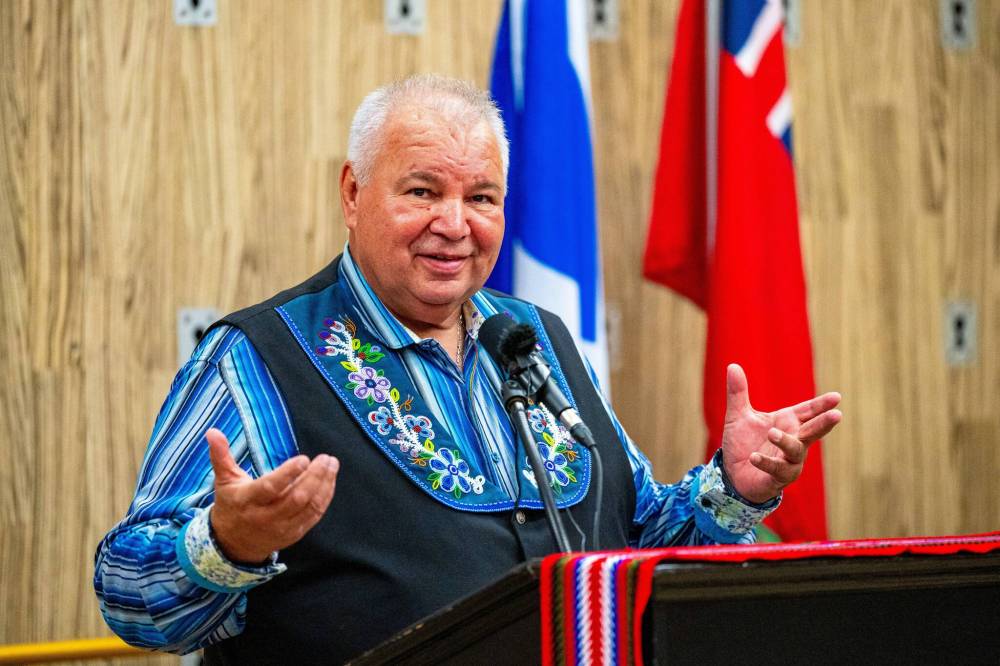
Manitoba Métis Federation President David Chartrand has pulled the organization out of a meeting with Prime Minister Mark Carney over the federal government's decision to include the Métis Nation of Ontario in talks surrounding national projects legislation. (Winnipeg Free Press)
MMF President David Chartrand argues that the PM’s decision to include representatives of the Métis Nation of Ontario undermines the integrity of the meeting, putting major projects at risk. He further claims that the federal government is also giving the Métis National Council undeserved legitimacy by including it among those groups invited to the meeting, despite the fact that the organization has just two provincial members due to conflicts related to the Métis Nation of Ontario.
The MMF, as well as other Métis groups and First Nations, argue that the communities represented by the Métis Nation of Ontario have no claim to Métis heritage. As a consequence, they argue it is inappropriate for the federal and Ontario governments to recognize them as legitimate organizations.
Yesterday morning, Chartrand told reporters that the federal government’s efforts to approve major projects would be jeopardized if it negotiates with “illegitimate bodies.” He said that “To the prime minister, the door is open,” but warned that “if you want to insult us, then we’ll see each other in a different political realm in the future.”
In response, the MNO argues that the Métis do not exist only in the Red River region. Mitch Case, the MNO’s co-secretary for rights, intergovernmental relations and communications, told reporters that the MMF is free to make decisions about its own participation at the meeting, but that it has no right to dictate who may be present.
To many, this dispute between Métis groups will appear to be nothing more than a petty rivalry involving leaders with over-inflated egos. The reality, however, is that Carney’s decision to invite MNO representatives to the meeting has put the MMF and other Métis organizations in an impossible position.
If the MMF and other groups did not register their immediate objections — if they meekly attended the meeting alongside MNO representatives and said nothing — it could be construed as an admission by them of the legitimacy of the MNO and the communities it claims to represent.
Such a conclusion would undermine the position taken by the MMF and other Métis and First Nations organizations that the communities represented by the MNO have no claim to Métis heritage. Of equal concern, the meeting would also give the MNO a voice in the discussions regarding the national projects legislation — a voice the MMF and other groups say the MNO has no right to.
Chartrand’s reference to “a different political realm in the future” should be regarded as an oblique threat of litigation if the federal government gives the MNO some sort of say regarding the national projects legislation. That litigation would likely argue that the Crown’s constitutional duty to consult with First Nations, Inuit and Métis organizations implies that the Crown must only consult with legitimate organizations — and that consulting with illegitimate organizations compromises not just the consultation process, but the outcome of those consultations.
Such complicated litigation could impede important national projects for years. Even worse, it could delay, if not destroy, much of Canada’s effort to respond to the U.S. government’s crippling trade policies.
Viewed from that perspective, it is surprising that Carney and his government stumbled into such a complex and contentious issue. Given the importance of the national projects legislation to Canada’s economy, however, they must now craft a way out of the “consultation quagmire” they have created.