
Overuse of Section 107 causing labour distrust
Advertisement
Read this article for free:
or
Already have an account? Log in here »
We need your support!
Local journalism needs your support!
As we navigate through unprecedented times, our journalists are working harder than ever to bring you the latest local updates to keep you safe and informed.
Now, more than ever, we need your support.
Starting at $15.99 plus taxes every four weeks you can access your Brandon Sun online and full access to all content as it appears on our website.
Subscribe Nowor call circulation directly at (204) 727-0527.
Your pledge helps to ensure we provide the news that matters most to your community!
To continue reading, please subscribe:
Add Brandon Sun access to your Free Press subscription for only an additional
$1 for the first 4 weeks*
- Enjoy unlimited reading on brandonsun.com
- Read the Brandon Sun E-Edition, our digital replica newspaper
*Your next Free Press subscription payment will increase by $1.00 and you will be charged $20.95 plus GST for four weeks. After four weeks, your payment will increase to $24.95 plus GST every four weeks.
Read unlimited articles for free today:
or
Already have an account? Log in here »
Hey there, time traveller!
This article was published 18/08/2025 (282 days ago), so information in it may no longer be current.
“The Liberals are violating our Charter rights to take job action and give Air Canada exactly what they want: hours and hours of unpaid labour from underpaid flight attendants, while the company pulls in sky-high profits and extraordinary executive compensation.”
— Wesley Lesosky, head of CUPE’s Air Canada Component
If you’re among the unlucky Air Canada passengers who have had flights cancelled as a result the AC-T flight attendants strike, you can perhaps be forgiven for some frustration, particularly if you were marooned at an airport mid-journey.
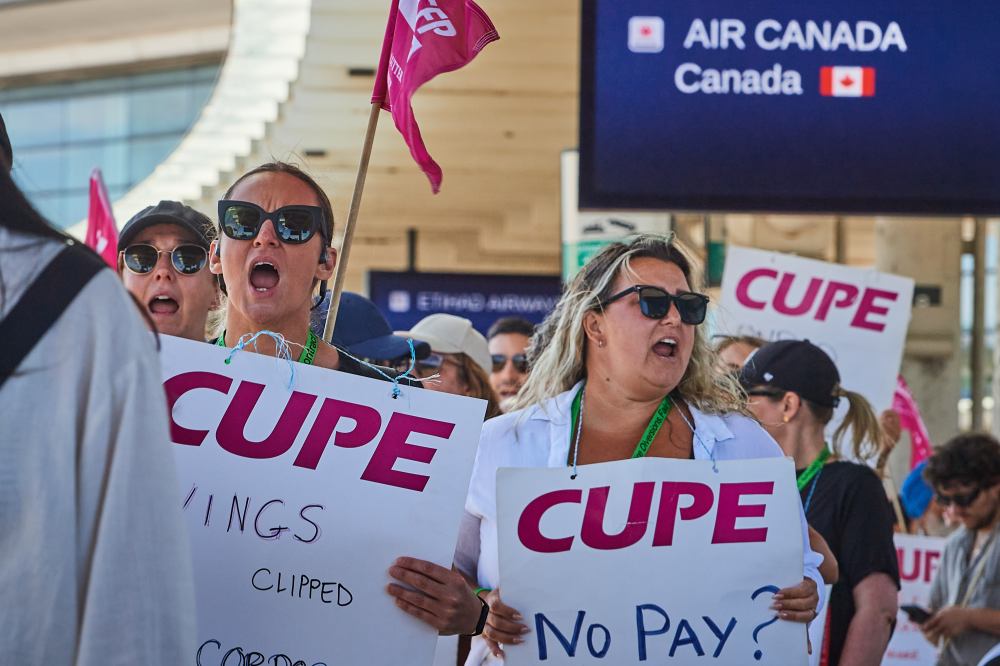
In fact, thousands of people were left trying to rebook flights over the weekend and into Monday after 10,000 members of the Canadian Union of Public Employees went on strike following months of failed negotiations.
While the strike has no doubt caused a considerable number of Canadians some headaches — and some folks are quick to blame CUPE and the flight attendants for their troubles — we urge those affected to spare some contempt for Air Canada and the federal government by considering how the company and government officials are handling this labour dispute.
On Saturday, just 12 hours after the strike action had begun, federal Jobs Minister Patty Hajdu directed the Canada Industrial Relations Board to order Air Canada and the union representing its flight attendants back to work. The minister also used Section 107 of the federal Labour Code to force the two sides into binding arbitration.
Hajdu defended the Liberal government’s decision citing the “negative impact” such a strike would have on the Canadian economy.
“Now is not the time to take risks with our economy,” she said at a news conference in Ottawa on Saturday. “A work stoppage would cause thousands of Canadians to be stranded abroad and across this country and this is simply unacceptable.”
The Canadian Press reported that Hajdu made the call after meeting with both sides on Friday night, and finding that talks had broken down and that parties remained too far apart to resolve the conflict quickly enough.
What the minister’s idea of “quickly enough” meant wasn’t exactly clear, but the federal government’s reliance on Section 107 to end a national strike has become a major crutch for the Liberals, and has evolved into a political quagmire.
CUPE members did not return to work on Saturday or Sunday, and on Monday the CIRB called the union’s decision to defy the back-to-work order “unlawful.” That has created a situation in which CUPE leaders, including national president Mark Hancock, are saying that they will move forward with the strike even if the federal government fines the union or arrests them.
It does appear on the outside looking in that the Carney government is favouring big business and executives with hefty financial contracts over the rights of union members to strike as a means to force a better deal. Whether under Mark Carney or Justin Trudeau, the Liberals have been quick to invoke Section 107 to force workers back on the job during national rail strikes, at Canada Post, against port workers in B.C., Montreal and Quebec City, and now at Air Canada.
It’s not as if flight attendants are getting rich off the backs of Air Canada flights either. According to the job search website Indeed.com, the average salary of a flight attendant is around $28.64 per hour. And looking at comments surrounding job satisfaction by flight attendants on that website over the last few years, it’s clear that many employees are stressed out and being asked to work many unpaid hours.
It’s hard to disagree with Unifor, Canada’s largest private-sector union, when it says that the Canadian government’s decision on Air Canada sends a poor message to federally regulated employers that bargaining in good faith is unnecessary because they can expect government intervention.
There are times that government can rightfully claim the need for back-to-work legislation — we don’t want the business of the nation held hostage for months on end unchecked. But ministers should be willing and able to defend that stance with evidence. And invoking Section 107 should be a rare occurrence, which has not been the case of late.
Whether through bad advice or its own hubris — or a mix of both — the Carney government has backed itself into a corner in this particular labour dispute. Continued use of this crutch will only create further distrust between labour unions, their members and the federal government.
Case in point: as of Monday afternoon, a petition started by Air Canada flight attendant Tanisha Smith demanding the removal of Patty Hajdu over her handling of the labour dispute had garnered more than 27,000 signatures.
Careful, Mr. Carney. Your government is flying in unfriendly skies.