
Pipeline MOU stirs up plenty of opposition
Advertisement
Read this article for free:
or
Already have an account? Log in here »
We need your support!
Local journalism needs your support!
As we navigate through unprecedented times, our journalists are working harder than ever to bring you the latest local updates to keep you safe and informed.
Now, more than ever, we need your support.
Starting at $15.99 plus taxes every four weeks you can access your Brandon Sun online and full access to all content as it appears on our website.
Subscribe Nowor call circulation directly at (204) 727-0527.
Your pledge helps to ensure we provide the news that matters most to your community!
To continue reading, please subscribe:
Add Brandon Sun access to your Free Press subscription for only an additional
$1 for the first 4 weeks*
*Your next subscription payment will increase by $1.00 and you will be charged $20.00 plus GST for four weeks. After four weeks, your payment will increase to $24.00 plus GST every four weeks.
Read unlimited articles for free today:
or
Already have an account? Log in here »
“If everyone thought Thursday was difficult, that was probably the easiest day in the life of that pipeline.”
— Heritage Minister Marc Miller
The Carney government and its various ministers seem to be under no illusion that the creation of a bitumen pipeline from Alberta’s oil patch to the Pacific Coast could end up being little more than a pipe dream.
Marc Miller, the former minister of Crown-Indigenous relations who was sworn in as minister of Canadian identity and culture this week, said as much to reporters ahead of Prime Minister Mark Carney’s address to hundreds of First Nations chiefs in Ottawa on Tuesday.
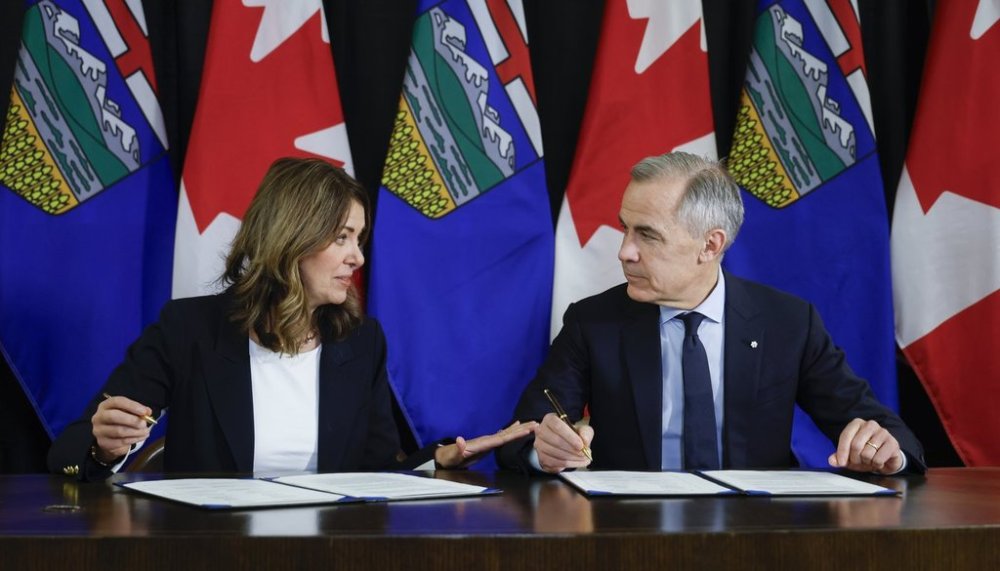
Last week, the Liberal government signed a memorandum of understanding with the Alberta government that was meant to clear a path for the construction of such a pipeline through British Columbia. As part of the MOU, Alberta would negotiate an industrial carbon pricing agreement by next April that would create an industrial carbon price of at least $130 per tonne. In exchange, the federal Liberals agreed to suspend clean electricity regulations in Alberta, and to not go ahead with the creation an oil and gas emissions cap.
Not only would the pipeline be privately constructed and financed — unlike the Trans Mountain project — under the terms of the agreement, it would allow for some Indigenous co-ownership as well.
However, the agreement has also opened up the possibility of an exemption from the federal oil tanker ban off the B.C. coast. While B.C. Premier David Eby was cautious in his comments regarding any new pipeline, saying that a tanker ban would have to remain in place for him to support it, the pipeline agreement was immediately panned by Coastal First Nations. And they’ve got a lot of support from other First Nations in Canada that are already uneasy about the Carney government running roughshod over Indigenous rights in his quest to strengthen Canada’s economy.
Before meeting with Carney on Tuesday, the Assembly of First Nations chiefs voted unanimously to demand the withdrawal of the pipeline deal between the federal government and Alberta, and affirmed their support for a moratorium on any oil tankers in coastal B.C. waters.
“Canada can create all the MOUs, project offices, advisory groups that they want: the chiefs are united,” said AFN National Chief Cindy Woodhouse Nepinak in addressing gathered First Nations. “When it comes to approving large national projects on First Nations lands, there will not be getting around rights holders.”
First Nations aren’t the only ones angered by Carney’s decision to strike a deal with Alberta. Shortly after Carney announced the deal together with Alberta Premier Danielle Smith on Thursday, then-minister of Canadian identity and culture Steven Guilbeault resigned from the prime minister’s cabinet in protest, citing his opposition to the agreement.
Guilbeault took issue with the environmental impacts of the proposed pipeline, the lack of consultation with First Nations and the B.C. government, as well as the fact that Alberta would be exempt from environmental regulations as a result of the agreement.
Guilbeault isn’t the only Liberal MP who is wary of Carney’s plan and its environmental implications. MPs from B.C. appear similarly uneasy. At the same time, environmental groups are raising the alarm of the federal government’s “doubling down” on the oil and gas industry, as Environmental Defence Canada executive director Tim Gray put it last week.
And while Mark Carney and Danielle Smith were all smiles at the signing of the MOU, a large number of UCP members within the premier’s own party greeted Smith with a hefty round of boos during a party convention when she expressed hope that people feel “more confident that Canada works than they did a couple of days ago.”
In spite of Smith’s comments to the contrary, there is most certainly a separatist base within the UCP that is gaining traction. And they let her know it over the weekend. This recent change of heart by the Alberta premier has clearly not gone over very well within her party. For her to show clear support for the federal government is akin to treason for some hard-right Albertans.
With that in mind, it’s worth questioning Carney’s thought process here. Is he deliberately trying to make gains with moderate Albertans by showing more outward support for the Prairie province? Possibly, but that can’t be the only reason.
Considering how vocal Smith was against the federal government in the wake of Carney’s election this past spring, and her political dalliance with Donald Trump earlier this year as a means to avoid the U.S. president’s tariffs, this may be simply a way of Carney getting a rather large irritation out of his way. By defanging the Alberta premier, he can simultaneously absolve himself of any fault if and when the deal fails.
Which he knows it likely will. There’s just too many players and necessary partners lined up against it.
If that’s the case, Smith fell for it hook, line and sinker.
If not, perhaps Carney isn’t the strategist he thinks he is.