
Climate change evidence too prevalent to ignore
Advertisement
Read this article for free:
or
Already have an account? Log in here »
We need your support!
Local journalism needs your support!
As we navigate through unprecedented times, our journalists are working harder than ever to bring you the latest local updates to keep you safe and informed.
Now, more than ever, we need your support.
Starting at $15.99 plus taxes every four weeks you can access your Brandon Sun online and full access to all content as it appears on our website.
Subscribe Nowor call circulation directly at (204) 727-0527.
Your pledge helps to ensure we provide the news that matters most to your community!
To continue reading, please subscribe:
Add Brandon Sun access to your Free Press subscription for only an additional
$1 for the first 4 weeks*
- Enjoy unlimited reading on brandonsun.com
- Read the Brandon Sun E-Edition, our digital replica newspaper
*Your next Free Press subscription payment will increase by $1.00 and you will be charged $20.95 plus GST for four weeks. After four weeks, your payment will increase to $24.95 plus GST every four weeks.
Read unlimited articles for free today:
or
Already have an account? Log in here »
Hey there, time traveller!
This article was published 03/12/2025 (301 days ago), so information in it may no longer be current.
Evidence of climate change is all around us. Pay attention, and you’ll see how so many little things start adding up.
If you follow U.S. college football, you might have been watching this past weekend when the Horned Frogs of TCU were playing the Cincinnati Bearcats. That is, until a lightning storm intervened.
Play was stopped for an hour and 33 minutes. The stands emptied, the players went to their dressing rooms, and the television broadcast for the commentators, well, got tougher.
There’s a lot of space to fill in when there’s a 93-minute delay, and the commentators did their best — talked about the teams, the rules around lightning delays, and the uncommon situation of a thunderstorm in Fort Worth, Texas, on Nov. 29.
One commentator argued that, during his own lengthy playing career, he’d only ever played in a game stopped by lightning once. This year, he said, there had been teams that had seen as many as three games with lightning delays during the less-than-12-game season so far.
The change in weather conditions has gotten common enough, the commentator said, that several coaches have now built lightning-delay training into their game preparations — players have to be ready for the possibility that they may have to return to the field cold, without warmups, and go right into high-impact, high-level play.
Interesting how things have changed. In the climate change business, you could call the move by the coaches “mitigation.”
Meanwhile, in southern Saskatchewan and also last week, there’s another kind of weather complaint.
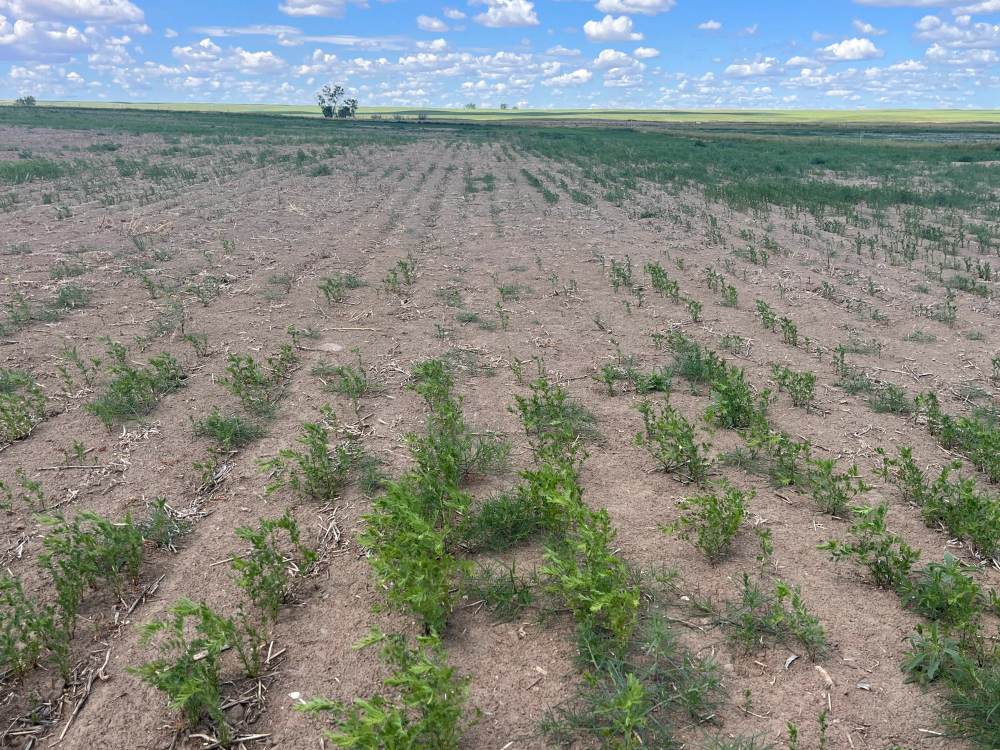
Farmers from southwestern Saskatchewan went to the province’s legislature to campaign for changes to crop insurance after facing nine consecutive years of drought.
“Our insurance programs were built for maybe two or three years of drought, but they were not built for these kinds of extremes,” Quinton Jacksteit, reeve of the Regional Municipality of Big Stick, told reporters. “We’re asking for insurance programs that are fair, so that we can buy enough insurance to sustain our farms.”
The farmers point out that between 50 and 75 per cent of the farms in their area are facing fiscal collapse, in part because the province’s crop insurance program doesn’t take into account multiple-year droughts of the type they are now encountering.
Sounds a bit like that province’s crop insurance system could also benefit from a bit of pragmatic climate “mitigation.”
Here in Manitoba, parts of the province have been facing drought-like conditions for several years in a row already. Trevor Hadwen with Agriculture and Agri-Food Canada told PortageOnline more than a year ago that “a large portion of the Prairies have been in drought for quite a while, and the severity of that drought has been fairly significant.”
At the time, he said drought-like conditions in Western Canada had persisted between three and five years. And 2025 extends that situation by another year.
That revelation should have hit the province rather hard this past September when Manitoba Hydro announced a consolidated net loss of $63 million for the fiscal year ending March 31, 2025, due to low water conditions.
According to president and CEO Allan Danroth, 2024 marked the second low water year in a row and third Manitoba Hydro has experienced in a four-year period.
The fact is that not every single climate change impact is as dramatic as the huge forest fires that struck Manitoba this year during a prolonged dry period.
The changes can be as simple as single species of trees suddenly facing a change in their range, or different species of fish having to move progressively further north as temperatures change in the oceans.
They can be as mathematically complex as the algorithms that insurance companies use to establish that there’s a far greater risk of fire and flood, corresponding increased costs for repairs and replacements, and a need to increase pretty much everyone’s premiums.
It’s the steady tick, tick, tick of vanishing species, and the northwards march of a tick that can make you allergic to eating red meat.
But it’s undeniably happening. Maybe you don’t think that climate change is serious enough to warrant trying to stop it. Maybe you don’t want to feel responsible for your small part in it, or want to pay your share of the cost of preventing its continuation. Maybe you are among those who think it has always been around — leaving aside the dramatic, rapid and expensive damage it’s already doing.
Denying it is really only burying your head in the sand. But at least there’s more sand to use: desertification is a big part of the change in some parts of the world, after all.
» Winnipeg Free Press and The Brandon Sun