
PM facing hard choices in the very near future
Advertisement
Read this article for free:
or
Already have an account? Log in here »
We need your support!
Local journalism needs your support!
As we navigate through unprecedented times, our journalists are working harder than ever to bring you the latest local updates to keep you safe and informed.
Now, more than ever, we need your support.
Starting at $15.99 plus taxes every four weeks you can access your Brandon Sun online and full access to all content as it appears on our website.
Subscribe Nowor call circulation directly at (204) 727-0527.
Your pledge helps to ensure we provide the news that matters most to your community!
To continue reading, please subscribe:
Add Brandon Sun access to your Free Press subscription for only an additional
$1 for the first 4 weeks*
*Your next subscription payment will increase by $1.00 and you will be charged $20.00 plus GST for four weeks. After four weeks, your payment will increase to $24.00 plus GST every four weeks.
Read unlimited articles for free today:
or
Already have an account? Log in here »
“The old relationship we had with the United States, based on deepening integration of our economies and tight security and military co-operation, is over.”
— Prime Minister Mark Carney, March 2025
Mark Carney is playing the long game with Canada’s economic future. That much has been clear, ever since Canada’s prime minister uttered these words this past spring.
Whether he — and Canada — win that long game will much depend on Canadians’ ability to sustain some short-term pain.
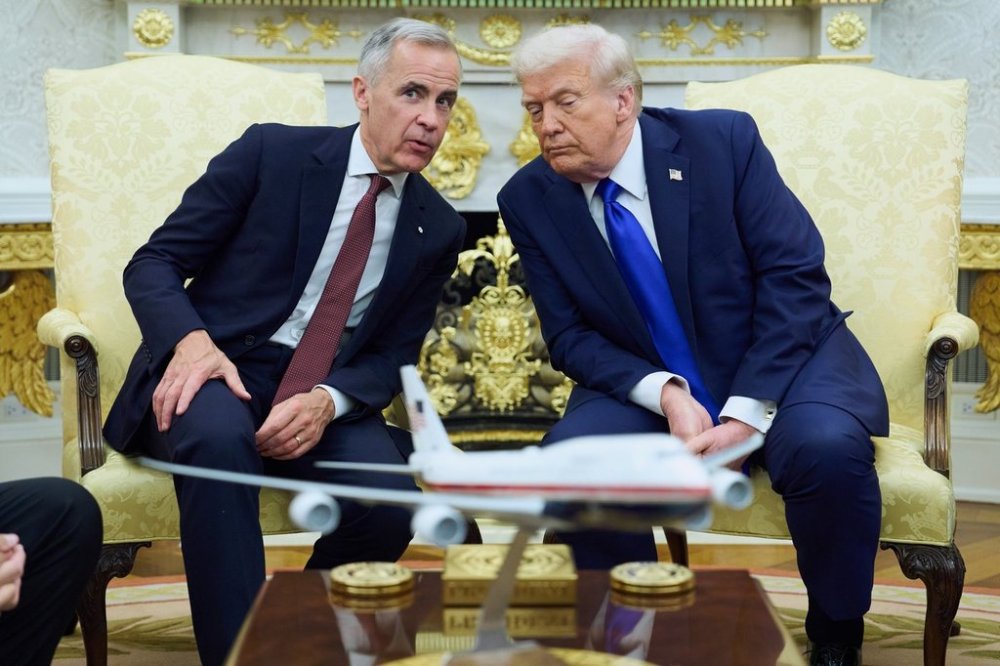
Carney has been making the rounds with eastern media this week for end-of-the-year interviews in both English and French. In a pair of French-language interviews, as reported by the Toronto Star, he revealed details of his private conversation earlier this month with U.S. President Donald Trump and Mexican President Claudia Sheinbaum during the World Cup soccer draw in Washington.
The prime minister told Radio-Canada that Trump didn’t really want to “tear up” the Canada-U.S.-Mexico free trade agreement — never mind the public sabre-rattling by the U.S. president and Trade Representative Jamieson Greer, who talked openly about letting CUSMA “expire.” Instead, the leaders discussed the process regarding the trade deal’s scheduled review, which he said will be a “negotiation.”
But it was Carney’s second interview that was more concerning. In his comments to Quebec’s TVA, he said Trump has made it clear in private that “in effect,” he wants Canada to have a “relationship of dependence on the United States, and I don’t accept that.”
While that may not be particularly surprising, given the antics of this American president over the past year — tariffs and all — it does offer a little more insight into Carney’s push to open up new trade horizons with countries other than the United States.
We are far from the glory years of the U.S.-Canada relationship, when a Canadian prime minister named Brian Mulroney hobnobbed with a U.S. president named Ronald Reagan. At the time, building closer and better ties with our U.S. ally seemed like the logical choice, an economic decision that created the landmark North American Free Trade Agreement in 1994.
But the hard lesson of 2025 has been that Canada puts its own independence and sovereignty at risk by placing all of its economic eggs in the U.S. basket. Trump’s America sees trade access not as a bargaining chip for negotiation, but as a weapon to bend other nations to its will.
We can see the undercurrent of that thinking in the most recent conditions laid out by Greer just this past Wednesday, when he told the U.S. Congress that CUSMA has been “successful to a certain degree,” but that there needs to be changes. Those changes would take aim, according to a CBC report, at Canada’s Online Streaming Act which brought Netflix, Spotify and YouTube under Canadian broadcasting rules, as well as our supply-managed dairy sector.
Greer said the streaming legislation discriminates against American tech firms, though it was used as a means to force these online platforms to carry Canadian content. And while the U.S. trade rep didn’t talk about dismantling supply management, the U.S. dairy lobby wants our trade rules relaxed.
No doubt Canadians can take a little pride in the fact that the provincial bans on the distribution of U.S. alcohol in liquor stores across the country made a rather heavy impact on U.S. companies. So much so, that Greer wants Canada to address the situation.
All of these changes and actions, according to a CBC report, would have to be made before Trump agrees to extend the agreement another 16 years or have it revert to yearly reviews. That kind of uncertainty is something our economy — as it currently stands — doesn’t need.
That officials are talking more about the coming review of CUSMA should tell us much about the state of tariff negotiations between Trump and Carney. Carney himself told the Globe and Mail that he does not expect Canada and the U.S. will reach a near-term deal to end Trump’s tariffs on steel, aluminum, autos and other sectors.
It’s more likely, he said, that these negotiations will become part of the CUSMA review. That puts a lot more pressure on the Canadian government to make the three-way trade deal work — and gives the Trump administration a lot more power over how those negotiations go, should we want to maintain our reliance on access to the U.S. market.
This is where Carney’s efforts to diversify Canada’s trade partners comes in. The more markets we open, and the more economic partnerships we hammer out with countries in Europe and Asia, the stronger and more resilient our economy becomes to U.S. pressure tactics. And Carney has made several swift and decisive steps in this direction.
Gaining greater autonomy for Canada is also at the core of the decision to initiate a formal review of the $19-billion contract for 88 F-35 fighter jets from U.S.-based Lockheed Martin. We’re legally committed to purchasing 16 of them, but we’re openly being courted by Saab in Sweden to fill out the rest of that order with Gripen E aircraft instead.
Not only would purchasing the Gripen ensure more homegrown benefits, including the promise of 6,000 new jobs across Canada, it would include an intellectual property transfer from Saab to help build additional capabilities in Canada’s aerospace industry — lessening our over-reliance on the U.S. defence industry.
The next year will test the Carney administration’s negotiation capabilities — this is not a simple renegotiation of an existing trade agreement with a friendly neighbour. There is no sugar-coating the fact that Trump sees Canada as a vassal state — the lesser partner in a relationship that merely feeds the U.S. economy and caters to U.S. interests.
As the Hill Times wrote this month, Trump’s recently released National Security Strategy has made it clear that there will be little tolerance for countries that pursue policies running counter to U.S. commercial interests. And we are actively within the cross-hairs of Trump’s America-first policy.
Carney has been playing it pretty smooth so far, trying to befriend the White House while pursuing international trade deals with other countries. But some hard decisions are coming up very shortly. The F-35 decision alone has the potential to derail trade negotiations with the Trump administration, depending on what the feds decide.
While that has economic and political implications for this government, capitulation to Trump’s demands would have a far more deleterious effect on Canada’s long-term future, in every way that matters.