
Riding the fiscal rollercoaster
Advertisement
Read this article for free:
or
Already have an account? Log in here »
We need your support!
Local journalism needs your support!
As we navigate through unprecedented times, our journalists are working harder than ever to bring you the latest local updates to keep you safe and informed.
Now, more than ever, we need your support.
Starting at $15.99 plus taxes every four weeks you can access your Brandon Sun online and full access to all content as it appears on our website.
Subscribe Nowor call circulation directly at (204) 727-0527.
Your pledge helps to ensure we provide the news that matters most to your community!
To continue reading, please subscribe:
Add Brandon Sun access to your Free Press subscription for only an additional
$1 for the first 4 weeks*
*Your next subscription payment will increase by $1.00 and you will be charged $20.00 plus GST for four weeks. After four weeks, your payment will increase to $24.00 plus GST every four weeks.
Read unlimited articles for free today:
or
Already have an account? Log in here »
It was truly a fiscal roller coaster of emotions.
On Dec. 12, Manitoba learned it would be getting a $355-million increase to its federal equalization payment, bringing the total to just more than $5 billion. Equalization involves the redistribution of federal income tax revenue from provinces with bigger economies to those with smaller economies to ensure all Canadians have access to the same levels of government services.
Just three days later, the euphoria over the increase in equalization was dashed by news the budget deficit had grown exponentially. The province’s second-quarter fiscal update showed the budget is now forecast to have a $1.6-billion deficit, nearly twice what the NDP government had budgeted in the spring.
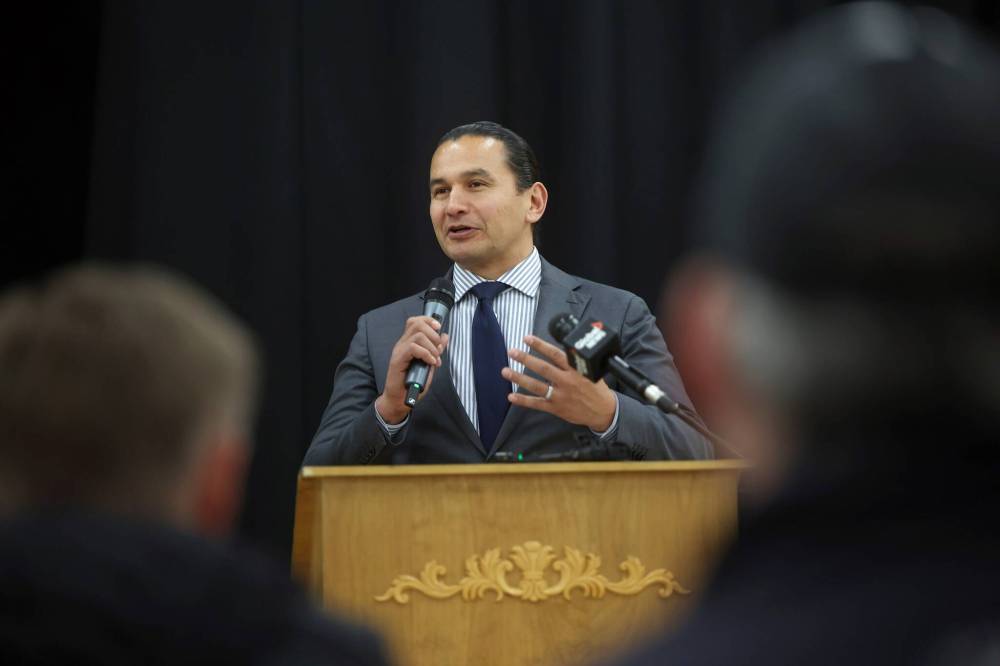
Premier Wab Kinew should forget about his lofty goal of having Manitoba becomes "have" province by 2040 and focus on more pressing priorities. (File)
The fiscal backsliding was attributed to the impacts of a historic drought. The province faced $227 million dollars in unfunded costs to fight wildfires. At the same time, Manitoba Hydro went from forecasting a small net profit to a $464-million loss, all due to drought that has lowered water levels.
If all that wasn’t enough, the quarterly report confirmed the Trump-inspired global tariff war is lowering own-source revenues.
Manitobans may ask themselves: what does this all mean for me?
Although the equalization windfall is good for the treasury, its impact is obviously diminished by the drought-induced spike in both unbudgeted costs, the free fall in Hydro profits and the slowing of economic growth. The net consequence is that Premier Wab Kinew has much less fiscal capacity to spend on the hallmark challenges he has pledged to address: homelessness, mental health and addiction; health-care waiting lists and physician/nurse recruitment.
With an election scheduled no later than the fall of 2027, the bigger question is how the Kinew government will manage its finances moving forward. One thing seems clear: Kinew will be unable to balance the budget before the next election, a key promise from the last election.
But that is not the only fiscal pledge Kinew has made. Recently, Kinew joined a long list of political leaders in this province by pledging to make Manitoba a “have” province — one that does not receive equalization — by 2040.
There is a lot of political hubris at work here.
Although there is a strong argument the growing deficit is due to historic forces beyond government’s control, Kinew’s musings on becoming a “have” province seem misguided at best, and potentially delusional at worst. The premier needs to show Manitobans he can get his priorities straight.
There is no shame in accepting equalization. The money redistributed by Ottawa largely reflects the impact of lucrative natural resources on some provincial treasuries. Equalization allows all Canadians, even those that live in provinces that don’t have oil reserves, to share in the wealth.
Similarly, there is no shame in running a large deficit. At the moment, every province in Canada is awash in red ink, and for largely the same reasons. Climate-change triggered disasters have laid waste to government balance sheets, while a global trade war has slowed economic growth to such an extent that a recession is not out of the question.
For Kinew, who may be considering an early election call, it will be helpful to put aside hyperbole and focus on the preservation of key government services at a time when costs are going up and revenues are going down. There is virtually no chance Kinew can cut his way to a balanced budget; he must hold the line on spending until the tariff war eases and the economy starts to grow again.
What he cannot do is spend any time worrying about whether Manitoba is a “have” or “have not” province.
Quite frankly, Kinew has much bigger things to worry about.
» Winnipeg Free Press