
Clean water a growing concern for communities
Advertisement
Read this article for free:
or
Already have an account? Log in here »
We need your support!
Local journalism needs your support!
As we navigate through unprecedented times, our journalists are working harder than ever to bring you the latest local updates to keep you safe and informed.
Now, more than ever, we need your support.
Starting at $15.99 plus taxes every four weeks you can access your Brandon Sun online and full access to all content as it appears on our website.
Subscribe Nowor call circulation directly at (204) 727-0527.
Your pledge helps to ensure we provide the news that matters most to your community!
To continue reading, please subscribe:
Add Brandon Sun access to your Free Press subscription for only an additional
$1 for the first 4 weeks*
*Your next subscription payment will increase by $1.00 and you will be charged $20.00 plus GST for four weeks. After four weeks, your payment will increase to $24.00 plus GST every four weeks.
Read unlimited articles for free today:
or
Already have an account? Log in here »
The Town of Virden’s ongoing arsenic troubles are leaving a bad taste in the mouths of area residents, many of whom have resorted to purchasing bottled water for their daily household needs.
But the difficult nature of the groundwater in the region — and the fact that low water levels in a more recently tapped aquifer necessitated a return to the arsenic-contaminated wells — should raise some questions.
The problem of arsenic for Virden residents first arose in 1993, when Canadian Drinking Water Standards reduced the acceptable level of arsenic from .05 parts per million to .025. Tests conducted by the town in 1994 showed consistent readings of slightly above .05.
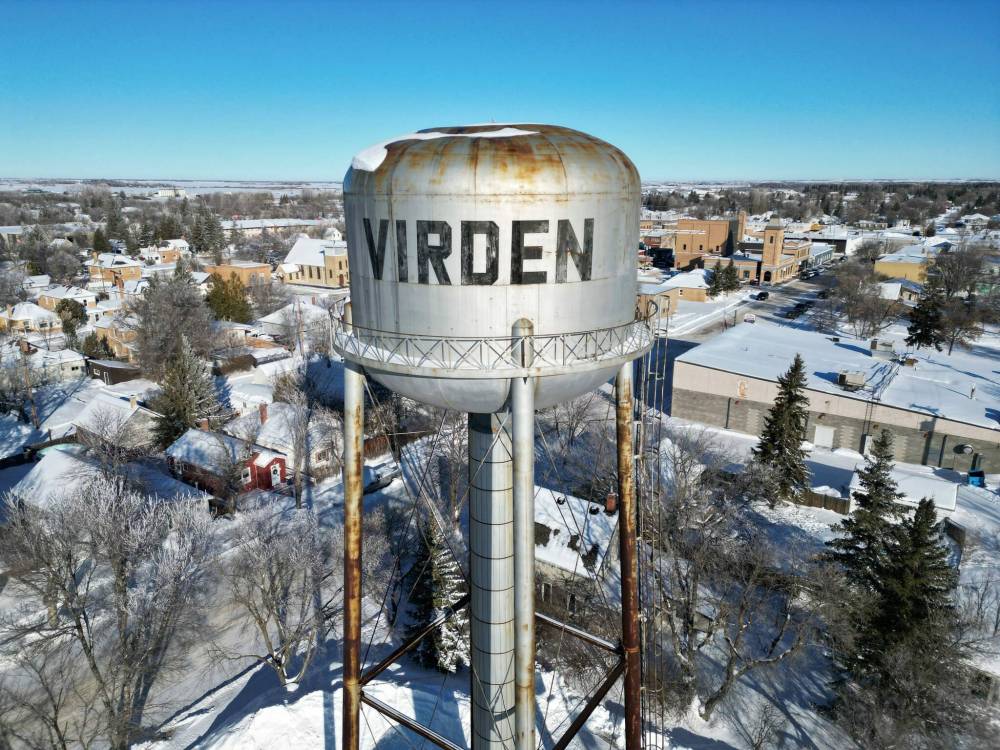
The historic water tower in Virden looms above the town on a sunny Wednesday.
After spending millions of federal, provincial and local taxpayer dollars for a remedy, the community hoped its arsenic troubles were over in 1998, when a new water treatment plant came into operation.
At the time, a local development officer told the Sun that good water was “essential” to attracting many types of investment, as well as for attracting new community residents.
Unfortunately, the new water treatment plant did not solve the issue, as arsenic levels were still above the national recommended level. In 2010, a $1.8-million upgrade to the plant was expected to solve the problem, but arsenic levels were yet again above the maximum allowed concentration in 2012, when Health Canada further reduced the allowable limit of arsenic in drinking water.
That prompted a drinking water advisory.
Problems arose again from August 2017 until April 2018, when arsenic in Virden’s water remained above the recommended limit.
By January 2020, then-Virden mayor Murray Wright was hopeful that they had finally found a solution to the arsenic problem with the discovery of a new source well. Ultimately, the water in the new aquifer, which came online in 2021, did in fact meet safe drinking levels.
However, as CBC reported last year, a 2020 water supply study by W.L. Gibbons and Associates on the water supply upgrade raised concerns about the long-term sustainability of groundwater withdrawals — this according to local Virden resident John Hipwell, whose well ran dry soon after the town began drawing from the shared aquifer in 2021.
Those fears became realized in October 2025, when water levels in the new aquifer became critically low. The town was forced to move to the other water source in November.
And in December, the town’s aquifer was found to have roughly 0.25 milligrams of arsenic per litre of water — well above Health Canada’s current drinking water safety guideline limit of 0.10.
Of course, Virden is hardly alone in western and south-central Manitoba when it comes to arsenic problems. There are several other communities with known arsenic in well water, including Notre Dame de Lourdes, Birtle, Russell, Winkler, St. Malo and Tolstoi. So, too, the Oak Lake aquifer, which has shown variable arsenic levels over the years.
Most if not all of these arsenic contaminations are naturally occurring. Elevated arsenic levels are often found in sand and gravel aquifers.
For now, as Mayor Tina Williams told the Sun this week, the levels of arsenic in Virden’s water supply are not astronomical, and there is no immediate threat to local health.
“They have slightly above the Canadian levels at the moment, but, I mean, there’s nothing high about it,” she said.
The challenge for Virden is finding a bigger and better source of water for the community that will, once and for all, solve the community’s water ills. We have no doubt that the town’s administration and the province are working to find a solution.
It’s the long-term effects that are the most problematic, as arsenic-laced water use — even in small amounts — can cause cancer along with other chronic diseases over long periods of time.
For the rest of the region, it’s the ongoing drought situation facing western Manitoba that should concern communities the most, particularly those that have had problems with ground water levels in the past.
Low rainfall can cause underground aquifers to recharge more slowly, and there is a need for communities to be more careful when it comes to water use.
The situation became dire for the City of Morden in 2021, for example, when extreme drought dropped water levels in Lake Minnewasta — the community’s water source — to 2.7 metres below normal.
We have to wonder how many other communities will be at the mercy of lower precipitation levels in the coming years.
So, too, the situation facing municipalities in the southwest corner of the province, where Montreal-based Deep Sky is considering the construction of a carbon capture project. Area residents have already voiced concerns about potential impacts on the local water aquifers and the environment.
Given the effects of climate change, it stands to reason that access to clean, potable water will be a growing issue for communities in western Manitoba, going forward.