
Carney, ministers need to stay wary of China
Advertisement
Read this article for free:
or
Already have an account? Log in here »
We need your support!
Local journalism needs your support!
As we navigate through unprecedented times, our journalists are working harder than ever to bring you the latest local updates to keep you safe and informed.
Now, more than ever, we need your support.
Starting at $15.99 plus taxes every four weeks you can access your Brandon Sun online and full access to all content as it appears on our website.
Subscribe Nowor call circulation directly at (204) 727-0527.
Your pledge helps to ensure we provide the news that matters most to your community!
To continue reading, please subscribe:
Add Brandon Sun access to your Free Press subscription for only an additional
$1 for the first 4 weeks*
*Your next subscription payment will increase by $1.00 and you will be charged $20.00 plus GST for four weeks. After four weeks, your payment will increase to $24.00 plus GST every four weeks.
Read unlimited articles for free today:
or
Already have an account? Log in here »
Prairie farmers can be forgiven if they seem more than a little irritated at the slow pace of Canada’s government to address China’s tariffs. It has been nearly a year since China imposed a 100 per cent tariff on Canadian canola oil, canola meal and peas, in addition to a 25 per cent tariff on Canadian pork and seafood products.
And since August, producers have also had to deal with an added 76 per cent Chinese tariff on canola seed.
As it stands, Rick White of the Canadian Canola Growers Association told The Canadian Press this week that Beijing’s steep levies on canola will cost producers at least $2 billion this year if the issue isn’t resolved.
For provinces like Saskatchewan and Manitoba, which grow approximately 50 per cent and 14 per cent of Canada’s total canola acreage, respectively, these are difficult financial pressures that will impact many farm operations, particularly those who still have canola in the bin with spring seeding only a few months away.
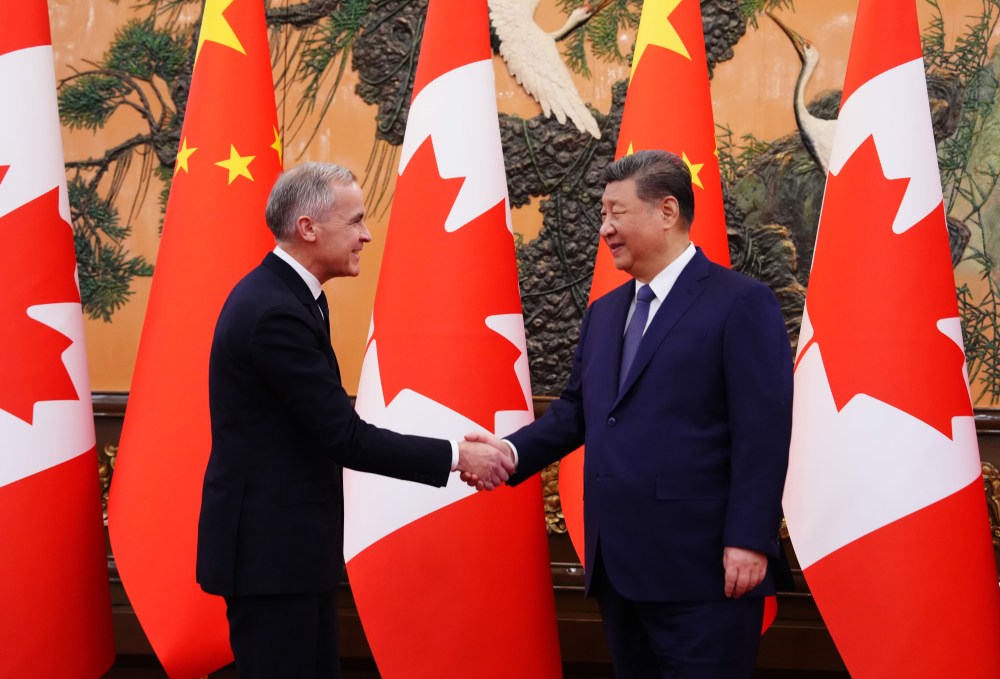
So there has been significant anticipation from area producers looking for some sign of movement on this issue coming out of Prime Minister Mark Carney’s visit to China this week. Unfortunately, they’re likely to be disappointed.
Even as Carney government officials were playing up the potential for setting a new tone with China, and possibly broadening Canada’s economic diversity — particularly regarding Canadian oil and liquefied natural gas exports to China, as well as better trade diversification — they were attempting to manage expectations for any kind of tariff resolution.
A story in the Globe and Mail earlier this week reported that government officials told those in the canola industry not to expect Carney’s trip to China to result in the elimination of tariffs. At best, it might result in reduced rates.
These agricultural tariffs have pitted Canada’s agricultural sector against Ontario’s automotive industry, as China only imposed them after Ottawa placed a 100 per cent tariff on Chinese-made electric vehicles, following the U.S. lead in late 2024. Beijing has been rather firm in stating that tariffs on canola, peas, pork and seafood would remain in place until Ottawa drops the EV levies.
It’s hardly the first time Canada has been caught in the middle of U.S.-China disputes, which have led to serious trade disputes between China and Canada. For example, in 2018 the arrest of Huawei CFO Meng Wanzhou in Vancouver at the request of the United States triggered a diplomatic freeze between Canada and China, and prompted a trade retaliation by China against Canadian canola, pork and beef.
China has not acted without its own measure of subterfuge either — Beijing has actively tried to exploit economic leverage and international relationships to fracture co-operation between the United States and Canada over the last several decades.
A September report by the Center for North American Prosperity and Security documented a 2022 Five Eyes intelligence assessment that noted Chinese operations had “successfully delayed or prevented several joint Canada-U.S. initiatives on critical technology protection and investment screening.”
These kinds of actions do nothing to encourage trust between nations, and China’s territorial assertiveness doesn’t make negotiating with the rising superpower any easier.
Nevertheless, Carney is correct when he says that its necessary for Canada to diversity its trading partners, particularly during “this moment of economic stress for our country.”
As such, Carney’s announcement on Thursday that Canada is entering a “new era of relations” with China must be seen through the lens of careful — and hopeful — diplomacy.
Carney has been signalling his government’s efforts to actively reduce Canada’s economic reliance on the United States, citing the “coercive U.S. trade policy” and the universal tariffs slapped on Canada by the Trump administration.
And it’s not surprising that China sees an opportunity to drive another wedge between the U.S. and Canada — an Associated Press story reported China’s state media had called on the Carney government to set a foreign policy path independent of the United States, what it called “strategic autonomy.”
According to Foreign Affairs Minister Anita Anand, talks on reducing Chinese tariffs on canola have been “productive,” with the negotiations “continuing.”
That’s a hopeful sign for the coming months.
And it must be said that negotiating with China is a far better alternative to having frozen relations between our two nations. Talk and diplomacy should continue to be Canada’s preferred option. We may yet see some movement on the canola tariffs yet.
But we urge Carney and his ministers to keep their eyes open. Given the adversarial nature of both China and the current U.S. administration, we have just as much reason to be wary of promises made by Xi Jinping as we do of Donald Trump.