
Promoting ethics in AI will be a real challenge
Advertisement
Read this article for free:
or
Already have an account? Log in here »
We need your support!
Local journalism needs your support!
As we navigate through unprecedented times, our journalists are working harder than ever to bring you the latest local updates to keep you safe and informed.
Now, more than ever, we need your support.
Starting at $15.99 plus taxes every four weeks you can access your Brandon Sun online and full access to all content as it appears on our website.
Subscribe Nowor call circulation directly at (204) 727-0527.
Your pledge helps to ensure we provide the news that matters most to your community!
To continue reading, please subscribe:
Add Brandon Sun access to your Free Press subscription for only an additional
$1 for the first 4 weeks*
- Enjoy unlimited reading on brandonsun.com
- Read the Brandon Sun E-Edition, our digital replica newspaper
*Your next Free Press subscription payment will increase by $1.00 and you will be charged $20.95 plus GST for four weeks. After four weeks, your payment will increase to $24.95 plus GST every four weeks.
Read unlimited articles for free today:
or
Already have an account? Log in here »
With the introduction of any new, earth-shaking technology, there are always going to be tradeoffs. Some good, some bad.
For example, the introduction of motorized vehicles gave citizens a faster and more convenient way to get from point A to point B, provided economic growth and job creation, and energized manufacturing and innovation in the business sector. But there were several downsides, too.
The growth of cars and trucks prompted an increase in accidental deaths, drastically increased pollution rates around the world, and eventually gave rise to urban sprawl and decay, among other things.
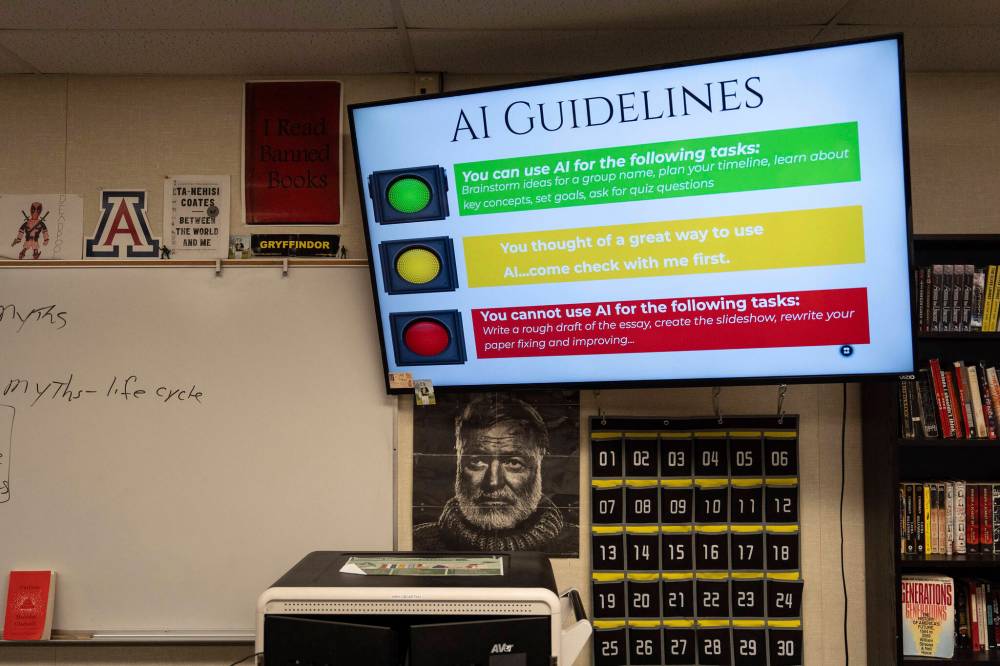
A screen displays guidelines for using artificial intelligence in a high school classroom in Santa Clarita, Calif., in August 2025. (The Associated Press files)
Electricity too was once a new and novel technology. While it eventually became indispensable to human society, in the early days of its incorporation electricity was considered both a menace and a marvel. As noted in a report last August on Medium.com, early wiring was wrapped in cloth, and power lines “sparked fires, electrocuted linemen and terrified factory owners.”
There were even attempts to discredit the technology — and one of its proponents, Nikola Tesla — by none other than Thomas Edison, who staged public demonstrations that included electrocuting animals to prove the dangers of alternating current.
And today, nearly 30 years after internet use became truly widespread — a technology that itself has transformed society, both positively and negatively — we are watching the rapid rise of artificial intelligence, which promises even more societal disruption in ways we may not even fully fathom yet.
Older generations are still either dipping their toes into the AI waters or backing away from the water’s edge, while those in their 40s and 60s are cautiously wading in a bit deeper. But it’s the 16- to 29-year-olds and 30- to 44-year-olds, Generation Z and the Millennials, respectively, who have begun integrating AI into their daily routines.
While there are professionals who are adopting the tech for work purposes such as brainstorming ideas and automating professional tasks, its use among students in high school and post-secondary institutions has skyrocketed.
The science website Phys.org reported just yesterday that a 2025 survey by Deloitte found that 76 per cent of Gen Zers have used standalone generative AI tools like ChatGPT for Claude — the highest rate of any generation. And among them, use of AI for education topped the list, with 61 per cent of respondents saying they use AI to support their learning.
This generation is looking at AI “with curiosity rather than caution, focusing on how it can streamline efficiency and improve everyday experiences,” the article reads.
It must be said that there are definite benefits for AI use. As several online articles have noted, AI can streamline tedious administrative tasks, aid researchers in collecting and analyzing data more efficiently, reduce errors, allow for faster health-care diagnostics and even augment human creativity.
But like all previous technologies before it, there are huge red flags as well, which have already been most keenly felt in the classroom.
Some of the most obvious concerns revolve around ethics. There has been a huge rise in academic dishonesty in using AI to cheat, and current AI use appears to undermine the use of critical thinking skills and creativity — not to mention the fact that many AI results are too often inaccurate, with some studies suggesting error rates of more than 60 per cent.
Other concerns include compromised student privacy and data security, as well as reduced emotional development when students have less human interaction.
Universities and colleges have already begun to grapple with the new technology. Some have decided to embrace AI and use it as part of the curriculum. It has also prompted changes to how post-secondary institutions evaluate work, putting more emphasis on in-class presentations, class discussions and handwritten assignments, while moving away from traditional essay assignments.
With that in mind, it makes sense for federal and provincial governments to begin the process of incorporating and monitoring AI use in the classroom, as a means to provide students with ethical guidelines on its use.
Which is why we’re glad the Manitoba government last week announced its plan to develop a provincewide framework, dubbed “Guiding Principles on AI in Education,” to support educators in our province.
The framework was announced at Manitoba’s first Artificial Intelligence in Education Summit in Winnipeg last Friday, a meeting that brought together 500 kindergarten to Grade 12 and post-secondary educators, school leaders, policymakers and industry partners from across Manitoba.
“Responsible use of AI is a big theme of today’s event,” said Education Minister Tracy Schmidt. “We want to give kids the tools to use AI in an ethical way, in a responsible way, and ultimately in a way that benefits them and doesn’t hurt them.”
While we have yet to see the result of these efforts, any move to offer some instruction for students is a good step forward, as so many technologies of the past had very little by way of expert guidance for their adoption.
But at the heart of this new framework must be a conscious effort to keep the humanity in creativity and innovation, while promoting adherence to ethical considerations. And that will be a difficult task for educators, as the technology’s growth has already outpaced humanity’s ability to grasp its societal implications.
We can only hope they’re a quick study.