
Hydro’s harsh realities forced turbine solution
Advertisement
Read this article for free:
or
Already have an account? Log in here »
We need your support!
Local journalism needs your support!
As we navigate through unprecedented times, our journalists are working harder than ever to bring you the latest local updates to keep you safe and informed.
Now, more than ever, we need your support.
Starting at $15.99 plus taxes every four weeks you can access your Brandon Sun online and full access to all content as it appears on our website.
Subscribe Nowor call circulation directly at (204) 727-0527.
Your pledge helps to ensure we provide the news that matters most to your community!
To continue reading, please subscribe:
Add Brandon Sun access to your Free Press subscription for only an additional
$1 for the first 4 weeks*
- Enjoy unlimited reading on brandonsun.com
- Read the Brandon Sun E-Edition, our digital replica newspaper
*Your next Free Press subscription payment will increase by $1.00 and you will be charged $20.95 plus GST for four weeks. After four weeks, your payment will increase to $24.95 plus GST every four weeks.
Read unlimited articles for free today:
or
Already have an account? Log in here »
There’s a lot to be said for the power of pragmatic economics.
That’s a particularly true statement when politicians of a sort find themselves forced to choose the lesser evil — namely what they can live with instead of the perfection they once promised.
Readers may recall that shortly after winning the 2023 provincial election, Manitoba Premier Wab Kinew issued a mandate letter to Finance Minister Adrien Sala, the minister responsible for Manitoba Hydro, instructing him to begin working on plans to phase out the on-demand use of the Brandon gas-fired generating station by 2035.
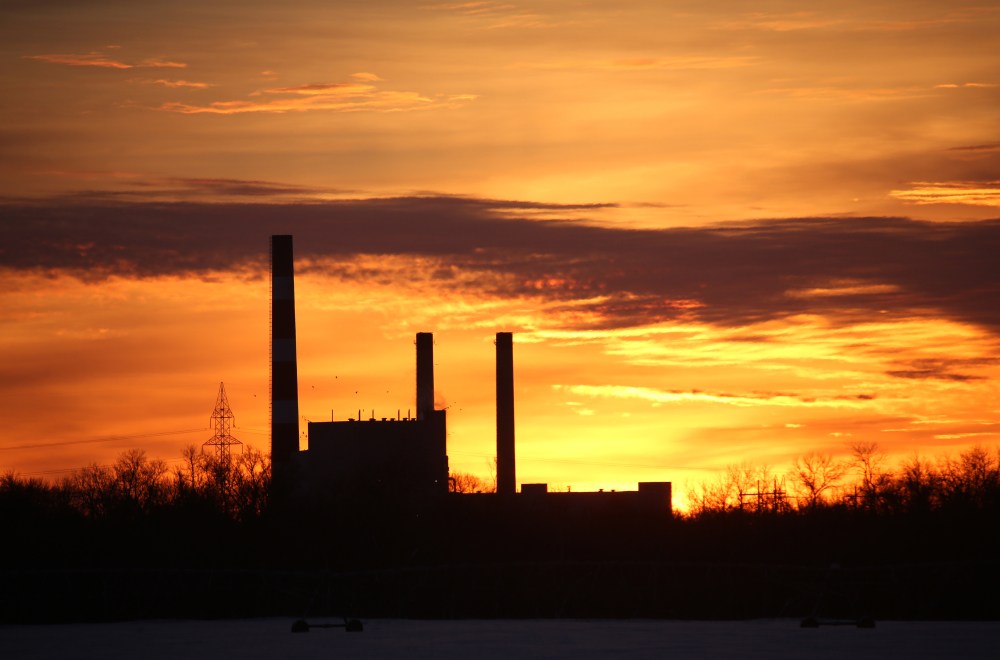
The point of that instruction was to help the government meet its stated goal of making Manitoba Hydro 100 per cent green, as well as the broader goal of making the province carbon-neutral by 2050.
But those efforts, however noble, did not take into account the rather large elephant in the room — that Manitoba Hydro would soon run out of electrical capacity.
A few months later, in February 2024, then-Manitoba Hydro CEO Jay Grewal told a room full of business people with the Manitoba Chamber of Commerce that the Crown corporation had an urgent need for new power generation by 2029-30 because of the rapid growth in demand for power in the province.
The challenge for Manitoba Hydro, she said at the time, was to find a way to double or triple Manitoba’s generating capacity in less than 15 years.
There were going to be no new hydro generating stations — successive droughts had already impacted Hydro’s bottom line. Instead, she believed that Manitoba Hydro would need build a lot more wind farms in the near future.
“Every utility is facing the impact of that policy (to reach net zero by 2035),” Grewal said. “We will be spending to build clean generation. Other provinces and utilities will have to spend to replace carbon-based generation and then build new (net-zero power generation).
“We are in an enviable position.”
Shortly after, she was fired from that position. Nevertheless, it appears she had a point — Manitoba Hydro has a capacity problem that is rapidly coming to a head.
To meet that demand, Kinew has not only had to reverse his plans to phase out Brandon’s existing gas-fired generating station, but has instead gone in the compete opposite direction by opting to spend up to $3 billion to build three new combustion turbine units in Brandon to help power the province during peak usage times.
We outlined the project in Saturday’s Sun, noting that natural gas pipelines would need to be installed in the rural municipalities of Elton and Cornwallis to connect to a main line. For interested area residents, Hydro will host a pair of open houses in Westman — one in Brandon and one in Rivers — over the next two weeks, with several other virtual information sessions available.
Perhaps not surprisingly, local municipal officials are fully supportive of the project, with Brandon city manager Dave Wardrop saying the city is “very excited” about it and that the community will see the benefits during its construction and operation. And that’s a fair expectation to have.
Not so groups like Climate Action Manitoba, which have been highly critical of any deviation away from a Manitoba with a carbon-neutral future.
Recent statements on the organization’s website have expressed “major disappointment” that the province has decided to undercut its own commitment to emissions reductions, and have questioned why $3 billion can’t be spent on building renewable energy instead, such as wind farms and grid-scale battery energy storage.
For the record, climate activists are right to be skeptical of large gas-powered turbine projects — particularly one like the Brandon project that comes with a significant cost, both financially and environmentally. And they’re right to question just how often the turbines will be put into operation. It’s an awfully tempting power to have when you begin to rely upon it.
But there is a harsher reality in this equation that has seemingly forced the premier’s hand. Manitoba Hydro itself has stated that wind power is, at best, an intermittent energy source that is not reliable enough to produce electricity 24-7. And while battery storage is increasingly seen as a capable tool for supporting energy grids like Manitoba’s, Manitoba Hydro still views it as a developing technology, one that remains more costly than already proven tech like gas-powered turbines.
Sala told the Sun that the promise of using hydrogen as an alternative fuel in these new turbines would be an option “when it becomes economic,” but that remains a goal for somewhere down the road.
Meanwhile, the clock is ticking — with a 2029 deadline, Manitoba Hydro does not have time to play around. When an electrical grid exceeds capacity during peak periods, the system becomes stressed and customers face risks of instability. That’s the last thing we need in a Manitoba winter when the mercury drops.
As we said … it may not be the answer to Manitoba’s electrical needs that the premier wanted when he first got the job, but it’s the one that he may have to live with.