
UPDATED: Council salaries decided amid hoopla and smoke
Advertisement
Read this article for free:
or
Already have an account? Log in here »
We need your support!
Local journalism needs your support!
As we navigate through unprecedented times, our journalists are working harder than ever to bring you the latest local updates to keep you safe and informed.
Now, more than ever, we need your support.
Starting at $15.99 plus taxes every four weeks you can access your Brandon Sun online and full access to all content as it appears on our website.
Subscribe Nowor call circulation directly at (204) 727-0527.
Your pledge helps to ensure we provide the news that matters most to your community!
To continue reading, please subscribe:
Add Brandon Sun access to your Free Press subscription for only an additional
$1 for the first 4 weeks*
- Enjoy unlimited reading on brandonsun.com
- Read the Brandon Sun E-Edition, our digital replica newspaper
*Your next Free Press subscription payment will increase by $1.00 and you will be charged $20.95 plus GST for four weeks. After four weeks, your payment will increase to $24.95 plus GST every four weeks.
Read unlimited articles for free today:
or
Already have an account? Log in here »
There has to be a better way to set the salaries of elected municipal officials. Because the compensation discussion process that the city of Brandon just went through felt a little like taking a brisk walk through a cloud of smoke.
Brandon City Council decided on Monday to give the position of mayor a $14,000 raise starting in 2027, and a more than $5,000 jump for councillors. That decision was made during a special meeting of council that was hastily called to deal — yes, with salaries — but also to further discuss whether to reduce the number of councillors around the table and to change the city’s ward system.
Not surprisingly, the concern and public discussion over ward changes and councillor numbers eclipsed much of any debate over the question of elected official compensation.
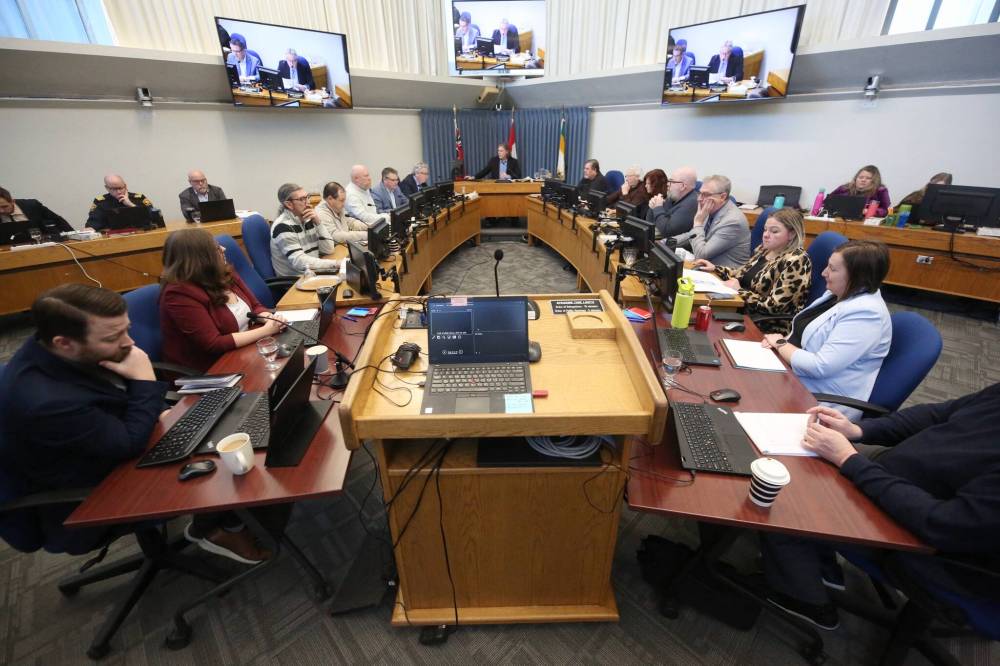
A view of the City of Brandon’s council chambers in January during budget deliberations at city hall. As Brandonites worried about a proposal for ward changes and the prospect of fewer councillors, city councillors gave the mayor and themselves a raise. (Matt Goerzen/The Brandon Sun files)
Perhaps that was the point?
Last November, council directed staff to do a comparison of the city’s salaries and council structure with other municipalities and communities of a similar size. The review was initiated by Coun. Bruce Luebke (Ward 6) and Coun. Kris Desjarlais (Ward 2) to see whether fewer, full-time councillors could yield better results for the city in the future, rather than the current cadre of 10 part-time councillors.
Among other things, the administration recommended:
• Instituting annual pay raises for council members, increasing their per diems and raising their personal vehicle compensation.
• Lowering the number of council members from 11 to nine (eight councillors, one mayor) and reducing the number of wards from 10 to four, with each ward having two council representatives.
• Increasing the mayor’s salary by three per cent every year until 2030 and setting councillor salaries at 30 per cent of the mayor’s salary.
On that last point, the report provided by the administration had a handy chart showing the base compensation of Brandon’s mayor compared to those in Medicine Hat, St. Albert, Grand Prairie, Spruce Grove, Moose Jaw and Prince Albert — all of them in Alberta and Saskatchewan.
And of course the Brandon mayor’s base salary in 2025 of $105,271 (it’s $108,429 for 2026) fell well short of most of these cities — Medicine Hat’s mayor’s basic compensation in 2025, for example, was $159,176. At the other end, Prince Albert’s was $94,258.
With Mayor Jeff Fawcett stepping away from discussion on his own salary, because of the obvious conflict of interest, councillors deliberated on Monday evening how much more the mayor should be paid, with recommended increases between $12,000 and $22,000, based on his 2026 salary.
So, after settling on giving the mayor’s position a $14,000 increase, council took the administration’s advice in deciding to give councillors 25 per cent of the mayor’s salary — in this case, a base pay of $30,625 — as of next year.
As per our report, multiple councillors said the mayor is “grossly underpaid” based on the data provided, and spent an extended period of time throwing out different numbers around the table for what the position’s salary should be.
But it must be said that these comparative communities feel a little cherry-picked by the administration.
For example, they could have used Sault Ste. Marie in Ontario, with a population of about 73,00, or Welland, Ont., near Niagara Falls, with a population of more than 55,000 — the mayors of these two cities in Eastern Canada have base salaries of $86,599 and $82,069, respectively. In fact, several Ontario cities under or near 60,000 have mayoral base salaries in the $75,000 to $90,000 range. While there may be differences in perks, Brandon’s mayor is not hard done by, comparatively.
That doesn’t mean we shouldn’t look west for comparable cities, but the administration’s choices are somewhat questionable, considering they didn’t look east at all.
Unfortunately, the idea of tying the mayor’s salary to a provincial representative’s compensation, such as a portion of a cabinet minister’s salary as is done in some other communities, was voted down. The idea had some merit in that it would have taken the choice of comparable cities out of the equation entirely.
Not surprisingly, the broader community conversation about tinkering with the current electoral system — the one that caught public attention — was dismissed by this council, after several councillors said they heard from residents that the current 10-ward system was preferable.
So what was all that hoopla about reducing wards and the number of councillors to free up cash to pay remaining councillors more? The way it was brought forward — completely out of left field — and then very quickly handled within a matter of a few weeks, makes it feel like that whole issue was more of a red herring than anything.
To be fair to the members of council, at least a few of our elected officials — including Mayor Fawcett — expressed dissatisfaction with how awkward it is to have to vote on your own salary increase. As Coun. Glen Parker (Ward 9) said, it’s a “challenging situation.”
He’s absolutely correct — no matter what decision you make, you will take on a load of criticism one way or the other.
Our mayor and councillors need to be fairly compensated for the work that they do. But if councillors dislike the optics of voting on their own compensation, perhaps they should have adopted similar procedures to what cities like Edmonton, Banff, Toronto and even Charlottetown have decided upon — enlist an independent third party, such as a citizen committee or a remuneration commission, to review and recommend compensation levels for mayor and council.
And then abide by those recommendations.
It would certainly take a little of the smoke out of the journey.
History
Updated on Wednesday, March 25, 2026 12:13 PM CDT: The original version of this editorial was based on numbers reported in the March 24, 2026 edition of the paper, which used salary data from 2025 instead of current 2026 values. That article has been updated, and as a result, has necessitated changes to this editorial for accuracy's sake.