
Lewis and NDP at a crossroads
Advertisement
Read this article for free:
or
Already have an account? Log in here »
We need your support!
Local journalism needs your support!
As we navigate through unprecedented times, our journalists are working harder than ever to bring you the latest local updates to keep you safe and informed.
Now, more than ever, we need your support.
Starting at $15.99 plus taxes every four weeks you can access your Brandon Sun online and full access to all content as it appears on our website.
Subscribe Nowor call circulation directly at (204) 727-0527.
Your pledge helps to ensure we provide the news that matters most to your community!
To continue reading, please subscribe:
Add Brandon Sun access to your Free Press subscription for only an additional
$1 for the first 4 weeks*
- Enjoy unlimited reading on brandonsun.com
- Read the Brandon Sun E-Edition, our digital replica newspaper
*Your next Free Press subscription payment will increase by $1.00 and you will be charged $20.95 plus GST for four weeks. After four weeks, your payment will increase to $24.95 plus GST every four weeks.
Read unlimited articles for free today:
or
Already have an account? Log in here »
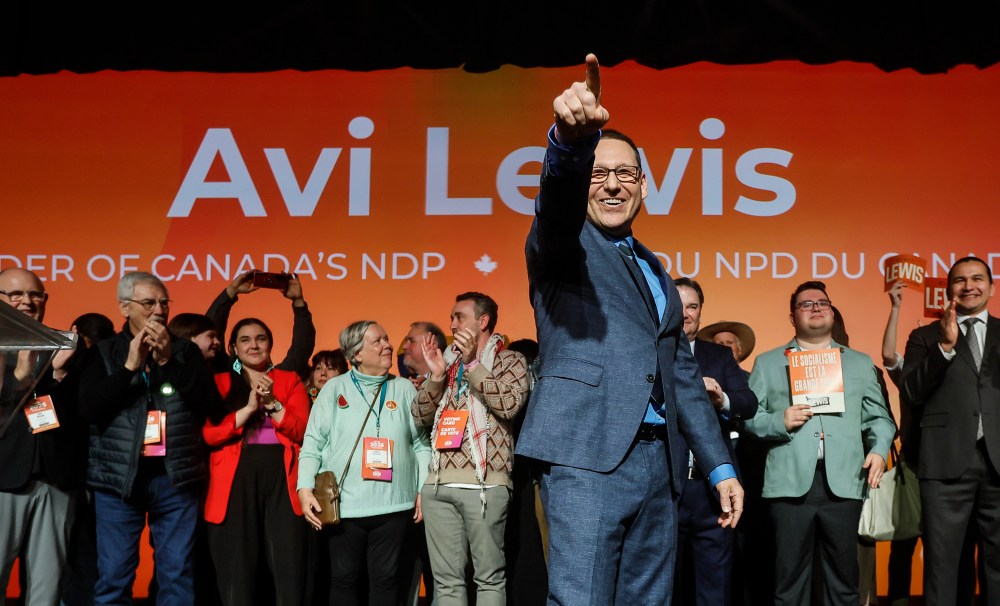
Avi Lewis has his work cut out for him. The newly elected leader of the federal New Democratic Party achieved a first-ballot victory this past weekend, receiving nearly 40,000 of almost 70,000 votes cast by party members in the ranked-ballot leadership contest. That’s an impressive accomplishment, but the task before him as leader is even more formidable.
His party is coming off of one of its worst results in a federal election in decades, in which then-party leader Jagmeet Singh was defeated and just seven NDP candidates were elected to the House of Commons. One of those MPs, Lori Idlout, recently crossed the floor to the governing Liberals while another, Alexandre Boulerice, is rumoured to be considering resigning as an MP in order to shift to Quebec provincial politics.
With such a small caucus, the NDP no longer has official party status, doesn’t have the higher budget that comes with that status, and is reportedly millions of dollars in debt.
To make matters worse, polls indicate that a large percentage of Canadians are happy with the performance of Prime Minister Mark Carney, and appear to believe the Liberals are better equipped than the NDP to respond to the heavy-handed actions of the Trump administration.
Just as seriously, the NDP is no longer viewed by many Canadians as the party that best represents workers. Many voters who had previously supported the party have shifted their loyalty to the Liberals or Conservatives.
With many polls showing that support for the NDP has plummeted to single digits, it’s up to Lewis to stop the party’s slide. That won’t be easy, however, given the controversial positions he has taken on many national issues. For example, he appears to favour the shutdown of Canada’s oil and gas industry, and is advocating for government-owned grocery stores.
His task became even more difficult Sunday afternoon, when Alberta NDP Leader Naheed Nenshi said on social media that “It is clear that the direction of the federal party under this new leader, someone who openly cheered for the defeat of the Alberta NDP government, is not in the interests of Alberta.”
Minutes later, Saskatchewan NDP Leader Carla Beck released a copy of a letter she wrote to Lewis, in which she says “The positions you have expressed publicly in this leadership race, and in your prior interactions with the New Democratic Party, are antithetical to the values of a party built with and for working people.“
British Columbia NDP Premier David Eby was more neutral in his comments regarding Lewis’s victory, saying on social media that “We will work with anyone and any federal leader who shares our priorities, and stand firm against those who put that progress at risk.” That is hardly a glowing endorsement.
Manitoba Premier Wab Kinew was more enthusiastic than his western counterparts, telling reporters that “I just love Avi, he’s just a great person and we don’t have to agree on everything in order to do big things together … We can have debates, heated debates, about any manner of other issues, but the values are there.”
It’s not hard to understand the difference in perspectives among the four NDP leaders. Eby’s government has a small majority in a province with deeply polarized politics. He can’t afford to appear supportive of Lewis’ controversial views without risking his government’s re-election hopes.
The same is true for Nenshi and Beck. Their respective parties have realistic shots at winning their next elections, but not if they endorse, let alone be perceived as agreeing with, Lewis’s determination to leave oil and gas “in the ground.”
Kinew, on other hand, must call an election by the fall of next year, but the polls suggest his government has a strong shot at being re-elected. A few supportive words for Lewis are unlikely to reduce that support.
In order to restore the NDP to its former status on the national political scene, Lewis must accept that success in politics often requires difficult compromises. In this case, Lewis must choose between the bold yet divisive policies he has favoured for years versus a less-divisive platform that unites New Democrats and attracts others.
The choice he makes will determine the success of his leadership and the future of his party.