
Hot air dominates wind debate
Advertisement
Read this article for free:
or
Already have an account? Log in here »
We need your support!
Local journalism needs your support!
As we navigate through unprecedented times, our journalists are working harder than ever to bring you the latest local updates to keep you safe and informed.
Now, more than ever, we need your support.
Starting at $15.99 plus taxes every four weeks you can access your Brandon Sun online and full access to all content as it appears on our website.
Subscribe Nowor call circulation directly at (204) 727-0527.
Your pledge helps to ensure we provide the news that matters most to your community!
To continue reading, please subscribe:
Add Brandon Sun access to your Free Press subscription for only an additional
$1 for the first 4 weeks*
- Enjoy unlimited reading on brandonsun.com
- Read the Brandon Sun E-Edition, our digital replica newspaper
*Your next Free Press subscription payment will increase by $1.00 and you will be charged $20.95 plus GST for four weeks. After four weeks, your payment will increase to $24.95 plus GST every four weeks.
Read unlimited articles for free today:
or
Already have an account? Log in here »
A recent report in Westman This Week about an open house for a proposed wind farm near Polonia should trouble anyone who values fair public debate. What was meant to be an information session appears, by the story’s account, to have been overtaken by angry denunciations that created such a hostile atmosphere that residents who supported the project felt intimidated into silence. When the loudest voices seize the floor, communities are denied the very discussion they need to make informed decisions.
An open house is intended to be “information for all”: a place to ask questions, hear details and engage in respectful exchange. This one was organized by the Manitoba Métis Federation in response to Manitoba Hydro’s call for Indigenous-owned wind energy projects. Working with Renewable Energy Systems, the federation has proposed a wind farm near Polonia capable of generating up to 200 megawatts of electricity. Whether residents ultimately support or oppose the project, they deserve access to accurate information about the trade-offs involved and a setting where questions can be asked without intimidation.
That opportunity is especially important because public discussion of wind energy is often clouded by misinformation. As one farmer at the meeting put it, “There’s so much information on how bad they are.” Much of that “information” is generated by conspiracy theories and, all too often, interests with ties to the fossil fuel industry. The record from other jurisdictions tells a very different story: wind farms across North America have operated for decades, providing steady tax revenue to rural municipalities, lease payments to landowners, and generating thousands of jobs.
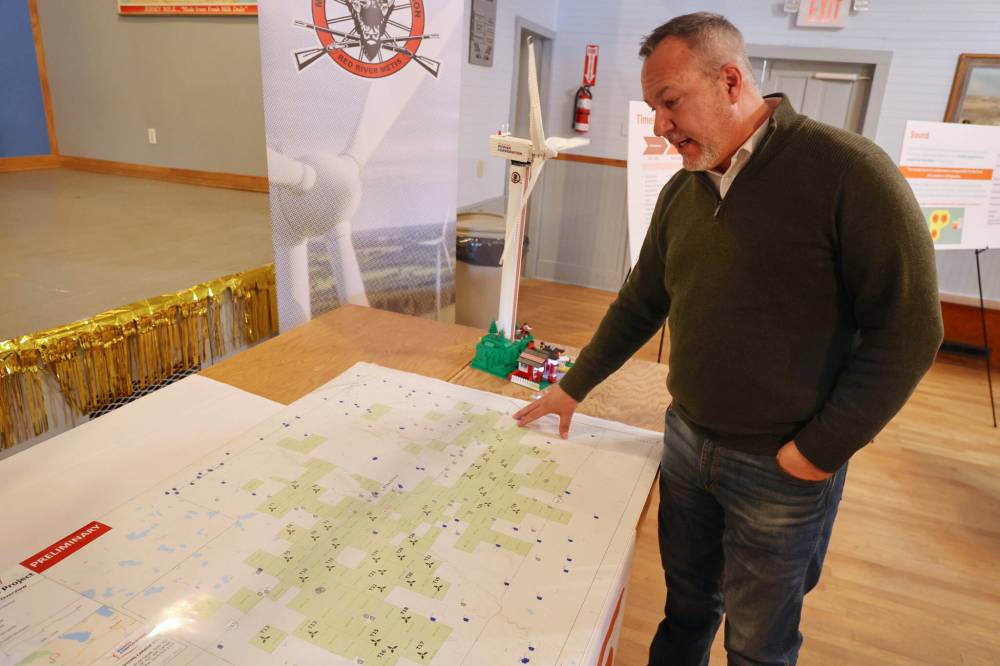
Manitoba Métis Federation senior economic adviser Lorne Pelletier gestures at a preliminary map where wind turbines are proposed around Polonia during a recent open house in the community. The green squares represent properties where the owner has made an early agreement to possibly host a wind turbine on their land. The locations are subject to change over time. (Connor McDowell/The Brandon Sun files)
Consider Texas, which now has more than 230 utility-scale wind farms generating over 43,000 megawatts — supplying almost a third of the state’s electricity — while supporting more than 26,000 jobs and bringing in billions of dollars in revenue.
Closer to home, in neighbouring Minnesota, 124 wind farms produce roughly a quarter of the state’s electricity and generate millions in local tax revenue and land leases for rural communities much like Polonia’s.
Wind power is also becoming markedly cheaper than gas-fired generation and is not exposed to the price volatility of fossil fuels.
This comparison matters because the alternative to wind development is not the status quo; it is expanded reliance on gas plants, including one now being proposed in Brandon. Manitobans are being told such facilities are necessary because alternatives like wind take too long — up to nine years — to build. Yet Renewable Energy Systems, which has developed projects across Canada and internationally, indicates timelines of 18 to 36 months. And gas plants come with significant costs. Unlike wind farms, gas plants release toxic air pollutants that are linked to a higher risk of asthma, heart attack, cancers and premature death. Gas-fired power is also more expensive than wind, with current projections indicating that wind will be 40 per cent cheaper than gas power by 2030. And gas plants emit greenhouse gases that are intensifying the climate instability already affecting Manitoba’s farmers. So, speak out against that project.
Some farmers oppose the Polonia proposal because turbines will alter a familiar landscape. That concern is understandable. Wind farms are visible in a way that distant oil and gas fields are not. But climate change, driven largely by fossil fuels, is also reshaping that landscape through more intense flooding, longer droughts and increasingly unpredictable growing conditions. Those changes pose a far more direct threat to farmers’ livelihoods than the sight of turbines on the horizon.
Communities like Polonia deserve a full, respectful discussion that weighs real evidence against real trade-offs. Wind farms are a key part of the transition away from fossil fuels, and farmers stand to benefit through lease revenue and a more stable, affordable energy future.
It appears that many at the open house already understand this. As one attendee at the open house observed of the louder opponents: “the group at the hall may not be representative of the community’s thoughts as a whole.” It is vital that those quieter voices have the chance to be heard.
DR. SCOTT BLYTH
Canadian Association of Physicians for the Environment
Manitoba Branch