
Taking a closer look at what Kinew said
Advertisement
Read this article for free:
or
Already have an account? Log in here »
We need your support!
Local journalism needs your support!
As we navigate through unprecedented times, our journalists are working harder than ever to bring you the latest local updates to keep you safe and informed.
Now, more than ever, we need your support.
Starting at $15.99 plus taxes every four weeks you can access your Brandon Sun online and full access to all content as it appears on our website.
Subscribe Nowor call circulation directly at (204) 727-0527.
Your pledge helps to ensure we provide the news that matters most to your community!
To continue reading, please subscribe:
Add Brandon Sun access to your Free Press subscription for only an additional
$1 for the first 4 weeks*
- Enjoy unlimited reading on brandonsun.com
- Read the Brandon Sun E-Edition, our digital replica newspaper
*Your next Free Press subscription payment will increase by $1.00 and you will be charged $20.95 plus GST for four weeks. After four weeks, your payment will increase to $24.95 plus GST every four weeks.
Read unlimited articles for free today:
or
Already have an account? Log in here »
“Hey we’re doing an awesome thing here. We’re making transit free for kids. We also have the lowest deficit in the country of any province. It’s easy to take a shot at the transit policy, or this and that here, but when we make a budget it’s about everything together. So what does this budget this year do? Free transit for kids. No tax on groceries. Big investments in infrastructure. Big investments in health care. And the lowest deficit in all of Canada.”
— Manitoba Premier Wab Kinew
In a scrum with reporters last week, following his State of the Province speech to a room full of Brandon Chamber of Commerce members, Premier Wab Kinew made a number of statements about transit and the state of the province’s finances that should not go unquestioned or unqualified.
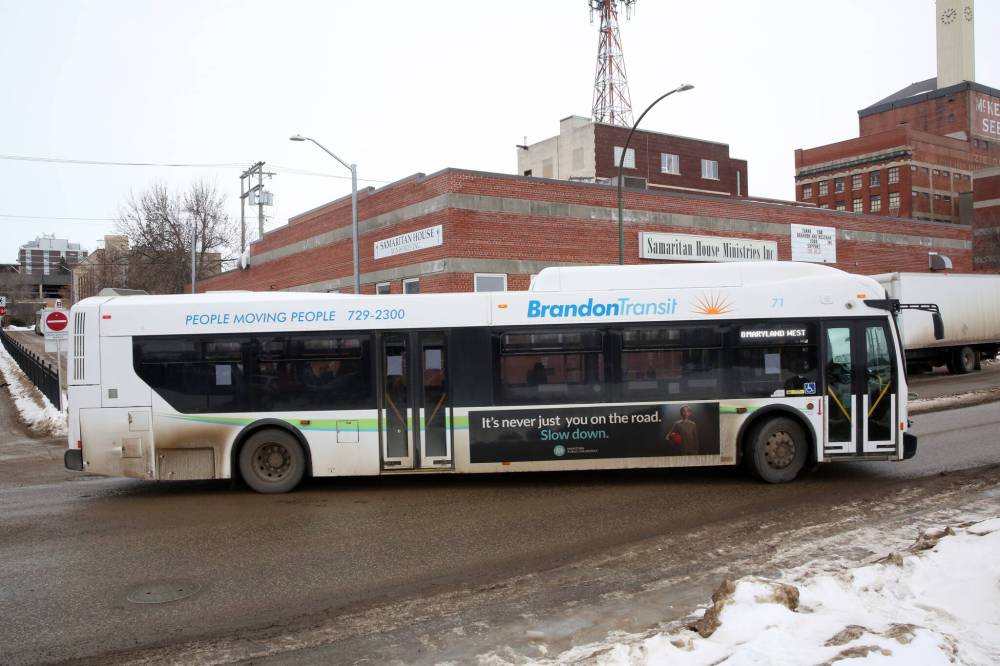
A Brandon Transit bus turns west onto Pacific Avenue from the downtown terminal at Eighth Street in December. The premier has got it wrong when it comes to transit funding. (Matt Goerzen/The Brandon Sun files)
Barely a week ago, we called upon the Manitoba government to restore the 50-50 transit funding formula for cities in Manitoba if it was serious about reducing our province’s environmental footprint and improving the lives of residents who face financial challenges.
Both Winnipeg and Brandon transit systems have struggled with higher fees and fewer routes since the Progressive Conservatives under Brian Pallister ended the cost-sharing arrangement.
But instead of reinstating that funding, the 2026 provincial budget earmarked a combined $10 million for the five municipalities that have transit systems, including Brandon, Winnipeg, Selkirk, Thompson and Flin Flon, as a means to help recuperate costs of youth not having to pay fares or buy passes.
In his comments to the press, Kinew defended his government’s decision not to restore 50-50 funding for transit operations, suggesting that the previous system of cost sharing was too open ended.
“I think we want it to be more targeted to specific outcomes because if we were to just go back to 50-50 the approach of the past tomorrow, what do we get for it? Would we get more stops? Would we get free transit for youth? Probably not. So that’s why I think targeting new transit investments to specific outcomes is probably a smarter way for us to get more bang for the buck.”
The premier’s answer seems a bit disingenuous. Not only does it paint an unfair picture of the cities that operate their transit systems — and the municipal councils that govern them — but it suggests that a new 50-50 funding formula couldn’t have its own set of targets. No doubt the councils in question would be open to negotiation.
But let’s talk for a moment about the budgeted transit funding the province has promised this fiscal year. The premier says his government’s increased transit funding will benefit kids in high school — or rather, their parents — and get them into the habit of using the bus instead of their parents’ car, thus improving the environment and increasing ridership down the road, so to speak.
Given the targeted nature of the funding, that’s a fair statement. But it leaves out a few details.
Most kids from grades 1 to 6 either walk to school or use the yellow buses provided by the Brandon School Division’s transportation department. There are, of course, exceptions, but they tend not to use Brandon Transit very much. Grades 7 to 12, on the other hand, often rely on Brandon Transit routes to commute. That’s particularly true of kids who take part in after-school activities like sports or who live outside a catchment area. But even then, they don’t make up the heaviest user base.
That designation falls to post-secondary students who are enrolled with Brandon University and Assiniboine College. A significant portion of this age group relies on transit because many don’t have a driver’s licence and can’t afford personal vehicles.
From our perspective, if you’re trying to do the most good and increase ridership, government funds would be best directed to this age demographic. But then, that would also cost more money, and this is a government that has promised to balance the budget before the end of its first term.
Honestly, it would be refreshing if the premier would just come out and say “we can’t afford to do that because we’ve got a budget to balance.” But then, that too would be a questionable statement, given the fact that they’re taking the PST off of junk food and other convenience items to “help Manitobans” with the cost of living.
That’s not really helping our pocketbooks or improving our eating habits.
Oh, and about that deficit claim …
The NDP government made it a major selling point this spring that as a result of their good governance, Manitoba has “the lowest deficit in all of Canada,” something Kinew repeated again on Thursday.
But that, too, is a very misleading statement, given the fact that the rather dramatic reduction in Manitoba’s deficit was achieved by a record-breaking spike in federal transfer payments — not from anything the province achieved by finding new revenue streams or cutting spending.
So yes, while it’s technically true that Manitoba has the lowest deficit-per-GDP ratio of any province in Confederation, we have Ottawa to thank for that.
And that’s not really something to boast about.